A new door has been opened, highlighting a policy change in how the United States approaches threats to the country. President Donald Trump is no longer going to argue about whether grandmothers praying outside abortion clinics belong on the government’s radar.
Thank God the government finally solved that problem.
President Trump’s latest strategy document narrows attention toward violent actors with money, weapons, border access, and international ties. Organizations that include Mexican cartels and organized extremist networks headline the threat assessment instead of ordinary religious or political communities.
But the terrorist threat has changed. We face new categories and combinations of violent actors that make the established ways of doing counterterrorism insufficient or obsolete. We face a multiplicity of deadly threats from terror groups and non-state actors often secretly supported by governments who wish to undermine us.
Currently we face three major types of terror groups:
- Narcoterrorists and Transnational Gangs
- Legacy Islamist Terrorists
- Violent Left-Wing Extremists, including Anarchists and Anti-Fascists
We can defeat every single one of these groups, but the threat is significant and pervasive. The borderless America created by the Biden Administration was so badly exploited by threat actors that during one 12-month period of the previous administration, more Americans died as a result of the illicit drugs flooded into the country by the cartels than all the U.S. servicemen killed in combat since 1945. That is an existential threat that President Trump does not tolerate.
Trump signed the new 16-page counterterrorism strategy Tuesday. White House Senior director for Counterterrorism Sebastian Gorka described the plan as a major shift away from the post-9/11 framework that centered almost entirely on ISIS and al Qaeda. Cartels operating throughout the Western Hemisphere now sit near the top of the administration’s list.
The document lays out a three-part approach to combating those threats: identifying terrorist actors and plots before they occur, cutting off funding and recruitment pipelines, and ultimately dismantling established networks — a framework that signals a more expansive use of intelligence, financial and military tools across multiple threat categories.
The strategy broadens the definition of terrorism in ways that could extend national security powers beyond traditional jihadist groups — opening the door to expanded use of military, intelligence and law enforcement tools against cartels and actors inside the United States.
Gorka argued the danger landscape changed while Washington kept staring at the same old map; fentanyl trafficking, human smuggling, cartel violence, and transnational criminal organizations now kill Americans at numbers that dwarf many foreign terror attacks since 9/11. Federal officials tied the strategy directly to border security and cartel activity spreading deeper into American cities.
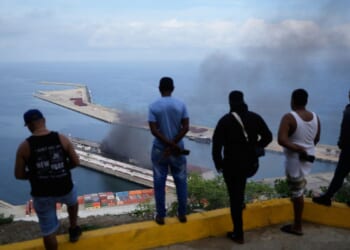
The United States has destroyed dozens of boats as part of what Washington has called a counternarcotics campaign linked to an operation that included the ouster of Venezuelan leader Nicolas Maduro this year.
“Our new counterterrorism strategy first prioritizes the neutralization of hemispheric terror threats by incapacitating cartel operations until these groups are incapable of bringing their drugs, their members and their trafficked victims into the United States,” Gorka said.
Within the U.S., Gorka said the strategy will also focus on identifying and neutralizing what he called “violent, secular political groups whose ideology is anti-American, radically pro gender or anarchist, such as Antifa.”
“We will use all the tools constitutionally available to us to map them at home, identify their membership, map their ties to international organizations like Antifa, and use law enforcement tools to cripple them operationally before they can maim or kill the innocent,” he said.
Gorka said U.S. counterterrorism officials will meet with international partners on Friday to ask how allies can increase efforts to combat terrorist threats, especially from Iran and in the Strait of Hormuz.
Trump’s strategy also targets violent domestic extremist groups from both ends of the political spectrum. Gorka specifically referenced anarchist and Antifa-linked violence while also stating violent right-wing extremists remain part of the threat picture. Federal agencies will reportedly use existing constitutional and law enforcement tools to map networks, financing, and operational ties before attacks occur.
The administration has been criticized for stretching the definition of terrorism too broadly. Civil liberties groups raised concerns over whether decentralized activist movements can legally fit traditional terrorism models.
Other analysts warn that shifting focus toward cartels and domestic unrest could divert attention away from jihadist threats that still exist worldwide. ISIS and al Qaeda remain active, especially through online recruitment and regional affiliates.
Still, political reality dramatically changed since the early 2000s; Americans no longer watch nightly footage of ISIS convoys rolling across Iraq. Instead, communities deal with fentanyl overdoses, cartel trafficking routes, organized smash-and-grab crews, violent protests, and foreign criminal gangs crossing porous borders. Eventually, Washington’s priorities followed public concern.
But it took forever.
Biden-era controversies helped fuel the political appetite for a reset. Congressional Republicans sharply criticized a 2023 FBI Richmond field office memo examining possible extremist ties involving some “radical traditionalist Catholic” circles.
Attorney General Merrick Garland later faced heavy scrutiny from lawmakers over investigations involving parents at heated school board meetings. Republicans spent years arguing that federal agencies blurred the line between violent extremism and ideological disagreement.
Trump’s new strategy reads like a direct response to those years of backlash. Religious Americans aren’t portrayed as emerging national security threats, and parents speaking at local meetings aren’t mentioned.
Instead, the document is dominated by cartels, trafficking organizations, violent extremists, and transnational criminal operations.
The shift also reflects Trump’s broader governing style: he tends to frame security threats through sovereignty, borders, organized crime, and operational control rather than ideological nation-building overseas.
The Trump administration increasingly treats cartel networks less like criminal enterprises and more like insurgent organizations with military-grade capabilities.
Few Americans would mistake the Sinaloa Cartel for a neighborhood street gang anymore. Cartels now operate drone surveillance, armored vehicles, encrypted communications, and international financial pipelines. Some intelligence officials increasingly describe portions of cartel territory as quasi-governed zones where local authorities barely function.
Washington spent two decades focused on caves, compounds, and desert training camps halfway around the globe. Trump’s strategy argues the next phase of national security may involve highways, ports of entry, encrypted apps, and cartel safe houses much closer to home.
Trump’s counterterror shift isn’t just about security policy. It’s also a blunt rejection of how federal power expanded after 9/11 and accelerated during recent domestic extremism debates. The political fight surrounding surveillance, ideology, and federal policing authority is far from over. PJ Media VIP members get the deeper analysis and context corporate outlets usually avoid. Get 60% off with promo code FIGHT.