
The Strait of Hormuz is open fully. Probably. Mostly. In a limited fashion. For now.
Regardless, oil is crashing. U.S. indexes extended gains into a 12th consecutive day. Gold, silver, and miners are ripping higher.
We still don’t have much clarity on when the conflict with Iran will be resolved.
So today we’re going to switch track and cover implications of the looming U.S. debt crisis.
Yesterday Bloomberg released an article which went mostly unnoticed due to the Middle East drama.
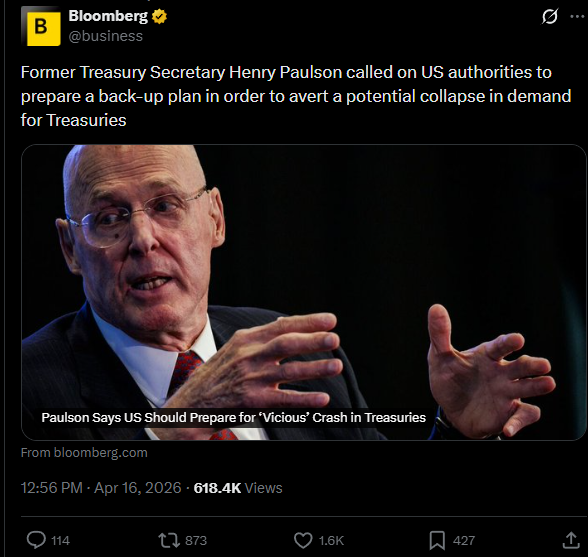
Source: X
The article covers a disturbing interview with Hank Paulson, our notorious Treasury Secretary during the Global Financial Crisis. The $700 billion TARP bank bailouts were Hank’s baby.
Paulson’s bailouts rescued big banks with taxpayer dollars, including Goldman Sachs, where Hank was previously CEO. The bailouts were almost 2 decades ago, but it still makes my blood boil.
Anyway, in this new interview Paulson warns that the U.S. needs to prepare a “back-up plan in order to avert a potential collapse in demand for Treasuries.”
“When you hit the wall and you’re trying to issue Treasuries and the Fed is the only buyer and the prices of the Treasuries are going down and interest rates are up, that’s a dangerous thing.”
In other words, investors might soon start demanding higher yields from U.S. Treasury bonds, notes and bills.
This would be a disaster, because U.S. Treasury yields spike, our debt problems would soon snowball out of control.
For example, of America’s $39 trillion in federal debt, about $9.3 trillion will have to be refinanced this year. The majority of our debt these days is in short-term securities (nobody wants to buy 30 year U.S. bonds anymore).
The current yield on a 3 month Treasury is 3.68%. If that spikes to 5%, or even higher, our debt problem would quickly spiral out of control. We’re already paying more than $1 trillion per year in interest costs alone. If yields on Treasuries are much higher, we’ll quickly hit $2 trillion, then $3 trillion, and on… Utterly unsustainable.
It’s a big deal that a well-connected guy like Hank Paulson is sounding the alarm. It’s recognition that this problem is no longer decades away. It’s immediate.
1940s Solutions?
The last time American debt-to-GDP was this high was during WWII.
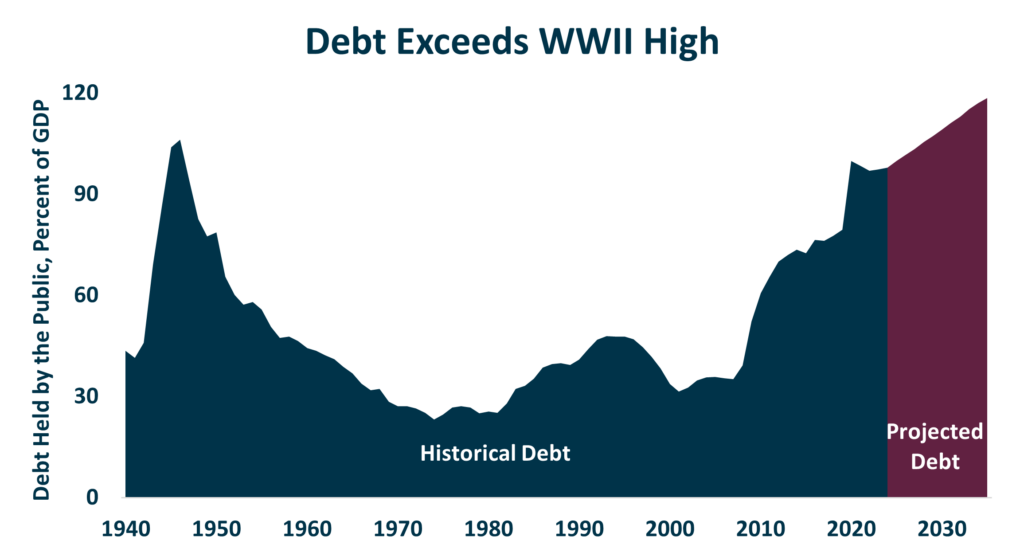
Source: Economic Policy Innovation Center
During the 1940s, the Federal Reserve and Treasury Department dealt with soaring debt using “yield curve control”.
In other words, the Fed committed to buying as many Treasuries as required to keep yields at rock-bottom levels. So it’s very interesting that Paulson says we could soon be in a situation where “the Fed is the only buyer,” of Treasuries.
The chart below tells the 1940s story. The blue line is inflation, and the red line is the yield on a 3-month Treasury bill.
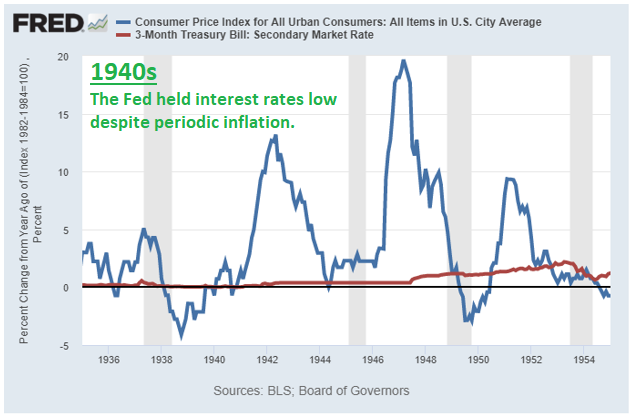
This chart shows how anyone holding cash or bonds got hosed. This is what’s known as “financial repression”. Even though inflation is near 20%, investors were still getting less than 1% on Treasury bills. At those levels, that’s a 19% loss of purchasing power annually.
Gold wasn’t an option then, at least in the U.S. Owning bullion was illegal for American citizens. And the price was capped at $35/oz regardless.
Fortunately today Americans can own precious metals. And they will be key to preserving wealth going forward.
So what did work in the 1940s? Commodities. Hard assets. Industrials. Defense.
I believe a return to yield curve control is inevitable. It probably won’t happen for a few years. If and when it does, you’ll want to have plenty of exposure to select foreign stocks and natural resources.
Even Higher Taxes?!
In 1939, only around 5% of American workers paid income tax. It only affected the wealthiest citizens.
By 1945, 60% of people paid income taxes. So in the 1940s, the debt problem wasn’t solved through yield curve control alone. This period also dramatically increased taxes.
And as we know, once you give the government an inch, they take miles.
In his interview, Hank Paulson hinted at more tax hikes ahead, “It’s going to take increased revenues, taxes, and dealing with expenses.”
This strategy worked during the 1940s because taxes were low going in. But now? Many are already paying 30-40% income taxes, then even more on capital gains, sales tax, and inheritance. We’re already taxed in countless ways.
Still, if the Democrats win midterms and the presidency in 2028, we could absolutely see even higher taxes ahead.
This is why it’s an urgent priority to get as much of our savings as possible into tax shelters. IRAs, 401ks, college savings plans, etc. Max them out whenever you can.
Once you get some money into a tax shelter, make sure you own some hard assets, precious metals, and emerging markets. These assets will be key to wealth preservation and growth in the chaotic decade ahead.
Oh yeah, and I would also limit your long-term exposure to U.S. Treasuries. It’s fine to hold some over the next year or two. In fact, they would rise in value if rates fall. But over the long run, these are NOT going to be a staple of a healthy retirement plan.
U.S. Treasuries (bonds, bills, notes) will be hardest-hit in the coming financial repression. Inflation will eat away purchasing power, as yields remain at artificially low levels.
We’ll discuss alternatives to U.S. Treasuries for retirement soon.