April 22 marked the one-year anniversary of the Pakistan-backed terror attack against Hindu tourists in Pahalgam in Kashmir.
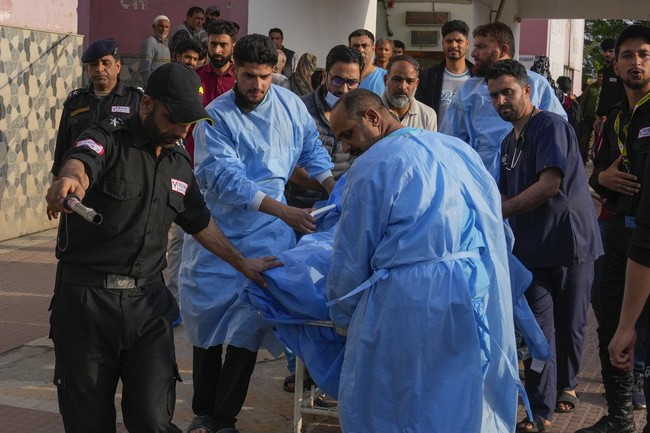
On this day, terrorists from the Resistance Front (TRF) — an offshoot of Pakistan-based Islamic terrorist organization Lashkar-e-Taiba (LeT) — stormed a meadow in Pahalgam, Kashmir. They ambushed and murdered 26 civilians, injuring dozens more. The terrorists sought out Hindus with chilling precision in the worst civilian massacre in India since 2008.
“This was a deliberate, brutal assault on innocent people whose only ‘offense’ was being Hindu,” said Suhag Shukla, Esq., the Executive Director and co-founder of the Hindu American Foundation (HAF). “Families were hunted, religiously profiled, and murdered in cold blood, making this not just a tragedy for Indians, but a matter of deep concern to all who value religious freedom and human dignity.”
On the first anniversary of the Pahalgam terror attack, U.S. Congressman Brad Sherman (D-Calif.) called on Pakistan to clamp down on terror groups such as LeT.
Speaking at an exhibition organized by the Indian Embassy in Washington on the “Human Cost of Terrorism”, Congressman Sherman remembered the victims of the Pahalgam massacre.
“The attackers, identified as the Resistance Front, targeted innocent people, reportedly separating victims by religion. The group is widely seen as linked to LeT, which has found sanctuary in Pakistan,” Sherman said at the exhibition.
“We must use this moment to demand that the Pakistani government clamp down on Lashkar-e-Taiba, Jaish-e-Mohammed [JeM] and other terrorist groups,” he added.
The Capitol Hill exhibition occurred while Pakistan is projecting itself as a peacemaker who can mediate efforts to end the U.S.-Iran war.
The digital exhibition displays major terror attacks perpetrated across the world, including the 1993 Mumbai bomb blasts, the 2008 Mumbai terror attacks, and the Pahalgam attack. It also identifies the terror outfits responsible for the attacks, including several Pakistan-based individuals and entities such as the LeT.
“The special exhibition essentially serves to remind us of a few things. One, the scourge of terror upon humanity remains determined to destroy our societies. Countries around the world need to come together and remain resolute in defeating terrorism,” India’s Ambassador to the U.S. Vinay Mohan Kwatra told reporters.
On May 7, 2025, India launched Operation Sindoor, which targeted terror infrastructure and decimated multiple terror infrastructures in both Pakistan and Pakistan-occupied Kashmir. The operation targeted nine sites, including the headquarters and training centers of LeT and another terrorist group, JeM, from where terror attacks against India were planned and directed.
Pakistan later also launched offensives against India. The military conflict between the two countries, lasting nearly 88 hours, halted on the evening of 10 May 2025 following a ceasefire agreement.
“Leaders like Atal Bihari Vajpayee were warning about this threat back in the 1990s, but very few people took him seriously. After the September 11 attacks, the United States realized terrorism is not confined to one region; it spreads and threatens freedom around the world,” Congressman Ro Khanna said.
“What Prime Minister Vajpayee said years ago was true: this is a global threat,” he added.
Rep. Richard McCormick (R-Ga.) described terrorism as a “unique evil” that threatens both India and the United States.
Indeed, Islamic terrorism has targeted the Hindu people and Indian civilization ever since Islam’s emergence in Arabia during the seventh century. Kashmir and the rest of India have for centuries been among jihad’s first targets.
Kashmir was historically inhabited by Hindus and Buddhists and had a majority Hindu population until the 14th century, when Islamic invaders entered the region.
Hindus indigenous to the Kashmir Valley, known as Kashmiri Hindu Pandits, are the original inhabitants of Kashmir. They possess an ethno-religious culture that dates back more than 5,000 years. Ancient Kashmir was renowned as a center for Hindu and Buddhist learning; it was ruled by Hindu kings until 1339.
The 14th-century Islamic military conquests and later political shifts (Sikh, Hindu dynasties) changed the demographics of Kashmir.
Following waves of Islamic invasions, numerous foreign-origin Muslim rulers occupied Kashmir until 1819. Under Muslim rule, Hindus faced periods of persecution, resulting in several mass migrations from Kashmir.
Later, at the time of India’s partition in 1947, Pakistan’s armed forces orchestrated an invasion of Kashmir. They used Pashtun tribesmen and Pakistan’s military personnel, who in turn committed mass atrocities against the people of Kashmir, including massacres of Muslims and Hindus, as well as the capture of non-Muslim women.
Kashmir is currently divided among three states. Jammu and Kashmir are part of India. Pakistan occupies approximately 30 square miles of Kashmir. There are no Hindus remaining in Pakistan-occupied Kashmir (POK) due to killings and forced conversions — though it remains home to ancient Hindu sacred sites. In addition, China started occupying a part of Kashmir during the 1962 Indo-China War, which led to a new boundary agreement with Pakistan the following year.
The Islamic persecution against Hindus in Kashmir has continued since India’s partition. Starting in the 1980s, Islamic terrorism, funded and supported by Pakistan’s military and Inter-Services Intelligence (ISI) agency, engulfed the Kashmir Valley.
Although the violence initially targeted Kashmiri Hindus in the Valley, Pakistan-sponsored Islamic militants expanded their operations to attack Hindu, Sikh, and Muslim civilians throughout the state, in violation of UN Covenants governing terrorism.
Islamists ethnically cleansed over 350,000 Kashmiri Hindu Pandits from the Kashmir Valley from 1989 to 1991. Most remain displaced over 30 years later. The atrocities committed by Pakistan-backed militants involved targeted killings, rapes, and destruction of homes and temples.
The European Foundation for South Asian Studies (EFSAS) reported that the Islamic terror group, Hizbul Mujahideen (HM), presented Kashmiri Pandits with three choices — “ralive, tsaliv, ya galive” (convert to Islam, leave the place, or be ready to perish) — and that HM pressured Pandit men to flee without their wives.
In 1993, Amnesty International (AI) reported that Kashmiri Pandits’ homes and temples in the Kashmir Valley had been damaged and destroyed en masse. In 1995, the National Human Rights Commission, headed by the former Chief Justice of India, M. N. Venkatachaliah, found the ethnic cleansing of Kashmiri Pandits “akin to genocide.”
The emergence of Pakistan-backed militancy targeting Kashmir has thus led to state-sponsored terrorism, proxy wars, Islamic radicalization, and ethnic cleansings. As the Hindu American Foundation (HAF) points out,
The insurgency in Kashmir is not purely grassroots — it’s heavily sponsored by Pakistan’s military and intelligence services. Continuous cross-border terrorism and support for Islamist ideology have exacerbated the conflict.
Islamic terrorism, however, is not a local phenomenon; it is a global threat. Terrorist groups such as LeT and JeM may have started in Kashmir, but they impact global security. LeT was behind the 2008 Mumbai attacks. On Nov. 23, 2008, a group of 10 Pakistani young men unleashed terrorist attacks using machine guns and grenades on seven locations around Mumbai, killing approximately 173 people and injuring 293 over the next three days.
According to scholars Dr. Soumitro Sen and Dr. Uttaran Dutta, “the Mumbai attacks were unique because collectively, the event caused a transnational crisis, claiming lives of Indians as well as people of various nationalities who were especially targeted; the attacks were perpetrated on multiple high profile, elite locations in Mumbai; they unfolded live on television; the attacks were carried out by terrorists under the close guidance of handlers in Pakistan.”
Jaish-e-Mohammad (JEM) carried out the 2019 Pulwama suicide bombing, killing 40 Indian security officers. These terror groups pose ongoing threats not only in South Asia but also beyond. They are designated as “Foreign Terrorist Organizations” by the United States.
Pakistan’s state terrorism has for decades been a source of destabilization in the wider region. Stability, however, is crucial to U.S. interests in South Asia, especially given the region’s proximity to Afghanistan and China. In addition, the U.S. should challenge Islam’s systematic religious and cultural erasures of non-Muslims in the region. Many people from Kashmir cannot go back to their homes or even visit the places where they or their families were born. A significant number are still living in refugee camps, awaiting the day they will be able to return to Kashmir.
America and India’s war against terrorism should be accompanied by policies that will help restore the religious, ethnic, and cultural diversity of South Asia that Islamization has largely devastated through force and violence.
Related: Pakistan: Professor Sentenced to Death Following Blasphemy Charges
Editor’s Note: Thanks to President Trump and his administration’s bold leadership, we are respected on the world stage, and our enemies are being put on notice.
Help us continue to report on the administration’s peace through strength foreign policy and its successes. Join PJ Media VIP and use promo code FIGHT to receive 60% off your membership.