Alternate headline: When will they ever learn? Maybe they already have.
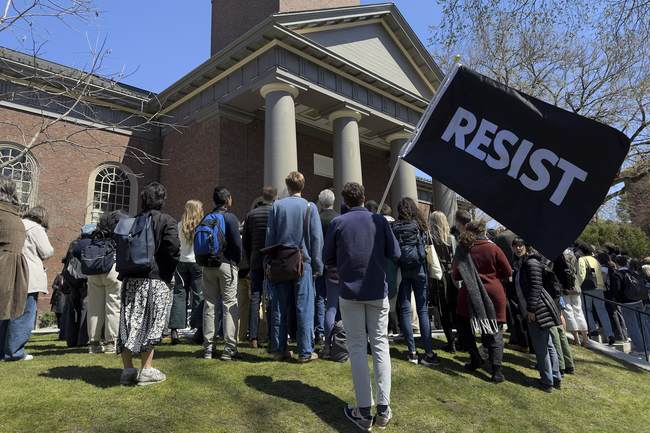
The Atlantic’s Rose Horowitch takes notice that the average college campus in the spring semester of 2026 looks significantly different from those in 2024 or 2025. College hasn’t become more difficult; in fact, it may have grown easier. Getting to class has become a lot less complicated now that the quads and greens have become, er … unoccupied, so to speak:
The events of the past three months seem almost perfectly engineered to spark campus unrest. In January, mass-deportation operations led to the brazen killing of U.S. citizens at the hands of masked immigration agents. In February, the Environmental Protection Agency declared that it would no longer regulate greenhouse-gas emissions. A few weeks later, the Trump administration joined forces with Israel to launch an attack on Iran without congressional approval. One might expect left-leaning college students to have practically started a revolution.
But campuses across the country—places where, just two years ago, students occupied buildings and colonized the quad to protest Israel’s war against Hamas—are strangely silent.
Ahem. Israel’s war against Hamas? Shouldn’t that be the other way around? Hamas launched the war on October 7, 2023, by massacring 1200 Israelis and foreigners, most of them civilians, and some of them attendees at a music festival devoted to peace. Hamas kidnapped 250 more people, not to mention their orgy of pillaging and rape, while violating a cease-fire brokered by the US. Characterizing the war that followed as “Israel’s war against Hamas” is repugnant beyond belief, but also sums up the kind of ‘education’ these institutions deliver about as well as possible.
Regardless, at least the students have returned their focus to their studies. Horowitch finds the lack of teen spirit dispiriting, or something. However, she diagnoses the situation better than she frames the disease:
These days, those same students mostly head to class. The extent of the change is jarring. David Sengthay, a Stanford senior and the head of the undergraduate-student senate, told me that protests typified the university’s history, up to and including his first two years in Palo Alto. But by the time he returned as a junior, in fall 2024, something was different. “My class is the last class to really witness what happened at Stanford during its peak organizing,” he said. “People come to Stanford, these young students, and they don’t have access to what was promised to them. I know we’re not UC Berkeley, but, I mean, we still protested the Vietnam War.”
This might seem like an abrupt and mysterious reversal in campus culture. In fact, it’s a sign that student protest was never a fact of nature, but rather an administrative choice. Universities chose to let campus demonstrations get out of control; now they’re choosing to suppress them. This is why, even as legal challenges have blocked the Trump administration from enacting much of its higher-education agenda, the president has clearly achieved his aim of ending the protest movement. He has been able to do so largely because university leaders, tired of the chaos they had allowed to thrive, were quietly on board.
Are they really on board, quietly or otherwise? That seems unlikely. The administrations of these universities allowed these protests because they supported the politics that drove them. Most of these schools operate as indoctrination centers for hard-Left radicalism, and have since the days when Pete Seeger’s protest music first emerged. The New Left colonized Academia first in their Long March through the institutions, and a few losses in court won’t change their nature.
Those losses have definitely incentivized new behavior, however. Horowitch has that much correct, and she rightly credits Donald Trump for forcing the change. Nor has Trump finished with those efforts. John wrote last Friday about the latest legal broadside from the White House against Harvard – a lawsuit from the DoJ’s Civil Rights Division that seeks the suspension of all federal funding to Harvard. The lawsuit accuses Harvard of systemic discrimination against Jewish students and faculty in large part by tolerating anti-Semitic protests and campus “occupations.” An earlier attempt to suspend payments administratively got shut down in federal district court, although the White House has appealed that decision. The lawsuit attempts to achieve the same thing via a direct legal action, and even the earlier ruling had noted this as a potentially viable alternative.
The administrators of other schools are not likely tired of campus chaos, especially for causes they clearly supported and encouraged. The real answer is that administrators now realize that Trump is willing to spend a lot of money and time to cut off their federal revenue streams if they allow radicals to hijack campuses, especially for the purpose of simping for terrorists like Hamas and targeting Jews while doing so. This is nothing more, and nothing less, than a practical demonstration of incentives and their impact on decision-making.
The lack of performative chaos on behalf of the radical-elite leadership’s agenda doesn’t mean that Academia has been redeemed, though. As soon as those incentives change, so will the campuses … unless and until we completely decolonize Academia.
Editor’s Note: Every single day, here at Hot Air, we will stand up and FIGHT, FIGHT, FIGHT against the radical left and deliver the conservative reporting our readers deserve.
Help us continue to tell the truth about the Trump administration and its successes. Join Hot Air VIP and use promo code FIGHT to get 60% off your membership!