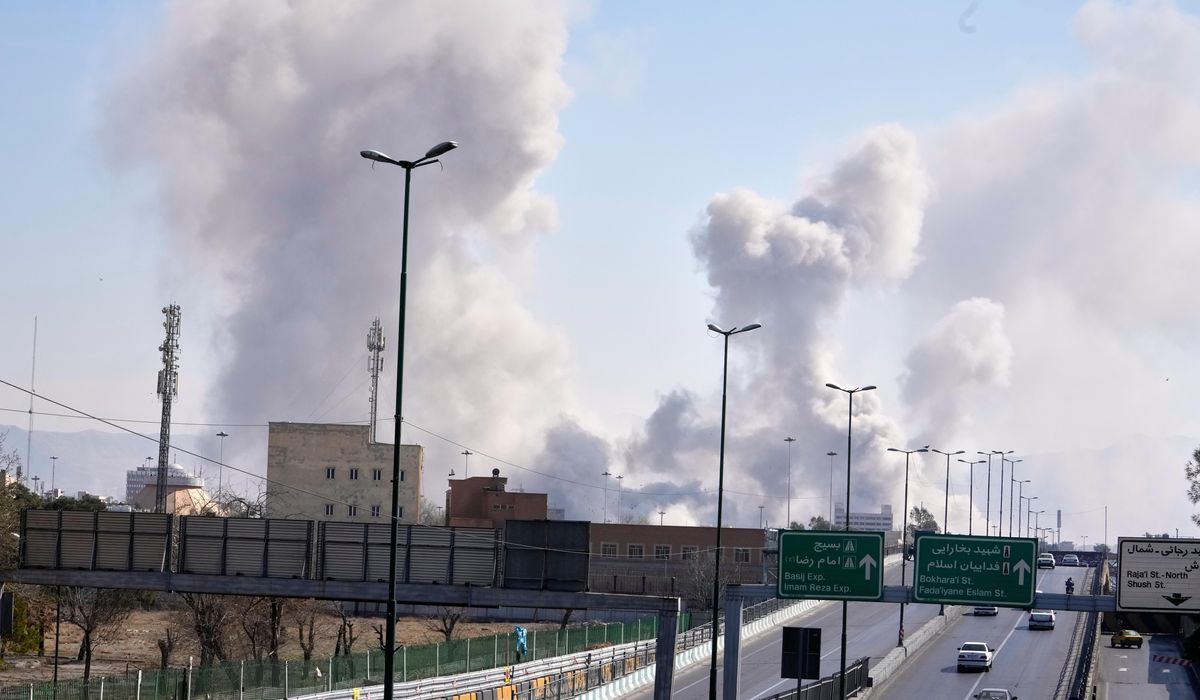
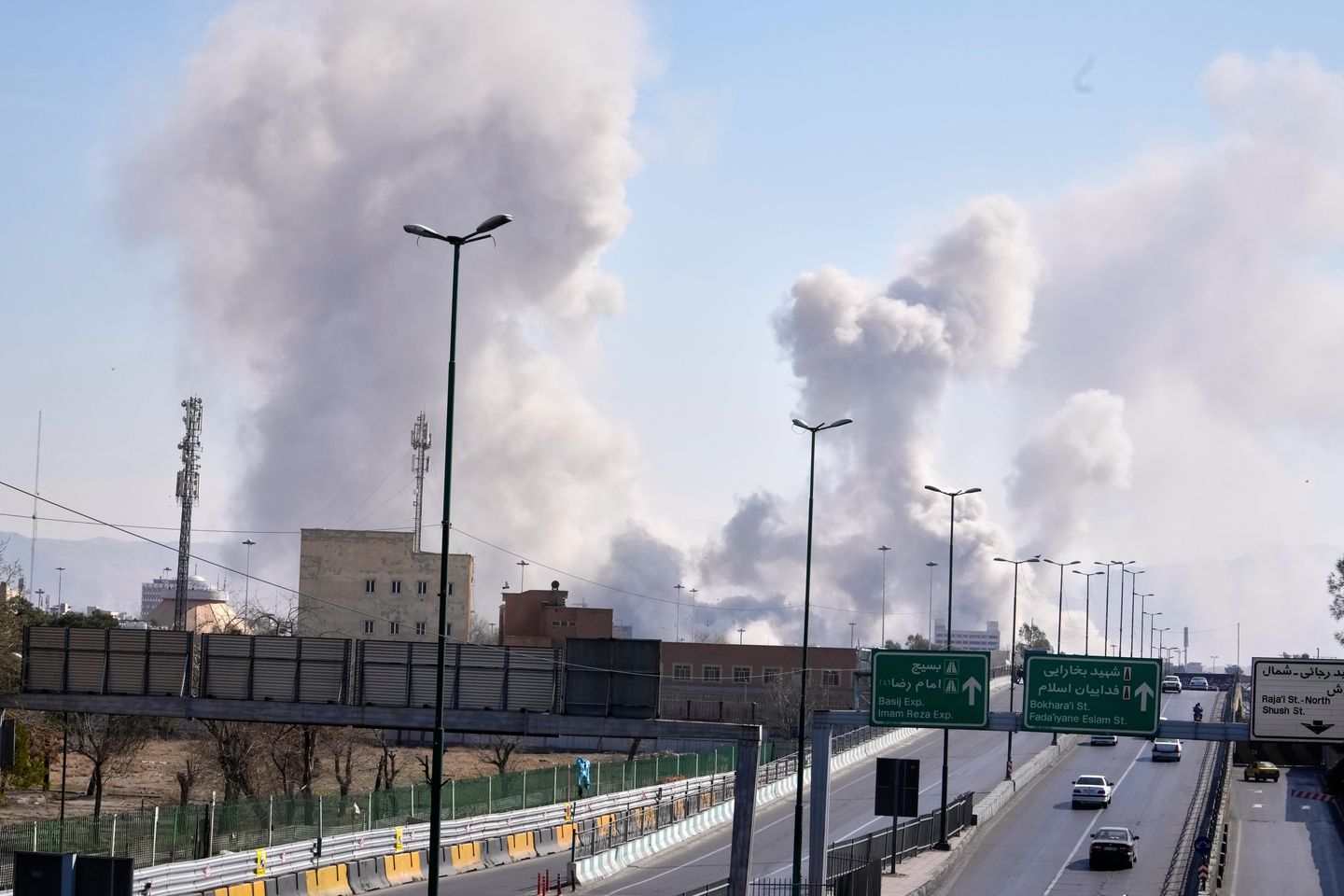
President Trump and defense officials praised the U.S. war effort in Iran on Thursday, saying Operation Epic Fury had almost eliminated the Islamic republic’s ability to defend itself and launch retaliatory strikes.
Mr. Trump said joint strikes by U.S. and Israeli forces had eliminated most of Iran’s air force and missile defenses, and continued assaults were making communication on the ground impossible.
“The United States military, together with the wonderful Israeli partners, continues to totally demolish the enemy, far ahead of schedule and at levels that people have never seen before,” Mr. Trump said at the White House.
The president said the U.S. had sunk 24 of Iran’s naval vessels.
Speaking at U.S. Central Command headquarters in Florida, Defense Secretary Pete Hegseth and Adm. Brad Cooper, head of CENTCOM, echoed the president’s comments. They added that retaliatory attacks by Iran’s drones and missiles had declined by more than 90% since the start of the war.
Adm. Cooper said U.S. bombers had struck more than 200 targets deep within Iran in three days.
SEE ALSO: Trump seeks cooperation from Iranian diplomats, says war is ahead of schedule
Mr. Hegseth rejected growing concerns among lawmakers and analysts that U.S. strikes have put extreme pressure on American stockpiles of precision-guided munitions.
“Iran is hoping that we cannot sustain this, which is a really bad calculation,” Mr. Hegseth said. “We’ve got no shortage of munitions.”
Adm. Cooper and Mr. Hegseth had previously confirmed that the U.S. would soon switch to less-expensive munitions, though they said this was because air superiority had been achieved and less-sophisticated munitions could therefore be used with much less risk.
War powers bid fails
Congress failed to pass a war powers resolution that would have halted Mr. Trump’s actions in Iran.
The attempt in the House failed on a 212-219 vote one day after a similar measure died in the Senate.
SEE ALSO: House blocks war powers resolution that would have curbed Trump’s actions in Iran
The administration and congressional Republicans say Iran is an imminent threat, and the strikes Saturday were carried out as a way to stop the U.S. from getting hit harder if they had waited.
“We have seen Iran as an imminent threat against America, not just for the last four days, not just for the last four months or four years, but for the last 40 years,” said Rep. Brian Mast, Florida Republican and chairman of the House Foreign Affairs Committee.
Iran has rejected U.S. and Israeli assessments that it is losing the war and has only increased its hostile rhetoric over the past few days.
Iranian cleric Abdollah Javadi-Amoli told state-affiliated media Wednesday that Shiite Muslims require the blood of Israelis and Mr. Trump.
Eliminating Iran’s missile and drone production capacity has emerged as the primary justification for the U.S. war with Iran.
Secretary of State Marco Rubio and Mr. Hegseth said this week that Iran was developing a “conventional shield” to protect the uranium enrichment infrastructure that enabled its pursuit of nuclear weapons.
Undersecretary of Defense for Policy Elbridge Colby reaffirmed this position before the House Armed Services Committee on Thursday and once again reminded lawmakers that the Trump administration is not interested in nation-building or regime change in Iran.
The future U.S. role
Despite such claims, Mr. Trump said he should play a role in selecting a new leader for Iran.
He said Mojtaba Khamenei, the son of Ayatollah Ali Khamenei and the apparent front-runner to replace him as Iran’s supreme leader, would be an unacceptable leader.
Intense U.S. and Israeli airstrikes may have seriously delayed Iran’s selection of a new supreme leader.
Iran’s Assembly of Experts, the 88-member body tasked with selecting a new supreme leader, has not revealed its choice nor the top contenders.
International analysts have predicted that, among other clerical leaders and former Iranian politicians, Mojtaba Khamenei could be one of the more popular options.
Mr. Trump’s comments are perhaps his most explicit on the topic of Iran’s future leadership, a question that has plagued the administration since the death of Ayatollah Khamenei on Saturday.
The president previously said that his administration was looking at several contenders to replace the current leadership in Iran after the operation, but “most of them are dead.”
Mr. Trump has called on protesters to rise up and overthrow the leadership of the Islamic republic amid U.S. and Israeli strikes, but has not provided any details as to how they should do so.
He said Thursday that Iranian diplomats abroad should help the U.S. form a new government in Tehran.
“We urge Iranian diplomats around the world to request asylum and to help us shape a new and better Iran,” he said at a White House event.
Aside from scattered celebrations in reaction to Ayatollah Khamenei’s death, there are few signs that an organized Iranian resistance is fighting Tehran.
Kurds get involved
Reports this week indicated that Mr. Trump has been in contact with Kurdish opposition forces in Iraq in anticipation of a ground offensive against Iranian forces.
He told Reuters on Thursday that he supported the idea but declined to comment on whether the U.S. had or would provide the Kurdish militia with military support.
The CIA has provided small arms to a collection of Kurdish groups near the Iran-Iraq border, but it is unclear what the goals of a Kurdish offensive in Iran would be and whether they could handle the Iranian military.
The Kurdistan Regional Government, the central leadership body for the Kurdistan region in Iraq, denied reports that its militia was preparing to invade Iran.
Iran lashes out
An Iranian drone struck targets in Azerbaijan on Thursday, marking yet another expansion of the already devastating war that has killed at least six U.S. service members and hundreds of civilians across the region.
The drones exploded in the Azerbaijani city of Nakhchivan. Videos showed large clouds of black smoke and small fires. The attack injured two people and caused minor damage to a nearby airport, the Azerbaijani Defense Ministry said.
Iran denied launching the drone and blamed Israel for the attack. It claimed that Israel is seeking to “disrupt relations between Muslim countries.”
The attack is yet another expansion of the war and a sign that Iran is trying to strike throughout the Middle East. Iranian missiles and drones have targeted Cyprus and Turkey this week, members of the European Union and NATO, respectively.
Iran denied targeting Turkey with a ballistic missile Wednesday.
As for the Cyprus attack, British intelligence suggests a pro-Iran militia operating in Lebanon may have been responsible for launching the Shahed-type drone attack on the Royal Air Force base in Akrotiri.
Although Turkey is a NATO member, Secretary-General Mark Rutte said the Iranian attack would not trigger the alliance’s collective defense clause. He said the missile’s interception was evidence of NATO’s strength.
Europe ups participation
The recent strikes on Cyprus and Turkey alarmed several European leaders, who have since ordered an increased military presence in the Middle East.
Britain, which previously initiated a standoff with Washington over the use of its military bases for strikes on Iran, has since permitted the U.S. to use its stations for defensive strikes against Iran’s ballistic missile sites.
The bases cannot be used to launch strikes against Iran’s political leadership.
Britain has dispatched a Type 45 air defense destroyer, capable of intercepting up to eight missiles at once, to the Mediterranean in addition to deploying F-35B fighter jets, which have destroyed Iranian drones over Jordan.
France has deployed the nuclear-powered aircraft carrier Charles de Gaulle to the Mediterranean, bringing a full air wing and escort frigates.
U.S. personnel are now allowed to use French air bases in the region.
Greece, Italy, Spain, the Netherlands and Germany have deployed fighter jets and various warships to the surrounding waters.
• Mike Glenn, Jeff Mordock and Mallory Wilson contributed to this report.