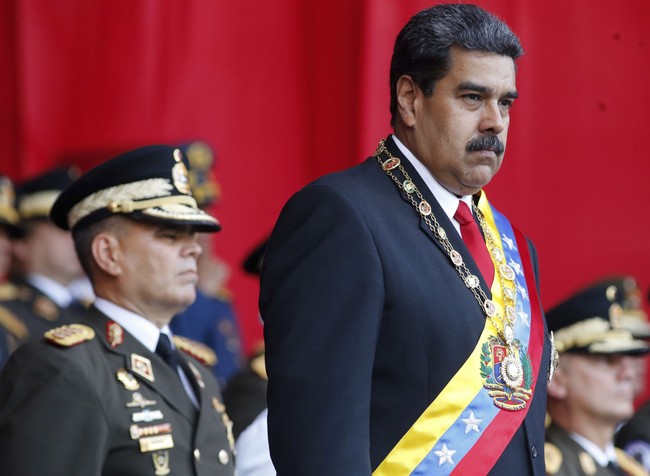
Venezuela’s “acting president” (aka Trump’s pawn), Delcy Rodríguez, made a big announcement on Wednesday: she dismissed the regime’s “Defense Minister,” Vladimir Padrino López, after he has spent well over a decade managing the country’s military.
“We thank G/J Vladimir Padrino López for his loyalty to the Homeland and for having been, throughout all these years, the first soldier in the defense of our country,” she wrote. “We are certain that he will assume the new responsibilities entrusted to him with the same commitment and honor.”
It’s not exactly clear what those “new responsibilities” will be. With any luck, they’ll be in Russia.
So, why is this big news? Well, first of all, Padrino López is one the key members of the Nicolás Maduro regime. As head of the military, he weaponized it against the people through every protest and stolen election over the past 11 or 12 years, and he used it as a major repression tool.
He’s also a member of the Cartel de los Soles, which is now considered a Foreign Terrorist Organization, and he’s a wanted a man in the United States. The State Department’s Narcotics Reward Program has a $15 million reward out for information leading to his arrest. In 2019, he was indicted by a federal grand jury in Washington, D.C. and charged with conspiracy to distribute and possess with the intent to distribute five kilograms or more of cocaine onboard an aircraft registered in the United States. Here’s more from the State Department:
DEA initiated the investigation of Padrino López in June 2014, and investigators learned Padrino López was utilizing his position as Venezuelan “Minister of Defense” to facilitate the movement of air shipments of cocaine from Venezuela to Central America. Padrino López charged drug transportation organizations a protection fee to allow these drug laden aircraft safe passage out of Venezuela. This protection fee was routinely in excess of $60,000. If the protection money was not paid in advance, Padrino López would have the unapproved aircraft destroyed by the Venezuelan military. Padrino López used subordinate members of the Venezuelan military to collect these protection fees. Additionally, Padrino López funded political campaigns in Venezuela with this protection money.
But most importantly, Padrino López represents one of the regime’s biggest remaining independent power centers.
I actually started a super in-depth article about this back in January, but I never published it, so I’m going to explain this the way it was explained to me by Venezuelan lawyer Estrella Infante earlier this year. Essentially, when Hugo Chávez died, “power was no longer centralized. It was divided among those with the strongest control networks.” The regime basically operated like organized crime.
Maduro was, of course, the narco-leader and face of the regime. He and his wife also controlled the country’s judiciary. Then there’s “Interior Minister” Diosdado Cabello, whom I think most of you know by now. He’s the hardliner, the muscle of the group, who controls the country’s police, security, and intelligence, as well as the Colectivos paramilitary and the torture networks. He’s currently got $25 million on his head.
Delcy was kind of the brains of the operation. She knew how to deal with international bad actors, like Russia, China, Iran, Turkey, and Spain. She knew how to evade sanctions. And she knew how to move Venezuela’s oil, gold, and highly desired minerals through complex global networks, which earned her the nickname the “Pirate of the Caribbean.” Her main ally and partner in crime is her brother, Jorge, who controls the Chavismo National Assembly, which is also often weaponized against the people.
And then there’s Padrino López who had quite a powerful grasp on the military. Until today.
“As years passed, the regime opened multiple black markets — gold, illegal mining, strategic minerals — and built a deeply corrupt internal system using currency manipulation, state monopolies, and repression,” Infante told me. “Power was deliberately distributed so that everyone was implicated: If one fell, the others would fall too. This created a mafia-style structure, where survival depended on collective loyalty.”
But, in the wake of the Maduro capture, that cohesion has unraveled. No one trusts anyone else. Delcy (and Jorge), who opted to take whatever deal Donald Trump and Marco Rubio offered (possibly one to save their lives), is now dismantling the Maduro regime.
Sort of.
The person she put in place of Padrino López isn’t exactly the guy most of us would have chosen. Gustavo González López was once head of the Bolivarian National Intelligence Service (SEBIN), and he’s considered a Delcy loyalist, as well as a close Cabello ally. He’s also heavily sanctioned by the United States, Canada, and the European Union for human rights abuses, including committing “acts of arbitrary detention, torture and cruel and inhuman treatment, including sexual violence.”
At first glance, it looks like Delcy and Cabello are building their own little regime of loyalists, but make no mistake: Trump and Rubio are not setting up Delcysmo to be the future of the Venezuelan government. There’s no way they’d allow that to happen. This is just one of many steps in breaking up the underlying criminal network. As Venezuelan journalist Orlando Avendaño pointed out on X, “Obviously, the appointment of González López to head the Ministry of Defense has the green light from the White House. Let’s recall what David Alandete reported a few days ago: the Secretary of War, [Pete] Hegseth, was tasked with holding periodic meetings with the Venezuelan regime.”
He’s right. I have seen reports that Hegseth is, along with Rubio, working with the regime, because correcting the country’s military is going to be a big part of the stabilization process. The higher-ups are largely corrupt and involved in narco-activity and repression, and many of the low-level members are aligned with the opposition. It’s also important to point out that González López met with CIA Director Ratcliffe in January.
Several others frame this as good thing. Opposition leader Juan Pablo Guanipa said that the Venezuelan people must “accept all these changes as temporary changes.” He added, “What is happening with Ms. Delcy’s presence in the presidency of the Republic is that it is a kind of transitional dictatorship.”
“Whatever happens to Mr. Padrino is of no concern to me. He was an irresponsible man who led the Armed Forces to become a political party, who violated the Venezuelan Constitution,” Guanipa added. “So I insist, what is happening is good for Venezuela. Obviously, one has one’s reservations about González López, but at least Padrino is gone and we are moving towards that transition process that we Venezuelans so desperately want.”
Delcy isn’t just making changes when it comes to the military. On Wednesday, she also replaced several other members of the “interim government,” including new ministers for Energy, Public Works, Transportation, Social Process of Work, and Housing and Habitat. She’s actually making these announcements as I’m writing this, so it’s possible there are more to come.
To further prove that isn’t just some sort of whim and is potentially aligned with the desires of the Trump administration, this big shake-up comes on the same day the U.S. Treasury Department’s Office of Foreign Assets Control (OFAC) announced that it’s issuing general licensing that will allow U.S. companies to engage in more transactions with the Venezuelan state oil company PDVSA.
“This license will benefit both the United States and Venezuela, while supporting the global energy market by increasing the supply of available oil. It will also help incentivize new investment in Venezuela’s energy sector,” said a Treasury spokesperson.
Related: Breaking the Curse of a Nation
That timing isn’t coincidental. While it may look a little murky from the outside, it’s just further proof that the process of making Venezuela great again is moving right along. As a matter of fact, Venevision, a privately owned media outlet in Venezuela that often self-censors to keep the regime happy, just used that exact phrase — make Venezuela great again — live on the air. Social media is going nuts over it because it’s just further proof that change is in the air.
Venezuela será grande nuevamente.
Make Venezuela Great Again.
En Venevisión. pic.twitter.com/VGmKvbPHAl
— Orlando Avendaño (@OrlvndoA) March 18, 2026
Want to support conservative media? You can do so by becoming a PJ Media VIP member. It’s less than $20 for the entire year, and you get some cool perks too. We can’t wait to have you!