
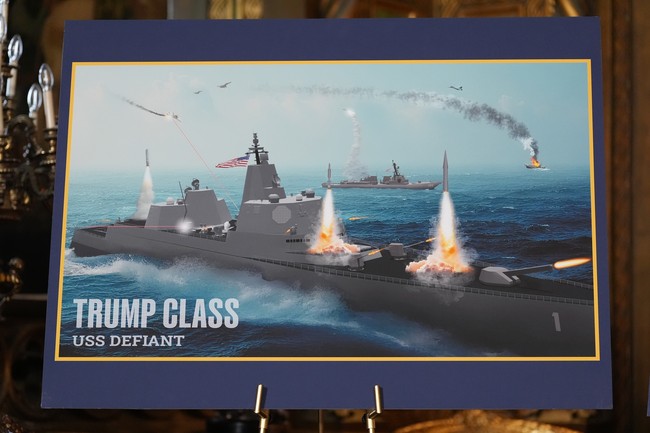
Following President Donald Trump’s Truth Social statement in January, the Pentagon will soon unveil a “generational investment” defense budget totaling a whopping ONE POINT FIVE TRILLION DOLLARS.
Nevertheless, Aviation Week recently reported, “there are still hard decisions to be made.”
You might think that a trillion-and-a-half bucks would buy the military everything we need it to have, but the “stuff” isn’t the problem; it’s the manufacturing. Stick a pin in that.
Right now, we have six major acquisition programs — aside from the now well-established F-35 and Virginia-class subs — that might be performing better than you believe. They are:
- Ford-class aircraft carriers (10)
- Columbia-class nuclear missile submarines (12)
- F-47 sixth-generation fighters/loyal wingman stealth drones (~185)
- B-21 Raider heavy bomber (145)
- Sentinel ICBM (400 operational, plus 200+ spares/test units)
The Fords are late and over-budget, but the teething problems and overruns seem to be largely behind us with the John F. Kennedy due to be delivered to the Navy next year. Keep making Fords, but keep options open for smaller drone carriers.
There’s a similar story with the Columbia SSBNs. The first one will be late and enormously expensive. The rest of the class should do better.
Now that Trump finally forced the Air Force to settle on an F-47 design, work should move forward about as well as these things ever do. I’d like things to move faster, but the first F-47 units ought to be combat ready in the early 2030s.
The Air Force just upped its request for B-21 stealth bombers from 100 to 145, yet that’s only a down payment on our actual requirement. The number we actually need — since the Raider will serve as conventional bombers and as our airborne nuclear deterrent — is probably 300.
Then there’s the Sentinel ICBM, which I doubt we even need, provided we buy an additional 8-10 Columbia SSBNs. That program is ridiculously over-budget, mostly because the other half of the program — the underground silos to house them — is a hot mess. Figure it out, fellas, or let the Navy have all the heavy nuclear missiles.
I’d also note that the Virginia-class attack sub program is freakin’ amazing. The new Block V models are basically attack subs and guided-missile boats, all wrapped into one deadly package. We will and ought to throw more money at increasing their production rate and the total buy.
There are two more programs almost in limbo. The Navy needs large numbers of small frigates and smaller numbers of larger destroyers/cruisers. If it takes an act of Congress to force a final design for both down the Navy’s stupid, stubborn throat, then do it. We don’t need gold-plated stealth ships; we just need tough, reliable surface combatants with plenty of missile cells.
It would also be nice to get at least four Trump-class battleships.
But if you’re like me, that ONE POINT FIVE TRILLION DOLLAR figure made you gasp at first. On reflection, it shouldn’t.
For perspective, President Ronald Reagan’s Cold War-winning defense budgets peaked in 1986 at $304 billion — or roughly $800 billion in today’s dollars. Dollar for dollar, that’s a little less than we’ll spend this year on defense, but in fairness, 40 years ago each defense dollar bought a lot more combat power.
That’s because America’s most vital combat arm — our private sector’s ability to manufacture the best stuff and make it in quantity — either got outsourced or M&A’d into oblivion.
Among the “hard decisions,” if necessary I’d cut the Army to the bone — a rapid-reaction force able to tip the balance for our allies — and put even more money into revitalizing our defense manufacturing base. The cold, hard truth is that armies can be raised in a hurry should the terrible need arise, but manufacturing takes time. We don’t produce enough artillery shells, bullets, drones, and everything else we need for a comparatively simple air war against a third-rate power like Iran.
Against China?
Fuggidaboudit.
We require a defense manufacturing capability that’s both deep and broad — and supply chains that aren’t reliant on rival powers like China or Russia. The bill for more than three decades of unseriousness about our defense needs finally came due. I don’t just mean big-ticket items like aircraft carriers and stealth bombers. The Pentagon’s “generational investment” had better focus bigly on our ability to make the small-ticket items like missiles and shells that our troops rely on.
Going back to Reagan’s Cold War budgets, spending peaked at a little over 6% of GDP during the mid-’80s. Today, that would be $1.7 trillion, give or take — or a significant fraction more than Trump asked for.
And yet it feels like such a struggle, such an impossible goal, to spend slightly less than we did four decades ago. I can explain why in exactly two words: health care. A spending item not even mentioned in the Constitution has nearly tripled as a fraction of the federal budget since 1986, ballooning from 10-12% to roughly 30% today.
Just four days of Medicare/Medicaid spending could buy another Ford-class aircraft carrier, cost overruns and all. It’s the same thing with the space program. If NASA had the budget (and the vision!) it had during Apollo, it’d have ten times today’s paltry $30 billion budget — and we’d have another manufacturing base at Moon City Armstrong by now.
The hardest choice we must make is whether we want to be a welfare state in long-term decline, or the fit and fearsome America left to us by the Greatest Generation.
Recommended: Who Killed Hollywood? Or Did it Kill Itself?
Want more like this?
Get exclusive content and support independent journalism with 60% off a PJ Media VIP membership. Use promo code FIGHT and join today.