
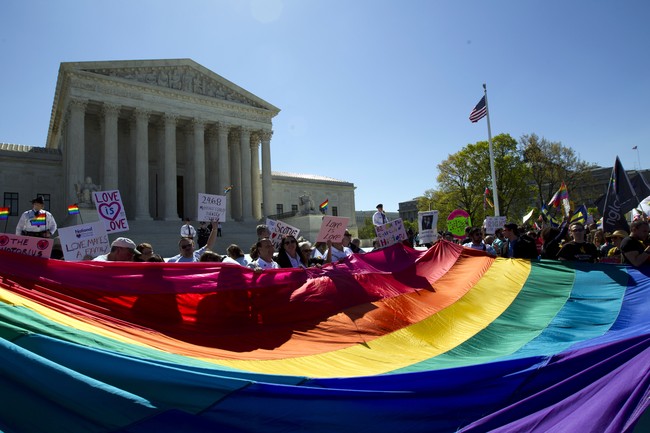
Last October the Supreme Court heard oral arguments in a case brought by a Christian therapist in Colorado named Kaley Chiles. Chiles argued that the states ban of talk therapy, which it passed in 2019, was unconstitutional as it violated her right to free speech.
Chiles, who is a practicing Christian, contends that although she does not try to “convert” her clients, she does try to help them with objectives that may include “seeking to reduce or eliminate unwanted sexual attractions” or becoming more comfortable with their bodies. Chiles filed a lawsuit in Colorado, asking a federal court to block the state from enforcing the conversion therapy ban against her…
Representing Chiles in the Supreme Court on Tuesday, lawyer James Campbell urged the justices to hold that the law is unconstitutional. He told them that the ban prohibits counselors “from helping minors pursue state-disfavored goals on issues of gender and sexuality.” If the ban and others like it are only subject to rational basis review, he suggested, it “would allow states to silence all kinds of speech,” and could “transform counselors into mouthpieces for the government.”
Principal Deputy Solicitor General Hashim Mooppan, representing the Trump administration, also argued that the court should strike down the law. There is no long tradition of state regulation of medical treatment that – like Chiles’ talk therapy – is based solely in speech, he emphasized.
There were signs during oral arguments that the state of Colorado’s argument on behalf of the ban was in trouble. Even Justice Kagan, of the leader of the progressives on the Court, seemed skeptical that this was anything other than viewpoint discrimination.
Today the Supreme Court sided with Chiles in an 8-1 decision, agreeing that Colorado’s law violated her right to free speech.
The Supreme Court on Tuesday sided with a Christian therapist, rejecting a Colorado law that prohibited mental health professionals from trying to change the sexual orientation or gender identity of L.G.B.T.Q. minors.
The court’s decision has implications for more than 20 other states that have similar laws barring so-called conversion therapy, which critics say is ineffective and potentially dangerous for young people.
In its decision, the court said the law, as applied to talk therapy, impermissibly interferes with free speech.
“Colorado may regard its policy as essential to public health and safety,” Justice Neil M. Gorsuch wrote for himself and seven other justices from across the ideological spectrum. “But the First Amendment stands as a shield against any effort to enforce orthodoxy in thought or speech in this country.”
You can probably guess who the one dissenter was.
Liberal Justice Ketanji Brown Jackson was the sole dissenter, taking the unusual step of reading a summary of her opinion in the courtroom. She focused on the distinction between speech and conduct.
“Under our precedents, bedrock First Amendment principles have far less salience when the speakers are medical professionals,” Jackson wrote.
Chiles celebrated the outcome as a win for freedom.
“The Supreme Court’s ruling is a victory for counselors and, more importantly, kids and families everywhere,” Chiles said in a statement. With the ban not in effect, she will be able to speak freely to clients “when they choose the goal of growing comfortable with their bodies,” she added.
My own sense of what happened here is that this is a case where LGBT advocates pushed their arguments too far and paid with a big public loss. The consensus against so-called conversion therapy was pretty well established when it came to gay teens. Had the argument stopped there I’m not sure it would have been challenged. But over the past several years, trans advocates have tried to extend that same argument to the idea that children know their gender regardless of their actual sex. Therefore any professional who challenges the self-ID of, say, a nine year old boy who declares he’s a girl, was potentially violating the new law.
In essence, the Colorado law (and others like it) was an attempt to legally enforce gender affirming care. The law said that supportive care (in the form of talk therapy) was fine but therapy aimed in the opposite direction was illegal and could result in a professional losing their license.
Trans people had won many of these arguments but then they demanded too much and the public turned against them. A decade ago they were winning on bathroom bills. And then they insisted that trans girls could compete in all sports at all levels and that even convicted male rapists should be sent to women’s prisons if they announced a new gender prior to sentencing. And eventually people started to say no and to reject the argument that self-ID was the final word in every situation. In fact it’s not an argument at all, just a demand for compliance, i.e. trans women are women. Now there is a backlash which calls into question all similar social demands based on this ideology. Society as a whole does not have to play along with these demands, especially when they involve children.
Editor’s Note: Do you enjoy Hot Air’s conservative reporting that takes on the radical left and woke media? Support our work so that we can continue to bring you the truth.
Join Hot Air VIP and use promo code FIGHT to receive 60% off your membership.