Before I get into why I loathe inheritance tax, let me issue a disclaimer.
Never, ever do anything to piss off the taxman. There’s a line: don’t even walk towards it, let alone cross it. With nearly everything happening electronically now, you won’t “outsmart” the revenue authorities, no matter how morally justified you feel.
Always pay a professional — accountant, tax lawyer, or both — not just for their advice but for their signature on the paperwork. That signature is often the thin blue line between your heirs and an aggressive auditor. Try to do complex planning on your own, and you’re putting your estate squarely in the crosshairs.
If your net worth is in the six or seven figures, you can’t afford to be casual about this.
Now, let’s get into it.
What Is Inheritance Tax?
Inheritance tax — often lumped together in conversation with “estate” or “death” taxes — is a levy on wealth passing from a deceased person to their heirs. Depending on where you live, the government may tax the estate itself, the recipients, or both.
When someone dies, their estate (the total value of their assets and property) is assessed. If the value exceeds the arbitrary threshold set by the government, a tax is applied. The exact thresholds and rates vary by country and region, but the principle is always the same: The State inserts itself as an uninvited “heir” to your life’s work.
The political sales pitch is that this helps everyone “contribute to public funds” and tackles “wealth inequality.” In practice, it means you give a slice of your money to strangers rather than to your children or chosen heirs.
Sometimes the tax is paid by the estate before any distributions are made. Sometimes it’s paid by the beneficiaries after they receive their share. That distinction doesn’t make it any better; it just changes who gets the bill for the wealth they didn’t create.
Why Inheritance Tax Is Immoral
Let me list some reasons why inheritance tax (IHT) is morally wrong.
Your assets are yours to dispose of as you wish, including passing them to whomever you like. Taxing wealth at the moment you transfer it to your heirs is a direct violation of that right; it is the State claiming veto power over your final act of ownership.
Most estates consist of assets that were already taxed as income, capital gains, property tax, sales tax, or all of the above. Hitting them again at death is not a “fair contribution.” It’s double-dipping by design.
IHT punishes families who save and invest across generations, while rewarding the State, which rarely shows similar restraint. It disrupts the intergenerational compounding that turns a successful small business or modest home into multi-generational security.
-
- Wealth preservation and growth
If you know The State will confiscate a large chunk of your estate on death, your incentive to build and preserve capital is reduced at the margin. Capital foregone is investment foregone — and that means fewer jobs, less innovation, and lower growth over time.
The wealthiest can hire entire teams of lawyers and accountants to exploit every loophole. The merely comfortable cannot. So the system marketed as “taxing the rich” often ends up hitting small business owners, professionals, and homeowners in expensive postcodes hardest.
For me, the argument begins and ends with property rights. You ought to be able to give what you want to whom you wish upon your death, without the taxman standing there with a collection plate.
Interestingly, one underappreciated driver behind the push for gay marriage was blunt: property rights. For years, same-sex partners routinely faced confiscatory tax bills when one partner died and left assets to the other. They were treated, for tax purposes, like strangers. Spousal rights were a way around that problem.
I’m not reducing marriage to a tax dodge; people marry because they love each other. But it’s telling that adults had to fight for recognition, partly to defend what should already have been a basic right: to leave your own property to the person you choose, without the State inserting itself as a third party.
U.S. Inheritance and Estate Tax
If you’re a U.S. citizen, the federal threshold is very high… for now.
The federal estate and gift tax system gives you a single lifetime exemption. You can use it while you’re alive through taxable gifts or at death through your estate. Above that, the top federal estate tax rate is 40%.
There is also an annual gift tax exclusion that lets you gift a certain amount to each recipient each year without using your lifetime exemption. Properly used, it can shift significant wealth out of your taxable estate over time.
But that’s just the federal layer. Several US states impose their own estate or inheritance taxes, often with much lower thresholds. You can be nowhere near the federal limit and still trigger a painful state-level tax bill. If your assets or heirs are spread across multiple states, this becomes even more complicated.
The bottom line: the federal numbers look generous, but you cannot ignore the state you live in, the state your property sits in, or the state where your heirs live.
There’s also an important conceptual distinction:
– Estate tax is levied on the estate itself before distribution.
– Inheritance tax is levied on the recipient after they receive their share.
Many people (including me in casual speech) lump them together as “death taxes,” but planners and revenue officers certainly don’t. Make sure you know which one you’re dealing with.
UK Inheritance Tax
The UK’s inheritance tax is asinine. It gets many families into trouble and is the reason you see so many stories of heirs forced to sell the family home just to pay the bill.
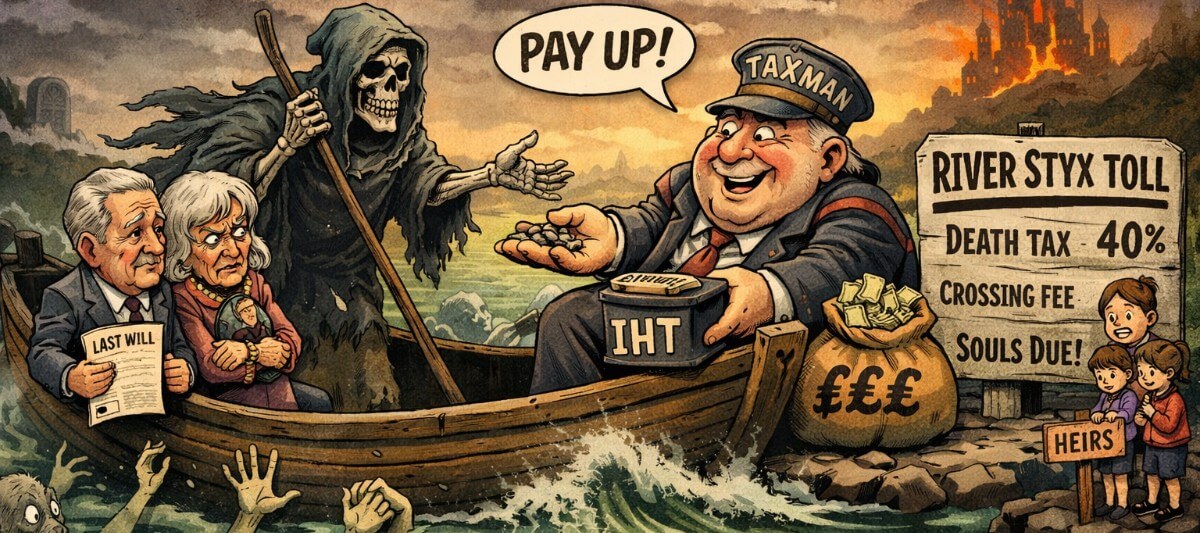
The standard UK IHT rate is 40%. It’s charged on the part of your estate that sits above your available allowances. The basic “nil-rate band” has been stuck at £325,000 for years. On top of that, there’s a “residence nil-rate band” — up to an extra £175,000 — if you leave your main home to direct descendants. In practice, many married couples can pass up to £1 million between them before the 40% rate bites, depending on how their wills and ownership are structured.
There’s also a reduced rate of 36% available on some assets if you leave at least 10% of your estate’s net value to charity. That’s the Treasury’s way of dangling a small discount if you cut them in and a charity in at the same time.
Even with these allowances, rising house prices and frozen thresholds mean more and more ordinary families are drifting into IHT territory. One badly drafted will, one unplanned property, one sloppy piece of paperwork, and your heirs can find themselves selling assets in a hurry just to appease HMRC.
If you’re a Brit and don’t see a lawyer or accountant about this, see a psychiatrist.
As a British citizen, I will do everything I legally can to avoid this tax.
Italian Inheritance Tax
Italy’s system is more convoluted on paper but much friendlier in practice than the UK’s, especially for spouses and children.
For assets left to a spouse or direct descendants, the standard inheritance tax rate is 4%, but only on the amount above a €1 million allowance per beneficiary. So if you leave €1.5 million to one child, the tax is 4% on €500,000.
On top of that:
- There are specific filing taxes on real estate transfers, often calculated as a small percentage of the property’s cadastral value or replaced with a flat fee if the property will be the principal home.
- Different rates and much lower allowances (or none at all) can apply for siblings, more distant relatives, or unrelated beneficiaries.
In short, in Italy, the combination of high allowances for close family and relatively low rates makes it far less likely that your heirs will be forced to sell the family home just to pay inheritance tax. In the UK, by contrast, selling property to meet IHT bills is depressingly common.
Planning Strategies to Reduce IHT
Again, if you face IHT issues, you must take professional advice from a lawyer or an accountant. I don’t know your personal situation, so please take this only as educational material, not personal tax advice.
The goal is not to “hide” money; it is to use the rules as they are written before the taxman uses them against your family.
Here are some common tools in the box:
Tax-free allowances and exemptions
Many jurisdictions provide tax-free allowances or exemptions for specific amounts of inherited wealth, particular types of assets, or transfers between spouses. By structuring your estate and timing your transfers, you can make full use of these allowances rather than waste them.
Making gifts during your lifetime can reduce the value of your taxable estate. Some gifts fall within annual exclusions, others within longer “survival” rules, and some jurisdictions treat certain gifts as immediately taxable. Done properly, lifetime giving lets you see your heirs enjoy the wealth and keeps more of it out of the State’s reach.
Trusts can be an effective way to manage and distribute assets while potentially reducing estate or inheritance tax liabilities. They allow you to separate legal ownership from beneficial enjoyment, specify how and when assets are distributed, and sometimes move growth outside your taxable estate. They are not magic wands, but in the right hands, they are powerful tools.
Donations in your will or during your life can reduce the taxable value of your estate and, in some systems, lower the tax rate on the slice that remains. If you’re charitably inclined anyway, you may as well let your chosen causes benefit instead of directing that slice to the government by default.
Properly structured life insurance can provide liquidity to help your heirs pay inheritance or estate tax without having to fire-sale assets. In some jurisdictions, policies written in trust may sit outside the taxable estate, but this is highly jurisdiction-specific and needs expert setup.
-
- Business and agricultural reliefs
Tax codes offer relief or exemptions for qualifying business assets or agricultural property, in theory, to support continuity in family businesses and farms. If you own a business or land, the difference between qualifying and not qualifying can be ruinously expensive for your heirs. Get clarity on this early, not on your deathbed.
If you have seven-figure wealth, definitely learn more about trusts, lifetime gifting, and the specific reliefs available in your jurisdiction. At that level, “doing nothing” is itself a costly decision.
Wrap Up
Nothing gets my goat more than unjust taxes, and the inheritance tax is near the top of that list.
Do what you can, completely legally, to avoid this insidious tax at all costs. Do it not because you hate society, but because you love your family more than you love feeding Leviathan.