Senate Republicans have mostly united around a proposal to avoid the year-end health care cliff.
The GOP plan is an alternative to reupping enhanced Obamacare premium subsidies that expire Dec. 31. Senate Democrats are pushing for a clean three-year extension, which Republicans said will cost $83 billion.
Republicans are still planning to spend some of that taxpayer money by redirecting it into Health Savings Accounts if Obamacare consumers enroll in lower premium, high-deductible plans.
Both the GOP and Democratic health care bills will get a vote on Thursday, and both are expected to come up short of the 60 votes needed to overcome a filibuster.
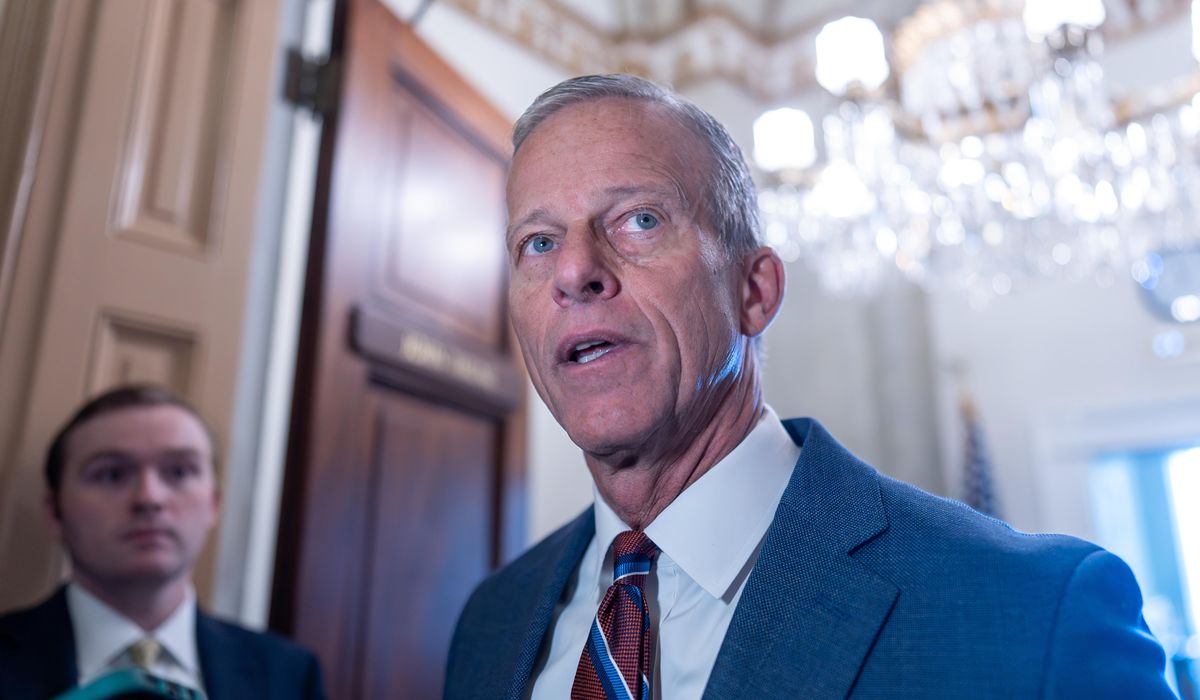
Senate Majority Leader John Thune, South Dakota Republican, said the Congressional Budget Office projects the GOP bill will drive down premiums by double digits.
“It delivers the benefit directly to the patient, not to the insurance company, and it does it in a way that actually saves money back to the taxpayer,” he said. “That is a win-win proposal.”
Senate Democrats rejected it.
“Their phony proposal is dead on arrival,” said Senate Minority Leader Charles E. Schumer, New York Democrat.
He knocked the GOP measure for not extending the enhanced Affordable Care Act premium tax credits for a single day, saying, “That’s what’s driving the price up.”
The base ACA subsidies do not expire, but more generous subsidies Democrats enacted during the COVID-19 pandemic will expire.
The expansion capped out-of-pocket costs at 0%-8.5%, based on household income, and extended access to the subsidies to families earning more than 400% of the federal poverty level, currently $62,600 for an individual or $128,600 for a family of four.
Democrats want to extend the extra benefits for three years without changes.
Most Republicans oppose extending the enhanced subsidies. Those who are willing to entertain a short-term extension have demanded an income cap and a minimum monthly premium payment to protect against fraud.
“There are millions of Americans who don’t even know they have coverage, and [Democrats] decided not to do anything,” Mr. Thune said. “Zero reforms to this program. And so the bill that they’re going to put on the floor will fail.”
Republicans, led by Senate Finance Chairman Michael Crapo of Idaho and Senate Health, Education, Labor and Pension Chairman Bill Cassidy of Louisiana, opted for a different approach.
Their bill, called the Health Care Freedom for Patients Act, would allow the government to make monthly deposits into an HSA for consumers enrolled in bronze or catastrophic Obamacare plans and earning less than 700% of the federal poverty level, currently $109,550 for an individual and $225,050 for a family of four.
The government funds, totaling $1,000 a year per person ages 18-49 and $1,500 per person ages 50-64, would only be available in 2026 and 2027.
HSA rules do not allow the money to be spent on premiums, but it can be used for deductibles, copays and other out-of-pocket expenses not covered by insurance.
“Because families want the best value for their money, they will seek out the most appropriate treatment over time,” Mr. Crapo said. “This will result in lower health care costs as providers compete for patients.”
Mr. Cassidy cited an example of costs for a Louisiana family with a 55-year-old couple and two adult children in their early 20s trying to enroll in Obamacare for 2026.
If they choose a benchmark silver plan, their monthly premium would be $2,967. But if they opt instead for a higher deductible bronze plan, their monthly premium would be $2,255, resulting in annual premium savings of $8,544 — plus $5,000 from the government in an HSA that they can spend toward the higher deductible.
Extending the ACA premium tax credits does nothing to help families pay for deductible costs that hit before insurance kicks in, Mr. Cassidy said.
“That first trip to the doctor, you’re paying out of your purse or your pocketbook,” he said.
The GOP bill adds a restriction to ensure that Obamacare-connected HSA funds could not be used for abortion or gender transition services.
Mr. Schumer said Democrats will not agree to any GOP plan with new abortion restrictions.
“They care more about taking abortion away from the women of America than they care about reducing health care costs,” he said.
The Crapo-Cassidy bill prevailed as the GOP consensus measure after the conference discussed a variety of Republican proposals.
Ohio GOP Sens. John Husted and Bernie Moreno, who floated separate plans to temporarily extend the enhanced Obamacare subsidies with an income cap and minimum premium payments, said they were still happy with the decision.
“I’m just interested in finding a pathway forward that helps reduce cost to consumers,” Mr. Husted said.
Mr. Thune told reporters on Monday that he preferred a solution that could get to 60 votes rather than failed partisan messaging votes. But several Republicans demanded that the conference have something to vote for if they were going to shoot down the Democrats’ bill.
One of those Republicans, Sen. Josh Hawley of Missouri, said earlier that it was a mistake for his party to “sit back and do nothing and say, ’You’re on your own.’”
After the call was made to vote on the Crapo-Cassidy bill, he said he would prefer something different, but “something is better than nothing.”