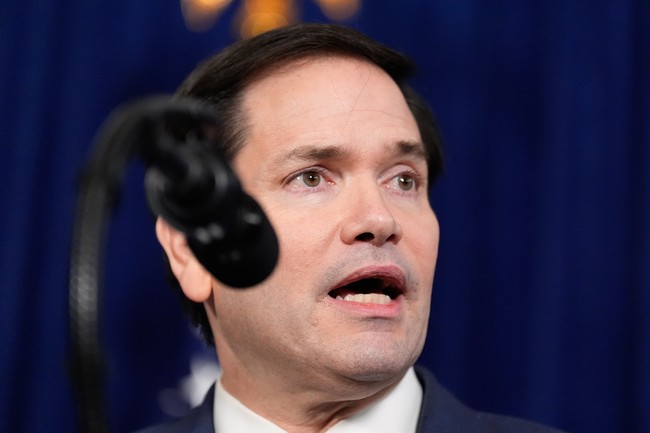
Late yesterday, in a post about the Barack Obama-Libya precedent, I included a short clip of Marco Rubio’s rebuke to Congress on claims that Donald Trump “illegally” attacked Iran. However, the Secretary of State’s remarks also included – indeed, largely focused on – a robust explanation for the necessity of Operation Epic Fury, In less than twelve minutes, Rubio laid out the most acute reasons for action at the moment, while setting aside the more substantial explanation that the Iranian regime has conducted a war against the United States since 1979.
Rubio’s remarks should be viewed in full, not just to absorb Rubio’s excellent framing of the acute situation, but also to see how critics have attempted to re-frame his argument into It’s all about the Joooos. It’s worth the twelve minutes of your time, just to watch Rubio firmly handle the press in this briefing (via Power Line):
Rubio makes the argument for operation Epic Fury.
Must watch 👇🏻 pic.twitter.com/0RhoT8LdSm
— Open Source Intel (@Osint613) March 2, 2026
At the time I wrote my post, Rubio’s comments on the decision to order hostilities hadn’t yet reverberated around the media and commentary space. By later in the evening, the narrative had formed – in the Protection Racket Media and in some corners of the conservative commentariat – that Israel had forced us into war with Iran. The Washington Examiner picked up on the specific remarks Rubio made that inflamed this narrative:
“We knew that there was going to be an Israeli action,” Rubio said. “We knew that that would precipitate an attack against American forces, and we knew that if we didn’t preemptively go after them before they launched those attacks, we would suffer higher casualties.”
“There absolutely was an imminent threat, and the imminent threat was that we knew that if Iran was attacked, and we believed they would be attacked, that they would immediately come after us, and we were not going to sit there and absorb a blow before we responded,” he told reporters, later adding that “we went proactively in a defensive way to prevent them from inflicting higher damage. Had we not done so, there would have been hearings on Capitol Hill about how we knew that this was going to happen, and we didn’t act preemptively to prevent more casualties and more loss of life.”
First off, this is a very curious hair at which to grasp. The US spent seven weeks assembling the largest armada the region has seen since the 2003 invasion of Iraq. Donald Trump issued a “red line” to Iran about harming protesters, which the regime ignored while massacring 32,000 unarmed civilians in the streets and in hospitals. Trump spent weeks threatening Operation Epic Fury while pressing the regime to negotiate in good faith. The order for the attack came just hours after Abbas Aragchi shouted at Steven Witkoff that Iran would never agree to enrichment restrictions. That is what made Trump choose military action. It had been clear that Trump would order a strike if the regime refused to take him seriously, and that the strike would have to be substantial, for the reasons Rubio also lays out here.
In fact, as I warned last week when Politico raised the possibility, Trump could not allow Israel to take the first action precisely for this reason – that everyone would claim Israel had pulled the US into a war:
The calculus is a political one — that more Americans would stomach a war with Iran if the United States or an ally were attacked first. Recent polling shows that Americans, and Republicans in particular, support regime change in Iran, but are unwilling to risk any U.S. casualties to achieve it. That means Trump’s team is considering the optics of how an attack is conducted in addition to other justifications — such as Iran’s nuclear program.
“There’s thinking in and around the administration that the politics are a lot better if the Israelis go first and alone and the Iranians retaliate against us, and give us more reason to take action,” said one of the people familiar with discussions. Both individuals were granted anonymity to describe private conversations.
Color me a bit skeptical about this idea. First off, it might just make the politics worse in the US. The progressive pro-Hamas activists (and the fringy anti-Semites on the Right) would immediately claim that Israel had led the US into a war we didn’t want. We’d see podcasters on the far end of the ideological donut screaming about Jewish control of American policy, AIPAC, rugelach, and Manischewitz. Also, no one would buy it, given all of the preparations Trump has made for a military response to Iran’s continued threats in the region. Israel might strike, but everyone would know who gave the order … and Trump probably prefers the credit.
More importantly, though, that would leave Iran with more capability in a first-strike response.
This was Rubio’s actual argument for imminence, as the full clip shows. He pointed out that Iran’s capacity for missile production exceeds our production level for anti-ballistic missile defenses, and the gap widened every month. Iran may have been about a year away from having so many ballistic missiles and drones that they could have pursued weapons-grade enrichment with impunity and openly developed nuclear weapons. The regime had already resorted to large-scale massacres of its own subjected people to maintain power; their “apocalyptic” theology would have encouraged them to use nuclear weapons against Israel and the US. Their refusal to discuss any limits on any of these ambitions became clear last week, and as Rubio argued, we needed to act while we still could.
Almost alone among the Protection Racket Media, Axios’ Marc Caputo unravels the truth from the narratives being spun:
The widely repeated translation: The U.S. couldn’t stop its ally — a far smaller nation that America arms, funds and protects — from attacking Iran on Saturday. So the U.S. had to strike Iran, too.
- Not quite, U.S. officials said later. Regardless of Israel, they said, Trump ordered the strikes because he felt Iran was negotiating a nuclear deal in bad faith, and the U.S. needed to destroy the country’s offensive military infrastructure.
- “This operation needed to happen,” Rubio told reporters, because Iran was developing too many missiles too quickly and was rebuilding its nuclear capabilities. ..
Reality check: The picture critics are painting — of a U.S. reluctantly pulled into war by a smaller ally — obscures the deep coordination between the two countries in the weeks before the strike.
- Israeli Prime Minister Benjamin Netanyahu had been urging Trump to strike Iran since December — but Israeli officials say he wouldn’t have moved without Trump’s explicit approval.
- It’s highly unlikely Netanyahu would’ve struck Iran without Trump’s green light, Israeli officials added. If Trump had preferred to keep negotiating, the strike would have been postponed.
Exactly. Caputo points out that Trump forced Netanyahu to end strikes in Syria last year when his military action threatened sensitive negotiations with the new regime in Damascus. Trump also pushed Netanyahu into accepting the Gaza peace plan that threatened his center-right coalition. Less well recalled was Trump’s role in preventing Israel from decapitation attacks in the June 2025 Twelve Day War, when Netanyahu wanted to take out Ali Khamenei while he had his chance at that time, because Trump wanted to keep the possibility of negotiations alive.
Israel hasn’t led Trump into anything. Trump has made his position as The Decider very clear in all of these conflicts. The decision to launch Operation Epic Fury can certainly be criticized, but it should be debated for what it actually is and the acute threats that formed the context for it, along with the 47 years of the Iranian regime’s acts of war against the US.