
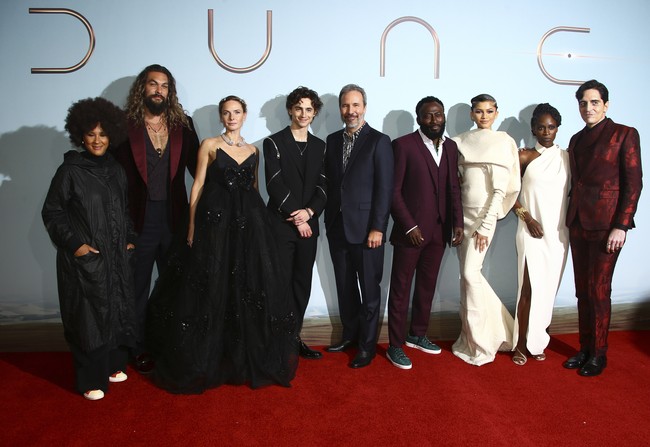
Conservatives still delighted by Project Hail Mary may soon have another film champion: Dune: Part Three. The forthcoming science fiction epic, slated for release in December, is directed by Denis Villeneuve and adapted from the books by author Frank Herbert.
At its heart, Dune and its sequels offer a powerful argument against big government, high taxes, and political messiahs who promise to save the world. In fact Dune: Part Three would be a perfect fit for the Anti-Communist Film Festival. Director Villeneuve and star Timothee Chalamet can consider themselves both invited.
The world and politics of Dune have been expertly analyzed by Daniel Immerwahr, a professor at Northwestern University. Immerwahr has explored the two sides of Dune author Frank Herbert: The environmentalist who grew up in Washington state, hung out with hippies and did drugs in the 1970s, and whose mentor was an American Indian, and Frank Herbert, the conservative Republican who hated taxes and leaders who promised people everything only to go on a power trip.
Although raised by socialist parents, Herbert experienced commune living with Native Americans, and it filled him with hostility to the federal government. Herbert rejected “any kind of public charity system” because he “learned early on that our society’s institutions often weaken people’s self-reliance.” Herbert worked for four Republican candidates, including very conservative Guy Cordon, the US senator from Oregon. Cordon was pro-logging, pro-business, pro-military, anti-labor, anti-regulation, and a supporter of Joseph McCarthy. A book Herbert wrote before Dune calls Soviet agents “the sinister embodiment of everything evil.”
In the 1960s, a countercultural activist gave him a book to read about log mining. Herbert was shocked, agreeing in that hysterical time g that humans were going to strip the Earth of all resources. All that would be left, he said, “is one big dune.” Herbert also had knowledge of Islam and its thirst for jihad – a central theme of Dune Messiah, before it was widely known in the West.
Combine all these elements together, and you get the Dune saga. The story is set in a galaxy in the far future. Noble families war for control over planets and resources. The most valuable resource is the spice melange, a substance that gives long life, heightened awareness, mesmerizing blue eyes, and the ability for interstellar travel. The source of the spice is Arrakis, a desert planet. Dune tells the story of Paul Atreides, a teenage boy who comes to Arrakis, leads a revolt against the empire, and fulfills a religious prophecy. In the recent Dune films, Paul is played by Timothee Chalamet, who is perfectly cast.
Dune is not an argument for a messianic leader to come and save us. It’s about resisting the lure of such a figure – an Obama who is deified as the answer to our spiritual desires and is the fulfillment of “the arc of history.” After supporting Richard Nixon and seeing the president resign, Herbert had an epiphany. “Nixon taught us one hell of a lesson,” he said, “and I thank him for it. He made us distrust government leaders.” One sequel to Dune offers the story of Leto II, a politician who becomes a tyrant in order to teach people a “lesson their bones would remember.” Leto abused the people, then offered this lesson: “I expect you to be exceedingly careful about the powers you delegate to any government.”
The last Dune novels Frank Herbert wrote would be welcome at C-PAC. The books were written while the IRS hounded Herbert for unpaid taxes, and in Heretics of Dune, the mere mention of the word “liberal” elicits rage from one character. She lives 25,000 years in the future, yet just hearing someone say “liberal” reminds her of “how much viciousness lay concealed in that word” and “how much secret ego demanding to feel superior.” She concludes; “Liberal bigots are the ones to trouble me the most.” Another character argues that “Liberal governments always develop into aristocracies.”
“The underlying question is not whether Paul wins or loses,” critic Michael Whittaker once observed about Dune. “It’s about whether he remains a hero or becomes the morally murky protagonist. Dune: Part Two is both horrifying and romantic, presenting a far, far future that is recognizable because people never change. While the war may be portrayed as a jaw-dropping spectacle, the answers to all those political and moral questions may leave the audience deeply uncomfortable. Herbert would be proud.”
Editor’s note: We now have the room to run syndicated commentary by some of our favorite and most provocative thinkers on the Right. That only happens because of the support of our readers, who ensure that we have the resources to keep providing an independent platform and independent voices in a sea of Protection Racket Media domination.
Help us maintain that fight! Join Hot Air VIP and use promo code FIGHT to get 60% off your membership.