This morning’s Gospel reading is Matthew 27:11–54 (shorter form):
Jesus stood before the governor, Pontius Pilate, who questioned him, “Are you the king of the Jews?” Jesus said, “You say so.” And when he was accused by the chief priests and elders, he made no answer. Then Pilate said to him, “Do you not hear how many things they are testifying against you?” But he did not answer him one word, so that the governor was greatly amazed.
Now on the occasion of the feast the governor was accustomed to release to the crowd one prisoner whom they wished. And at that time they had a notorious prisoner called Barabbas. So when they had assembled, Pilate said to them, “Which one do you want me to release to you, Barabbas, or Jesus called Christ?” For he knew that it was out of envy that they had handed him over. While he was still seated on the bench, his wife sent him a message, “Have nothing to do with that righteous man. I suffered much in a dream today because of him.” The chief priests and the elders persuaded the crowds to ask for Barabbas but to destroy Jesus. The governor said to them in reply, “Which of the two do you want me to release to you?” They answered, “Barabbas!” Pilate said to them, “Then what shall I do with Jesus called Christ?” They all said, “Let him be crucified!” But he said, “Why? What evil has he done?” They only shouted the louder, “Let him be crucified!” When Pilate saw that he was not succeeding at all, but that a riot was breaking out instead, he took water and washed his hands in the sight of the crowd, saying, “I am innocent of this man’s blood. Look to it yourselves.” And the whole people said in reply, “His blood be upon us and upon our children.” Then he released Barabbas to them, but after he had Jesus scourged, he handed him over to be crucified.
Then the soldiers of the governor took Jesus inside the praetorium and gathered the whole cohort around him. They stripped off his clothes and threw a scarlet military cloak about him. Weaving a crown out of thorns, they placed it on his head, and a reed in his right hand. And kneeling before him, they mocked him, saying, “Hail, King of the Jews!” They spat upon him and took the reed and kept striking him on the head. And when they had mocked him, they stripped him of the cloak, dressed him in his own clothes, and led him off to crucify him.
As they were going out, they met a Cyrenian named Simon; this man they pressed into service to carry his cross.
And when they came to a place called Golgotha —which means Place of the Skull—, they gave Jesus wine to drink mixed with gall. But when he had tasted it, he refused to drink. After they had crucified him, they divided his garments by casting lots; then they sat down and kept watch over him there. And they placed over his head the written charge against him: This is Jesus, the King of the Jews. Two revolutionaries were crucified with him, one on his right and the other on his left. Those passing by reviled him, shaking their heads and saying, “You who would destroy the temple and rebuild it in three days, save yourself, if you are the Son of God, and come down from the cross!” Likewise the chief priests with the scribes and elders mocked him and said, “He saved others; he cannot save himself. So he is the king of Israel! Let him come down from the cross now, and we will believe in him. He trusted in God; let him deliver him now if he wants him. For he said, ‘I am the Son of God.’” The revolutionaries who were crucified with him also kept abusing him in the same way.
From noon onward, darkness came over the whole land until three in the afternoon. And about three o’clock Jesus cried out in a loud voice, “Eli, Eli, lema sabachthani?” which means, “My God, my God, why have you forsaken me?” Some of the bystanders who heard it said, “This one is calling for Elijah.” Immediately one of them ran to get a sponge; he soaked it in wine, and putting it on a reed, gave it to him to drink. But the rest said, “Wait, let us see if Elijah comes to save him.” But Jesus cried out again in a loud voice, and gave up his spirit.
Here all kneel and pause for a short time.
And behold, the veil of the sanctuary was torn in two from top to bottom. The earth quaked, rocks were split, tombs were opened, and the bodies of many saints who had fallen asleep were raised. And coming forth from their tombs after his resurrection, they entered the holy city and appeared to many. The centurion and the men with him who were keeping watch over Jesus feared greatly when they saw the earthquake and all that was happening, and they said, “Truly, this was the Son of God!”
Note: This reflection was first published in 2017.
Our faith teaches us that all things serve God in one way or another, and all will be made to serve His will eventually. On our pilgrimage to the Holy Land a little over three years ago, our guides and our pastor told a story that reflects this. We asked how the traditional sites of reverence in the life and Passion of Jesus have been established, and they had a very interesting answer to this often-asked question — and it reminded us of this belief, and of the fact that pilgrimages to these sites have been ongoing for two thousand years.
Shortly after the Resurrection, believers in Christ sought out these sites and began to build altars to further consecrate them. Roman authorities saw this new sect springing from Judaism as a threat, more so than most other native religions within their empire. Beginning almost immediately under Nero and going all the way to Diocletian in the early fourth century, Roman emperors would wage persecutions of Christians, murdering them by the thousands, only to see tens of thousands take the place of the martyrs.
One emperor saw the pilgrimages as part of the problem. About a century after the Passion of which we read today, Hadrian tried to wipe out Christianity by destroying its holy sites and heritage. He ordered the destruction of the altars, shrines, and nascent churches at these sites (such as the tomb, the site of Jesus’ birth in Bethlehem, and others), and had pagan temples built to Roman gods at each of them. Hadrian expected that to result in the death of the “cult” that had arisen over the previous century.
Not only did that not work, it also wound up backfiring on Hadrian, although he was long gone by that time. Two centuries later, St. Helena — the mother of Roman emperor Constantine — went to the Holy Land on her own pilgrimage to find the holy sites. It turned out to be remarkably easy to find them; all she had to do was look for the pagan temples built by Hadrian. Rather than wipe out the sites, Hadrian’s efforts guaranteed that future pilgrims (such as ourselves) could know where to find them.
We see similar phenomena in today’s reading of the Passion, too. Judas betrays Jesus out of his own free will, but it ends up serving God’s purposes. Peter betrays Jesus too, which also serves God’s purpose, but Peter will seek out forgiveness while Judas despairs and commits suicide. The crowds demand the release of a criminal rather than Jesus; that serves the Father’s will too, with a sacrifice that will later save them all if they choose to follow Christ.
But perhaps the best example of the sheer inevitability of serving God’s will comes at the end of the passage. The temple leadership shows up to plead with Pilate to take action to ensure that Jesus’ disciples don’t turn Him into a martyr. Pilate agrees to setting a guard at the tomb and sealing it closed to prevent any mischief with the body. In a way, this was an attempt to pre-emptively accomplish the same goal as Hadrian, a century later — to deprive the nascent Christians of their core faith. Instead, the Resurrection takes place anyway, with Roman security in place to validate that this was not sabotage or subterfuge.
The Passion demonstrates that all will eventually serve God, whether willingly or not, knowingly or not. However, it also demonstrates that we may not be around to see it unfold to God’s purpose, and cannot accurately judge it in this lifetime. Hadrian, for instance, built his temples over the Christian sites after putting down a Jewish revolt in 135 AD, and died three years later, having no real opportunity to see whether his policy would have its desired effect. Pilate had no idea how his decisions in the confrontation that made him something other than a historical obscurity would result in the transformation of the Western world, and especially of the Roman culture.
The Lord works on a different time frame; He does not have the same kind of deadlines we who live within linear time impose on ourselves. Therefore, we cannot expect to see how events in our lives will play out in time. The crowds that welcomed Jesus to Jerusalem likely had no idea that they would be calling for His blood less than a week later; while they called His blood at Pilate’s palace, they surely had no idea that His blood would save them and all their descendants who follow Christ.
Our reading from Isaiah today makes reference to that as well. He describes his life as a prophet serving God, partially a lament but also praising the Lord. “I gave my back to those who beat me, my cheeks to those who plucked my beard; my face I did not shield from buffets and spitting,” Isaiah writes. And yet, he continues, “The Lord GOD is my help, therefore I am not disgraced; I have set my face like flint, knowing that I shall not be put to shame.”
This parallels what happens to Jesus and how Jesus responds, too. Paul writes to the Philippians in our second reading that Christ “emptied himself, taking the form of a slave … becoming obedient to the point of death, even death on a cross.” Christ understood this was the Father’s will and accepted it willingly. Both Isaiah and Jesus do not expect the Lord to simply alleviate their problems; they have faith, though, that they “shall not be put to shame” in eternal life, having served the Lord’s will regardless of whether they understood it at the time or not.
That is faith — trust in the Lord despite the darkness of the hour. Peter forgot that in the courtyard, but recovered his faith in the morning. Judas forgot it altogether and consigned himself to destruction. Even the systematic persecutions of Roman emperors that murdered countless Christians allowed for the testimony of the Gospel to spread and thrive. To have faith is to trust that all things will serve His will, even the suffering we must endure, and even the injustice and the evil we see and experience.
Here’s one more piece of advice. On whatever kind of pilgrimage you may take to find Christ, don’t despair if you see nothing at first but secular and pagan idols and distractions. Sometimes they just serve to help us find our way to Jesus. May we remain a pilgrim people on that journey throughout our lives.
Previous reflections on all Palm Sunday readings:
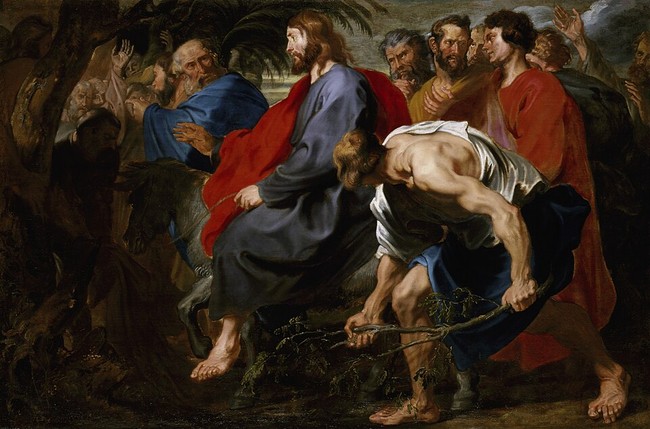
The front page image is “Entry of Christ into Jerusalem,” Anthony van Dyck, 1617. On display at the Indianapolis Museum of Art. Via Wikimedia Commons.
“Sunday Reflection” is a regular feature that looks at the specific readings used in today’s Mass in Catholic parishes around the world. The reflection represents only my own point of view, intended to help prepare myself for the Lord’s day and perhaps spark a meaningful discussion. Previous Sunday Reflections can be found here.
Editor’s Note: Our Sunday Reflections are free to all readers, but our VIP members help keep this platform going for everyone. Join the effort by using the promo code FIGHT to get 60% off new memberships and upgrades to VIP Gold and VIP Platinum!