LONDON — A brazen gangland murder outside Albania’s main airport last month has intensified fears that the NATO ally is sliding deeper into organized-crime rule — with opposition leaders warning the country is on the brink of becoming Europe’s first true narco-state.
Gilmando Dani, a leader in the Shullazi criminal network, was killed in a hail of gunfire in broad daylight as he returned to Albania from Spain on Nov. 11.
In a video of the incident, a hit squad emerges from a parked vehicle to ambush the crime boss’s luxury sedan. The shooters calmly confirm their victim is dead after a burst of automatic weapons fire and then flee the scene.
Such stark scenes are becoming alarmingly common in Albania, critics say. Shullazi’s criminal network is involved in several activities, including the drug trade. Opposition leaders and international counter-narcotic experts warn that it has become a Balkan beachhead for drug cartels from Latin America and an essential center of the European marijuana trade.
“Albanian branches of South American narco-terrorist cartels are currently the main transporters of this drug from South America to Europe, and they control its price in Europe, and continue to strengthen their influence in the USA market as well,” former Prime Minister Sali Berisha told The Washington Times.
Mr. Berisha and other members of the center-right Democratic Party have called for U.S. President Trump to formally designate Albanian drug cartels as narco-terrorist organizations.
Mr. Berisha said the U.S. government under President Biden turned a blind eye to the narcotics trade that flourished during the term of socialist Prime Minister Edvin “Edi” Rama, whose party has ruled since 2013.
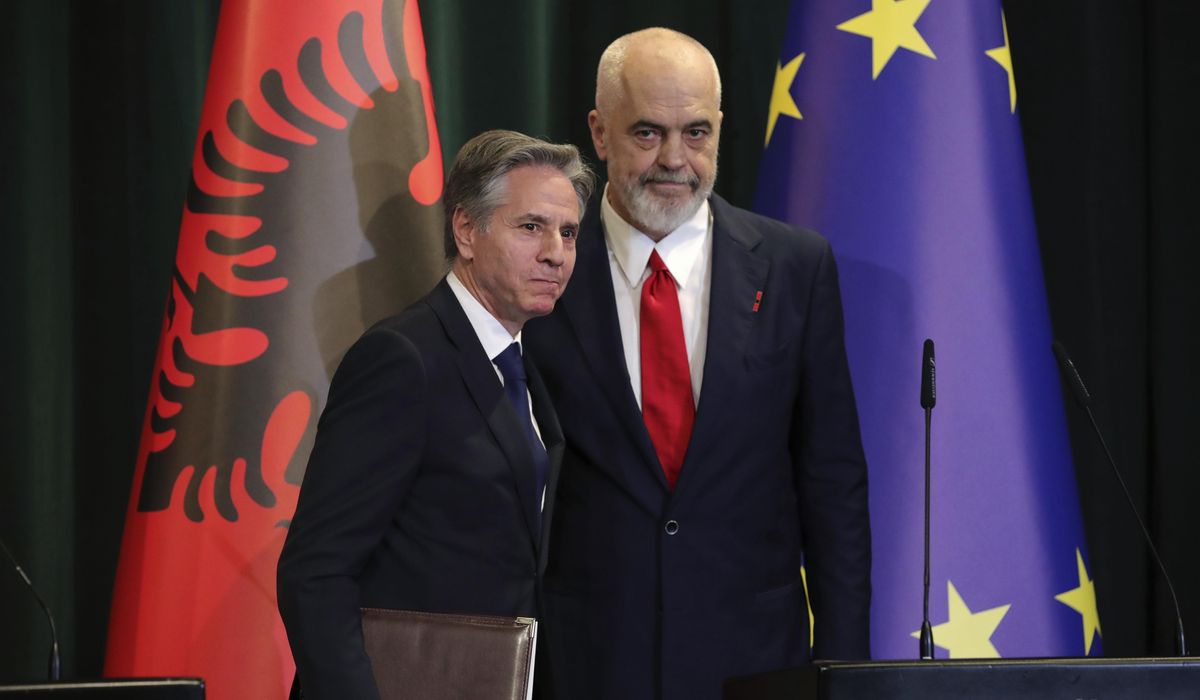
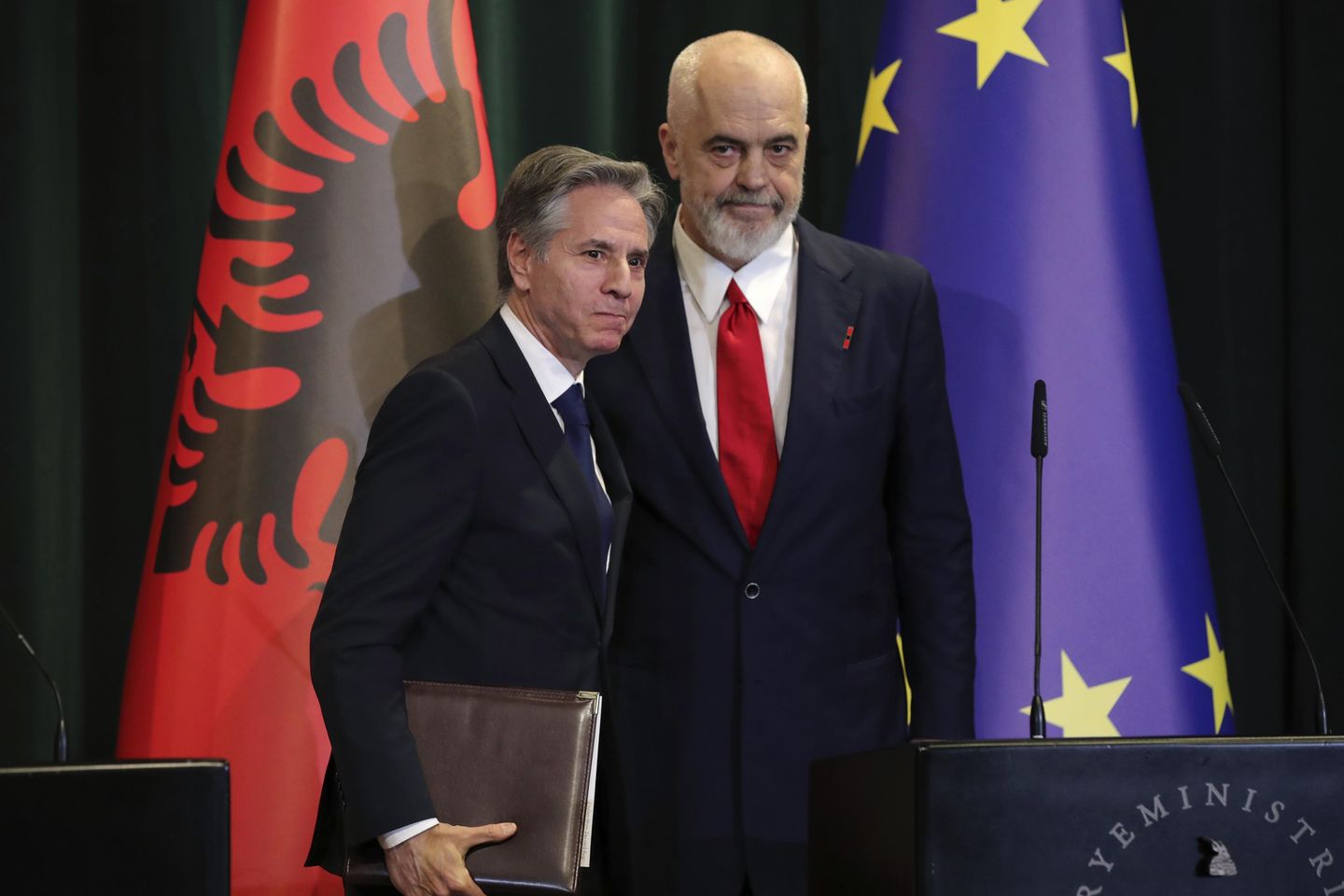
Mr. Biden’s then-Secretary of State Antony Blinken offered “tribute” to Mr. Rama, whom he described in the press conference as “an extraordinary partner for the United States” during a visit to the country on Feb. 15, 2024, for his role in supporting U.S. efforts regarding Afghan refugees and on Ukraine.
The International Democrat Union, a federation of center-right and Christian-democratic parties, passed a resolution this month accusing the ruling Socialist Party of Albania of allowing “criminal infiltration of public contracts, construction, and tourism.”
Mr. Berisha himself was sanctioned by the Biden administration for corruption in 2021 and barred from entering the United States — a designation he disputes as politically motivated.
Both corruption and organized crime have long been a problem in Albania since the anarchic collapse of communism in the 1990s. In the last decade, Albanian criminal networks have expanded their ties with criminal organizations in Italy, like the Ndrangheta (Calabria) and Camorra (Naples), as well as newer groups in Latin America.
These linkages have fueled a new wave of violence across Europe, with echoes of the drug violence in Latin America.
On Sept. 29 in Brussels, thousands of commuters passed by the body of an alleged Albanian drug dealer. The body hung for hours. The first ever murder of its type in Belgium, but it is a common tactic of Mexican drug cartels to ensure their murders serve as warnings to others.
The evidence of Albania’s booming drug trade can be found in an unlikely place — the city’s rising skyline.
Tirana in the early 1990s had only a handful of traffic lights. Today, it is seeing a dramatic construction boom. Last year, construction accounted for 14.4% of Albania’s overall economic output in 2024, according to Eurostat. A figure higher than that of any other country in Europe. The government recently approved 16 new high-rises in Tirana — one of which, if built, will overlook the U.S Embassy.
“According to international anti-crime watchdogs, a significant portion of Tirana’s construction surge — particularly projects exceeding 10 floors — is believed to be backed by criminal syndicates using illicit drug profits to launder money,” wrote the Tirana Times this year.
Elsewhere, a third of the population lives below the poverty line, and more than 1 million Albanians have left the country since the collapse of communism in 1991. Use a traditional “hawala” system of informal banking, which allows the quick transfer of large sums of capital. Albanian drug traffickers have exploited this traditional system.
Mr. Rama has announced a series of new measures aimed at curbing Albania’s increasingly brazen narcotics trade — a battle that has defined much of the country’s recent political tumult.
The prime minister has rolled out anti-drug policing campaigns — including a dramatic 2014 raid in the cannabis-growing hub of Lazarat that attracted international media attention when it became a pitched battle. Yet despite these efforts, the illicit industry has not only survived — it has evolved.
The legalization of marijuana for medicinal use in 2023 has fuelled a new surge in the drug trade. Albanian syndicates have developed discreet cultivation techniques, and their influence reaches well beyond the Balkans. As far away as Scotland, Albanian marijuana farmers have reportedly been smuggled in via small boats to lead illicit lives.
Rama’s government has turned much of the judiciary against political opponents rather than fight crime, opposition leaders claim. They point to the yearlong detention of Tirana’s mayor, Erion Veliaj. His detention without timely charges has sparked EU-wide concern over Albania’s rule of law and judicial independence, raising questions about procedural fairness. Critics see the prosecution and judicial handling as symptomatic of broader institutional weaknesses, where anti-corruption efforts risk being weaponized for political ends rather than strengthening governance
“In 2017, while serving as Minister of the Interior, I was informed of a list of 126 high-ranking State Police officers who … had been denounced to the Serious Crimes Prosecutor’s Office as being involved with drug gangs,” said former Minister of the Interior Dritan Demiraj, who now lives in the United States.
In so-called narco-states, institutional rot blurs the lines between government, security forces, and criminal organizations. The justice system also unravels. Such patterns have been seen before in Colombia or Afghanistan.
“If the elected representatives of a NATO member state are involved in organized crime,” said Mr. Demiraj, “NATO faces real and pressing security challenges. Such a country can become a weak link in the alliance, one that Russia, China, or Iran could exploit to destabilize it from within.”