If you’re above a certain age, you probably remember scenes like this from the fall of 1973:
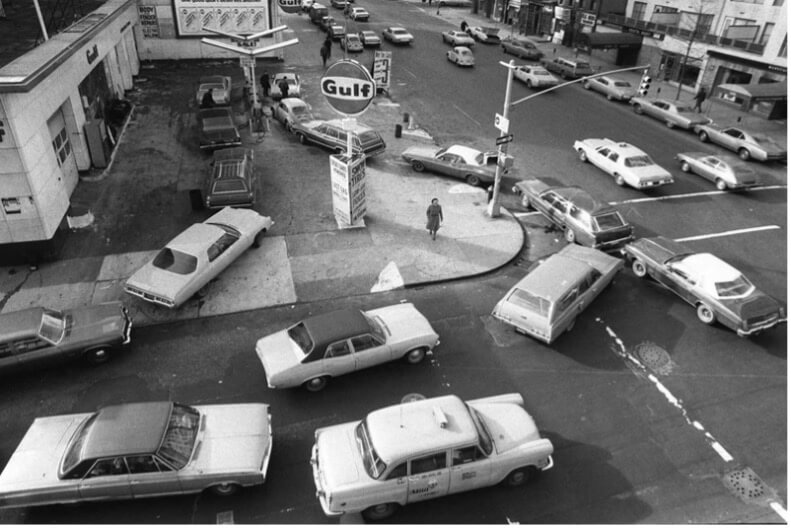
Gas lines at filling station, 1973. Courtesy Time-Life Images.
I sure as heck recall the era. In fact, this is what Massachusetts Avenue looked like, right outside the window of one of the student dining halls at Harvard. It’s burned into my brain.
Obviously, those are cars. And behind the wheel of those cars were annoyed, often angry motorists waiting in line to buy gasoline. That is, to buy gasoline IF it was available, and on occasion with low limits like 5 gallons maximum.
Back then, in some states you could only buy fuel depending on your license plate number. If it ended in an odd number you could buy on an odd-numbered day; if your plate ended in an even number, you could buy on an even-numbered day. And if you really needed fuel right then? Too bad. Figure something else out.
Frustrating? Oh yeah… And it was a national phenomenon, from Tacoma to Oklahoma, Laguna to Altoona, Austin to Boston.
Back in 1973-74, as the issue of fuel price and availability unfolded, it changed the psychology of the country in ways that still echo today. Definitely, this is the case when it comes to crude oil – which very few people actually buy or use – and refined products like gasoline, diesel and jet fuel, on which everybody relies.
So, with this in mind let’s discuss one particular angle, namely the U.S. Strategic Petroleum Reserve (SPR). What is it? Where is it? And considering current events with oil and fuel prices, what happens now? And will President Trump tap into it?
Price Gyrations, Up & Down
Let’s begin with recent moves in oil prices. Two weeks ago, oil traded in the low-$60s per barrel, where it had languished for many previous months. Many oil producers complained that they weren’t making enough profit to keep investing in new wells, while Trump bragged that the price of gasoline was down from the bad old days of Sleepy Joe Biden.
Then last week, things changed with the war on Iran. Indeed, at one point oil traded near $120 per barrel, not quite a double from before. Although the price dropped hard yesterday (Monday) based on comments by President Trump that implied the war might end sooner versus later.
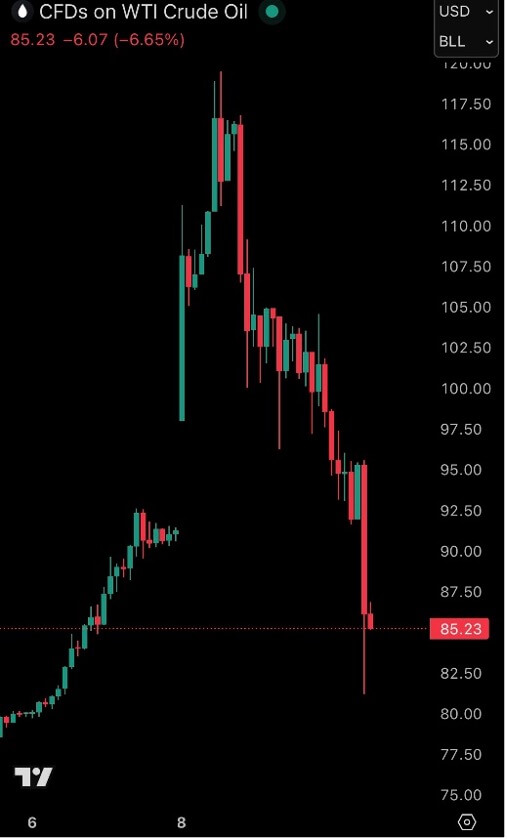
West Texas Intermediate (WTI) oil price chart for Monday, March 9, 2026.
This morning (Tuesday), oil trades in the range of $89 per barrel, up strongly from two weeks ago but down from its recent high. And looking ahead? Who knows? Wars are dynamic, and maybe the Iran conflict will end relatively soon… or not. We’ll have to wait and see.
Meanwhile, across the U.S. and throughout the world, fuel prices are headed up big-time. For background on this, last Friday I discussed fast-rising pump prices for readers of Strategic Intelligence, here.
Now, eleven days into the war, we have calls – from Senator Schumer (D-NY) no less, and many other Democrat politicians – for President Trump to tap into the SPR to moderate price increases.
So, will Trump take Sen. Schmer’s advice and open the valves to the SPR? Okay, stop laughing because yes, even during wartime America has its own, sordid version of bizarre, political comedy theater.
But on a more serious level, I’ll give away the punchline and say that No, we are not anywhere near the energy and economic stress point where Trump should begin pumping oil from the SPR. Although, again, sometimes reality doesn’t matter when politicians want to drive the country off a cliff (so to speak).
The point is that the SPR idea is out there as a political football, and a topic of discussion. And it behooves us to get a handle on the facts, if not investment angles of the issue.
First let’s review some fundamentals about SPR. Then we’ll consider implications of pumping SPR oil during the current energy situation, versus keeping the oil in place as events unfold.
The Basics: SPR 101
As the name implies, SPR is a “reserve” of petroleum stored by the U.S. government for “strategic” purposes. The idea originated in the 1970s, in the wake of the Arab oil embargo against the U.S. after the October 1973 Yom Kippur War between Israel and an alliance of Arab nations.
During the war, the U.S. openly sided with Israel which angered the Arabs. And this led a group of Arab nations to embargo exports of their oil to the U.S…. Which led to massive oil shortages, right? Refineries ran dry, yes? Not enough fuel, right? (See that photo at the top.)
Well, no… Not at all. That’s NOT the reality. Because despite the Arab embargo, there absolutely was no less oil in the world. Everybody’s wells still pumped oil, but the problem was that cargo movements were interrupted and global markets had to readjust.
In particular, Middle East Arab producers still pumped petroleum and loaded tankers. But their anti-U.S. embargo created a logistical issue that limited where those tankers and cargoes could go, meaning not to the U.S.
So, what happened? Easy; the U.S. imported oil from non-Arab nations (eg., Nigeria, Angola, Indonesia, etc.) and in general things could have worked out alright. Except… American media and politicians went kind of nuts. The storyline was “Shortages!”, and people reacted by panic-buying. An analogy would be, say, toilet paper in 2021 during the pandemic days.
Again, this makes for a long story, but not today. The takeaway point is that media and politics combined to create a national panic; sort of a “run” on gas stations that drained them dry.
Then out of the gas lines and collective political anger and will of a nation of drivers waiting to buy fuel, Congress authorized construction of oil storage facilities – aka our Strategic Petroleum Reserve – in case the country ever again faced a true cutoff of imports.
More realistically, back then the true threat to the U.S. in those Cold War days came from the Soviet Union. And in fact, many sober people with some historical knowledge analogized the need for an SPR to how, during World War II, German submarines sank many tanker ships carrying oil between U.S. ports.
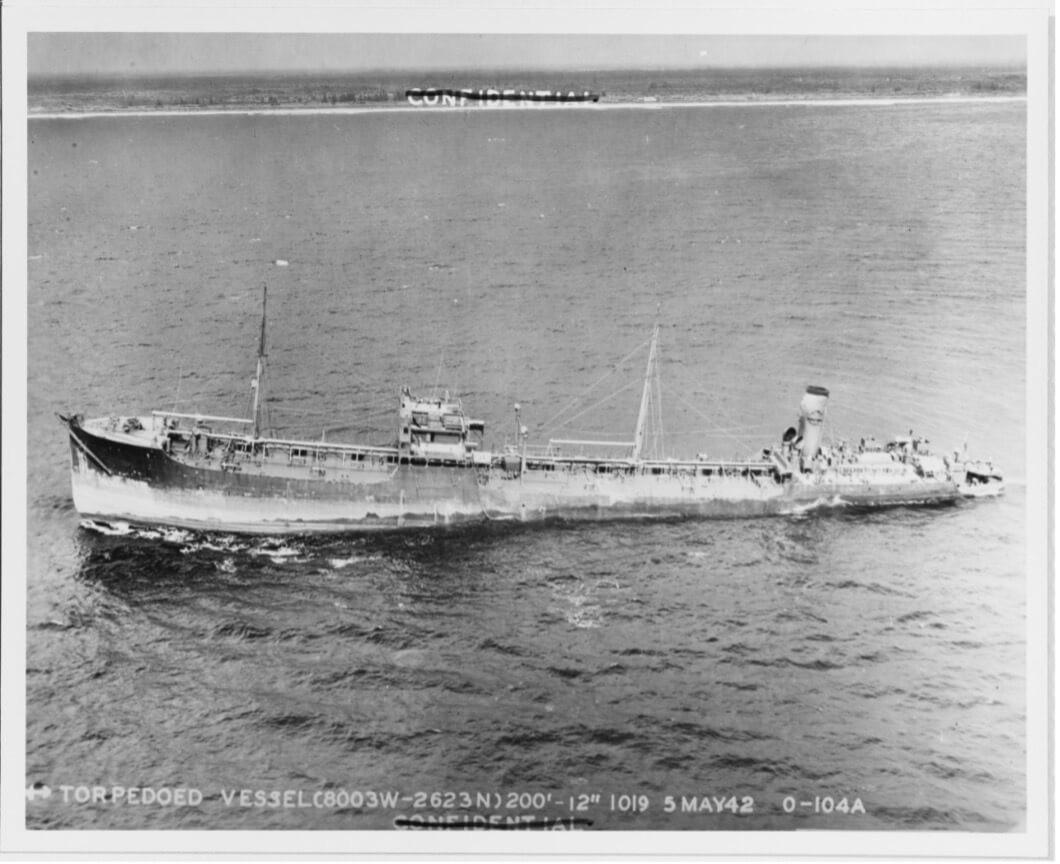
American tanker torpedoed and sunk, May 1942. Courtesy U.S. Navy/National Archives.
At any rate, out of those energy-short days, America determined to build an SPR, and that’s when and why it came into being. Now, let’s consider where, and how.
Caverns (Not) Full of Oil
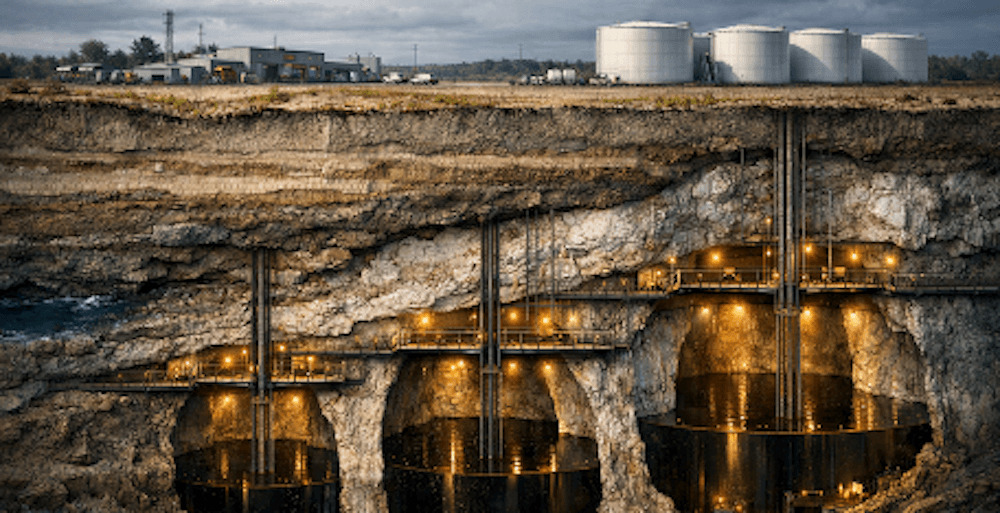
If you were wondering – and over many years I’ve met people who don’t know this – SPR is not a series of huge, above ground storage tanks like you might see as you drive along I-95 in Philadelphia, or along Refinery Row outside of Houston.
Instead, America’s SPR complex is underground. It’s comprised of four sites operated by the U.S. Department of Energy (DOE), located along the Gulf Coast of Texas and Louisiana. Each site is built in a geological feature called a salt dome, which is what it sounds like: a massive underground body of salt laid down via evaporation of ancient seas and now buried in the earth’s crust. (Much as it pains me, I’ll skip the fascinating geology and chemistry.)
Construction of these caverns was authorized in 1974, just after the Arab-Israel war and the American gas-lines. This required excavation of quite a bit of salt; yes, people mined it out like people mine coal. Or they used water to dissolve salt and pump out brine into the ocean.
In essence, and in terms of engineering, the caverns are huge voids in the salt now filled up with oil which does not dissolve the salt like water does.
Or imagine a big glass jar filled with oil. The glass represents the salt, in that it doesn’t dissolve due to contact with oil. But it gets complicated because to move the oil upwards, the trick is to pump saltwater down to the bottom of the oil column. And then, because oil floats on water due to density differences, when it comes time to withdraw oil the pumps just lift the petroleum off the top. (Hold that thought; it’s important.)
In 1977, and after immense efforts, SPR was ready to go with a potential volume of 727 million barrels, per DOE records. Over time, SPR was filled up with different varieties of crude oil (“sweet” and “sour” for our purposes), suitable for various refineries in the Gulf Coast region. Here are these almost-current details, courtesy of DOE.
Crude Oil Inventory by Site (as of February 18, 2026)
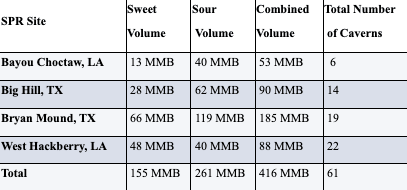
As you can see, the recent total volume in storage is 416 million barrels, but as noted, the capacity is 727 million barrels.
So, why do we have that lowball number? Because between 2022 -24, former President Biden and his administration sold oil from SPR to manipulate markets, keep oil prices down, and by extension keep the price of motor fuel low. Yes, it was total politics at work.
Here’s a chart that shows SPR volumes over its history, dating back to 1982:
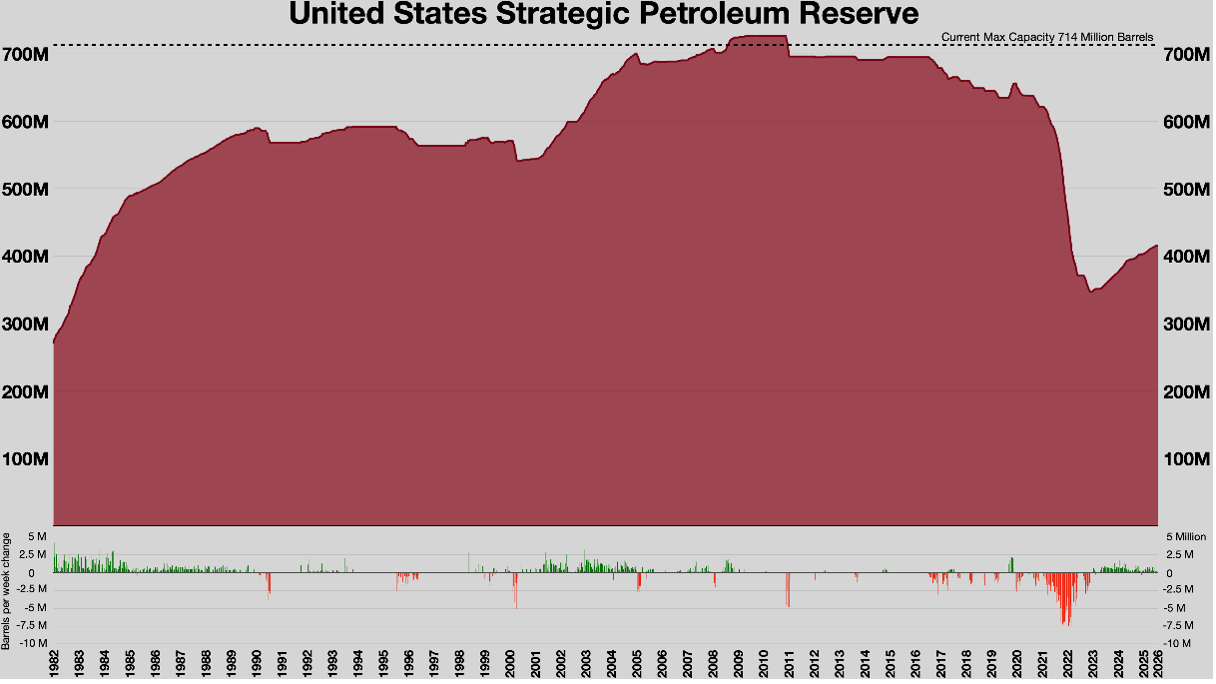
SPR barrels in storage, 1982 – 2026. Based on DOE data.
The chart shows a buildup of storage throughout the 1980s, and then another buildup in the early 2000s. By early 2022, SPR contained about 650 million barrels, and then the Biden group began to pump out about a million barrels per day to manipulate markets towards lower prices.
Over the next two years (2022-24), SPR storage dropped to about 350 million barrels, which means that Biden sold off about 300 million barrels of SPR oil.
And when President Trump took office in January 2025, he began to refill SPR but encountered a couple of problems.
First, Congress didn’t appropriate significant funds to buy oil to put into storage. And so, Trump’s administration bought some oil but not enough to refill the drained SPR. Having no money can be a very big problem when you want to buy oil.
Meanwhile, remember how oil in the SPR gets moved around? That is, by pumping saltwater down to the bottom of the oil-water column and “lifting” the oil that floats on top?
Well, when SPR managers pumped all that water and lifted those 300 million barrels up and out of the caverns over two years, that process damaged the salt walls in some areas. The walls thinned out and weakened, which required significant, expensive and technically challenging repairs (and I could say lots more, but it gets deep into the engineering weeds).
So, the bottom line with SPR is that the U.S. has oil in storage, but not nearly the amount it had just four years ago. Plus, the storage caverns are damaged, so it’s been difficult to pump in new oil. And Congress hasn’t appropriated enough funds either to buy much new oil, let alone to fix the overall storage issue.
If you’re shaking your head, thinking, “What the hell?” Umm… yes. You get it.
Can Trump Tap SPR?
Now, we return to the question at the top of this article: should Trump tap into SPR to deal with rising oil prices? Let’s consider:
First, oil prices have risen sharply in the past week and a half, but as of yesterday and today they seem to be moderating. So, is the worst over? Well, that depends on whether or not tankers can pass through the Strait of Hormuz during the Iran war.
If tankers begin again to pass unimpeded through the Strait of Hormuz – and several HAVE made the run in just the past two days! – that will not just put a lid on rising prices but could also begin the process of lowering global oil prices.
Second, there’s no true shortage of oil in the U.S. People might not like the price increase at the pump, but at least there’s ample oil flowing from American wells, running through pipelines to refineries, and cooking their way through the cracking towers. We have fuel, but now it costs more.
Another way to say it is that the U.S. produces significant amounts of its own oil, and imports additional product from Alberta, Canada. If the U.S. requires other blends of oil to keep the refineries working, America has traditional suppliers like Nigeria and Angola, plus new sources from Venezuela, along with output from vast new oilfields offshore Guyana, in South America.
In other words, no, there’s no actual shortage of oil for the U.S., and it’s not like anybody is sinking tanker ships off the Eastern Seaboard.
So, again, will Trump tap SPR? There’s no physical reason to do so because there’s still oil out there for U.S. refineries. Sure, there’s the political angle of manipulating markets and prices, and on that point anything is possible.
But the good news is that SPR is there, just drained down under Biden; but still available if the country encounters a true emergency. And I suspect that Trump and his advisers know that.
Meanwhile, domestic oil companies will prosper in this pricing regime, and big internationals like ExxonMobil (XOM) and Chevron (CVX) ought to do well. Plus, service plays like Schlumberger/SLB (SLB) and Halliburton (HAL), although I must note these are not formal recommendations here.
That’s all for now. Thank you for subscribing and reading.