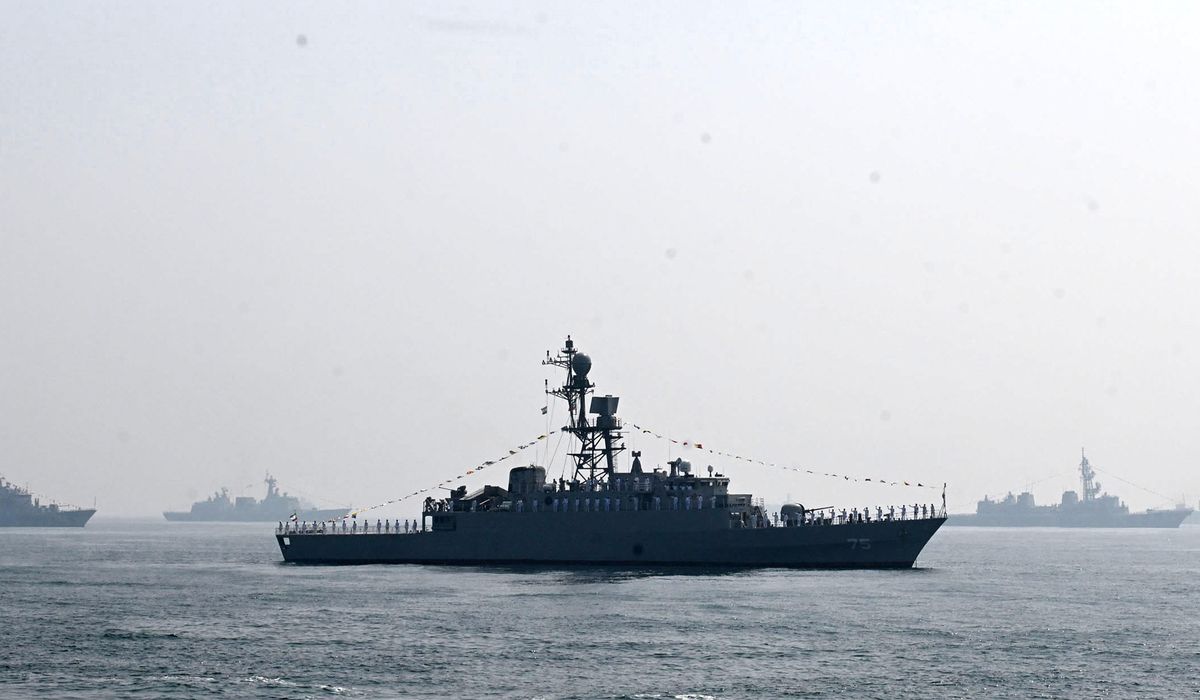
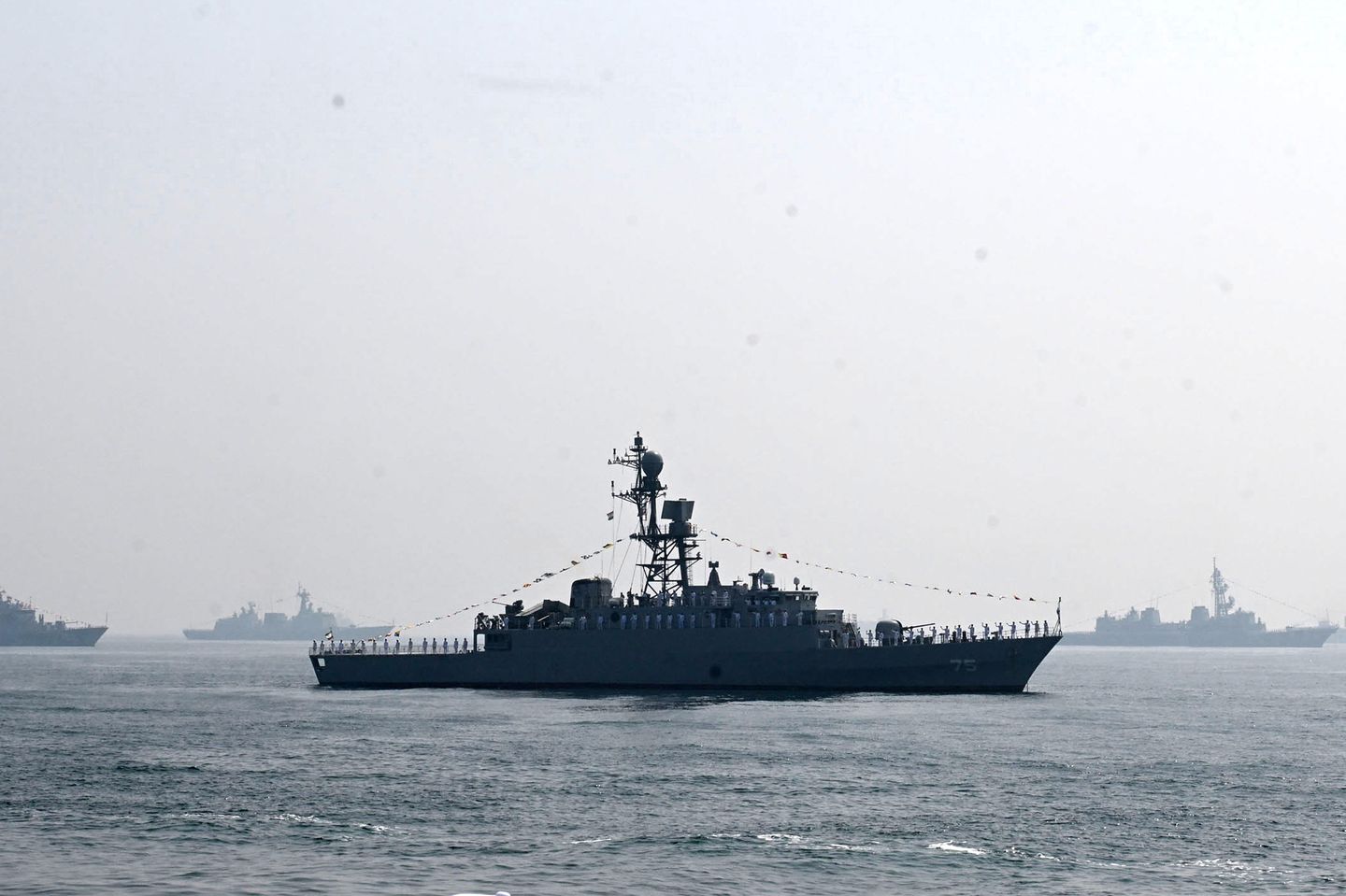
NEW DELHI — Two Iranian warships sailed into India’s International Fleet Review last month. One is docked in Kochi, its 183 crew members housed at Indian naval facilities. The other is on the bottom of the Indian Ocean, 40 miles off Sri Lanka, sunk by a U.S. Navy torpedo on Wednesday. Eighty-seven sailors are dead. Dozens are still missing.
India’s external affairs minister called taking in the Kochi crew “a humane thing to do.” India’s Navy deployed ships and aircraft to help search for the dead. The government has said nothing about the war that killed them.
The conflict that Washington described as a targeted campaign against Iran’s leadership has reached the Indian Ocean, the waterway India has spent three decades building a navy to command. The question now, as American and Iranian officials courted Indian counterparts in New Delhi on the same day this week, is whether New Delhi can maintain the posture it has held for 30 years — or whether the war has made that position untenable.
The exposure is structural. The Heritage Foundation Index of U.S. Military Strength released this week puts daily oil flow through the Strait of Hormuz at 20.3 million barrels, a fifth of the global oil supply. India imports 88% of its crude. Roughly half of it moves through Hormuz.
On Wednesday, tanker traffic through the strait had collapsed to five vessel crossings. Three were Indian-flagged. By Saturday, Brent crude had surged to $90 a barrel, a 24% rise since the war began.
Helima Croft, global head of commodity strategy at RBC Capital Markets, called it the biggest energy crisis since the oil embargo of the 1970s.
Iraq cut production by 1.5 million barrels per day, oil with nowhere to go. Qatar halted operations at its largest liquefied natural gas export facility. Saudi Arabia shut its largest oil export terminal.
Three Indian nationals have died in the strait. Indian shipping groups have formally requested naval escorts from the government. Indian refiners are drawing on Russian crude floating in vessels near Indian waters, an estimated nine to 30 million barrels that amount to an unplanned wartime buffer.
The crisis is suppressed but not neutralized — and with Iran’s command structure degraded by continued American and Israeli strikes, it is not entirely controlled either.
Brent Sadler, senior research fellow for naval warfare at the Heritage Foundation and co-author of the index, flew from Washington to New Delhi on Wednesday, the day it was published. In a Thursday interview with The Washington Times, he described the situation in Hormuz plainly.
“There’s always a risk going through that strait,” he said. “There are the small boats, there are mines, there are drones that they could launch. That threat is being suppressed. I wouldn’t say it’s gone.”
Mr. Sadler said the United States Navy has two of its 11 aircraft carriers in position to hit Iran from separate angles, one in the Arabian Sea and one in the Eastern Mediterranean. It’s an expenditure of manpower and resources putting enormous strain on U.S. commitments elsewhere around the world.
“We have to solve this Iran problem quickly and for a long time,” he said.
What American officials said in New Delhi this week made the strategic ask plain.
U.S. Deputy Secretary of State Christopher Landau, speaking at the Raisina Dialogue security conference, said the American-Indian relationship would “decide the future of this century.” The Trump administration has offered naval escorts for Indian tankers and insurance coverage through the Development Finance Corporation. France has announced the formation of an international naval coalition to escort commercial vessels through Hormuz. India is not in it.
Bonnie Glick, a senior fellow at the Foundation for Defense of Democracies and former deputy administrator of the U.S. Agency for International Development, told The Times in New Delhi that the U.S.-India partnership has limits.
“Probably not yet at the point where our safety and security is going to be dependent on Indian forces,” she said. “It would be amazing if we reached a point where we could rely on that.”
On the same day Mr. Landau spoke, Iranian Deputy Foreign Minister Saeed Khatibzadeh met India’s External Affairs Minister S. Jaishankar on the sidelines of the conference. Mr. Khatibzadeh told reporters that India and Iran share “a chess mentality,” unlike, he said, the American football mentality. Both Washington and Tehran were courting New Delhi on the same day.
On stage, Mr. Jaishankar was precise. He said India had allowed the Kochi crew to dock on humanitarian grounds. Their ship had been heading home from the same Indian-hosted naval exercises when the war started. “When this ship wanted to come in and got into difficulties, I think it was a humane thing to do,” he said. “We were guided by that principle.”
On the larger question — what it means for India’s standing as a security provider that a U.S. submarine fought in waters India has long described as its own — Mr. Jaishankar was a diplomat.
Diego Garcia has been in the Indian Ocean for 50 years, he noted. The U.S. Fifth Fleet is based in Bahrain. “You have to take into account what the actual ground and water situation is,” he said.
The sinking of the Iranian frigate Dena has opened a domestic fault line that Mr. Jaishankar’s careful language reflects.
Former Foreign Secretary Kanwal Sibal has publicly criticized the government’s silence on an attack that killed sailors who had been India’s guests days earlier.
Indian officials have specifically denied sharing tracking data on the Dena with the United States.
The torpedo that sank it was the first by an American submarine since the Pacific theater of World War II.
Harsh V. Pant, vice president of the Observer Research Foundation in New Delhi, said the sinking has complicated the domestic politics of the U.S.-India partnership. “Incidents like this bring to the fore cold warriors in India, those who have been saying you can’t trust America,” he said. “They become emboldened.”
India’s navy is substantial on paper. The Heritage Index puts the country’s defense budget at $75 billion, fourth largest in the world. India commissioned its first indigenously built aircraft carrier in 2022 and operates a nuclear-powered ballistic missile submarine. During the Houthi attacks on Red Sea shipping two years ago, India deployed its navy to the northern Arabian Sea, running a parallel mission that coordinated with but did not operate under the U.S.-led Operation Prosperity Guardian.
“They realize that no one else is going to defend their sea routes,” Mr. Sadler said. “They are aspiring — and I think rightfully so — to be a strong maritime power.”
Adm. Dinesh Tripathi, India’s chief of Naval Staff, said in New Delhi on Thursday that the assumption of short, decisive wars “may have questions over it.” The Iran war was one week old when he said it.
Two weeks before the war started, Prime Minister Narendra Modi visited Washington and announced a new series of American-Indian defense initiatives covering autonomous systems, artificial intelligence-driven maritime technology and undersea warfare cooperation. The war started before the framework was in place.
Sreeram Chaulia, dean of the Jindal School of International Affairs and a senior fellow at the Observer Research Foundation, said the Islamic revolution is “effectively a spent force because it devoured its own children at home and overplayed its hand abroad.” The regime India spent three decades carefully managing around is gone.
“The rise of India will be determined by India,” Mr. Jaishankar said in New Delhi this week. “It will be determined by our strength, not by the mistakes of others.”