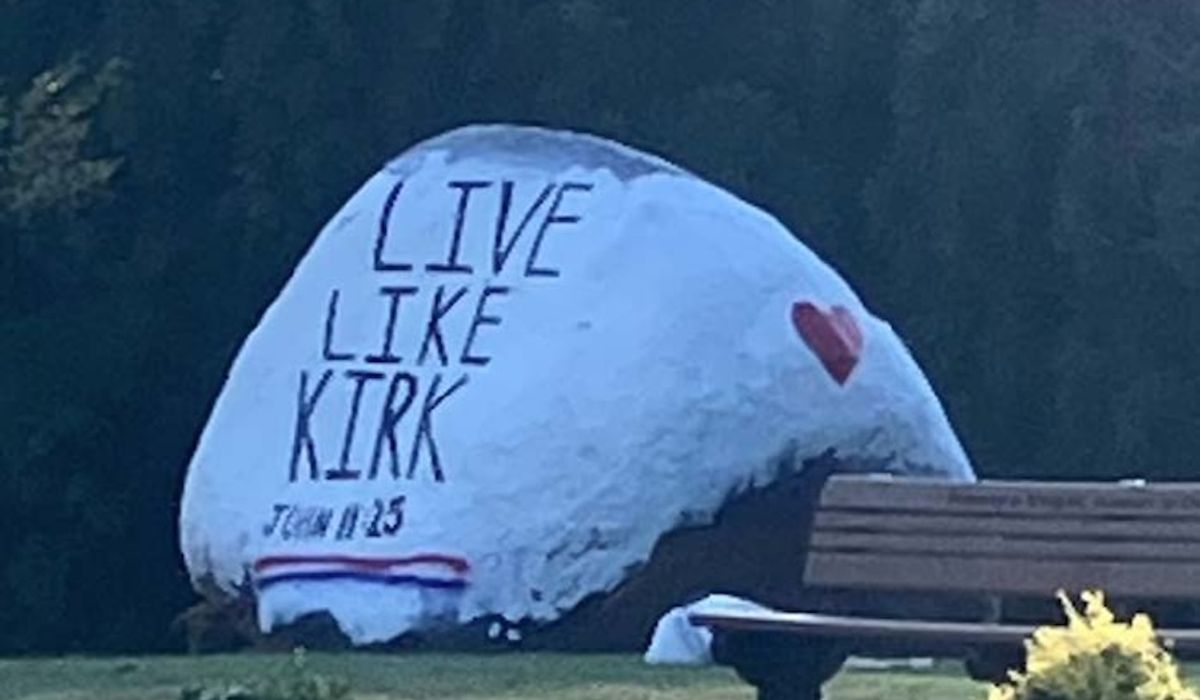
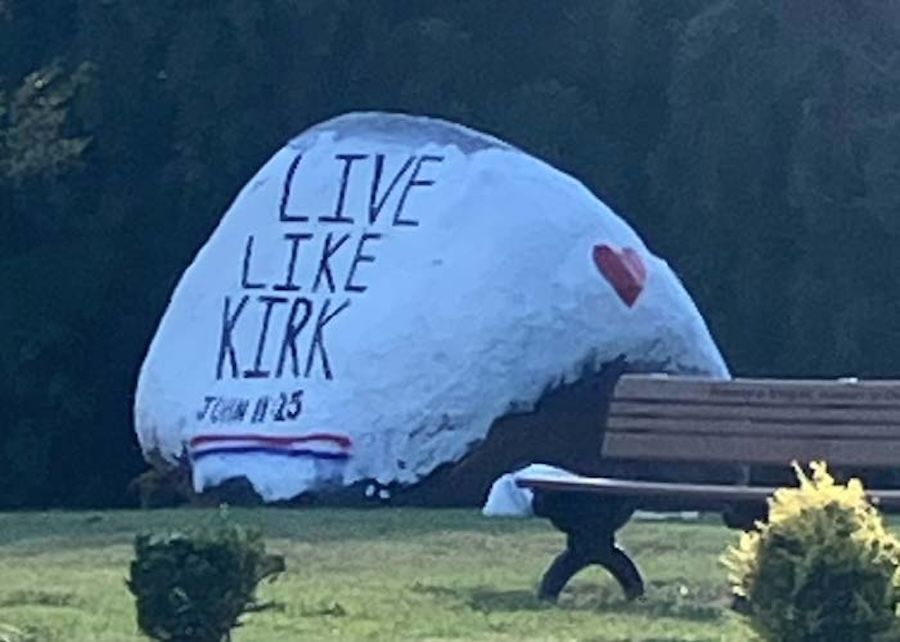
Charlie Kirk was known as a stalwart defender of free speech, a detail that was apparently lost on North Carolina school officials who muzzled a student’s tribute to the slain conservative activist.
The Charlotte-Mecklenburg Board of Education was sued in federal court by a student whose homage to Kirk on a campus forum called the “spirit rock” was painted over and investigated as vandalism, even though she said she received prior approval from a school employee.
The student, identified in the lawsuit as G.S., and her friends had painted a heart, an American flag, “Freedom 1776,” and “Live Like Kirk — John 11:25” on the large rock near the entrance of Ardrey Kell High School.
Travis Barham, Alliance Defending Freedom senior counsel, highlighted the irony of the district’s actions.
“Charlie Kirk boldly defended open and respectful discourse on school grounds literally until his last breath, and this courage inspired many across the country, including the student who painted the message on Ardrey Kell High School’s spirit rock,” Mr. Barham said in a statement. “This situation goes beyond irony, however, as school officials illegally censored and threatened students for sharing a widely held message with which they happened to disagree.”
The lawsuit filed Dec. 8 in North Carolina federal court comes with allegations of free-speech violations flying in the wake of the Sept. 10 assassination, although most of the outrage has come from Kirk detractors, not supporters.
A Nov. 19 investigation by Reuters found more than 600 cases of workers who were fired, suspended, disciplined or otherwise punished for their anti-Kirk posts, touching off a national debate over whether speech that glorifies or celebrates violence is constitutionally protected.
Those working in the private sector can typically be dismissed for offensive or inflammatory posts, but public employees enjoy greater latitude under the Supreme Court’s “Pickering test,” which established a three-prong standard for determining when their speech crosses the line.
The issue is now playing out in the courts. More than a dozen lawsuits have been filed by employees over Kirk-related reprisals, the latest by a former Tennessee public employee.
Monica Meeks sued a state agency Tuesday after being fired for “bringing the State into disrepute” by calling Kirk a “White Supremacist” in a Facebook reaction to a friend’s post.
“You may disagree with Monica’s take on Charlie Kirk. But letting a few angry individuals get a public employee fired for off-the-clock speech, even when it has no impact on the workplace, will inevitably boomerang back on people with views you do support,” said Cary Davis, attorney with the Foundation for Individual Rights and Expression, which represents Ms. Meeks.
The foundation has also taken action on behalf of Kirk supporters, such as an Oklahoma State University student who was reprimanded for wearing a hat to a student-government meeting with the Turning Point USA logo. Kirk co-founded the conservative student group in 2012.
Kirk foes have accused the right of hypocrisy for targeting speech after years of decrying left-wing cancel culture, while his supporters counter that those who celebrate violence deserve to face consequences, as opposed to those who espouse widely held conservative views.
‘Black Lives Matter’ praised, ‘Long Live Kirk’ censored
As the rock-painting saga played out, the Charlotte-Mecklenburg district was grappling with another Kirk flare-up: Melissa Easley, a school board member, faced calls to resign for a Facebook post condemning violence while condemning Kirk.
“Political violence is not okay no matter what side you are on,” said Ms. Easley in her post, then added: “But do not expect me to feel sorry, pitty [sic] or mournful for the man that has gone around saying I or my spouse are abominations, that we are mentally ill, that we don’t deserve the same rights as everyone else.”
The lawsuit argued that her reaction “set the tone for other District officials.”
“Within hours after G.S. and her friends finished painting the Ardrey Kell High School spirit rock, Defendant’s officials ordered her tribute to Charlie Kirk censored and painted over it,” the complaint said.
The next day, Principal Susan Nichols posted a message on the parents’ portal saying the tribute “was not authorized,” even though the teen had called the school beforehand in the presence of her parents and received the go-ahead from an office employee, the lawsuit said.
Ms. Nichols’ message continued: “Acts like these are considered vandalism to school property,” and “Law enforcement has been contacted and we are cooperating with the investigation.”
According to the lawsuit, however, “there was no policy that prohibited students from painting the Ardrey Kell High School spirit rock as G.S. and her friends had done.”
Indeed, the rock had been painted with numerous messages in the past, including a “Black Lives Matter” slogan with a raised fist in 2020.
“In fact, when other students painted over the Black Lives Matter message, Defendant’s officials held an emergency meeting to coordinate parents and staff to undo the painting over of the Black Lives Matter message,” the complaint said.
It was a different story with G.S., who was ordered to report to the principal’s office and write down a statement about the Kirk tribute. A school official ordered her to open her phone and access her call log, which showed she had placed a call to the school on Sept. 12, the day before painting the rock.
Two days later, the principal told the student’s father that “she had closed her criminal investigation into G.S.’s efforts to paint the spirit rock” and would take no disciplinary action against the teen, but never made a statement exonerating her, despite pleas from her parents.
The district also released a “Revised Spirit Rock Speech Code” saying that messages must “uphold the inclusive values of our school community,” and “MAY NOT … contain religious, and/or political statements/symbols.”
A district spokesperson contacted by The Washington Times said the district does not comment on active litigation.
The complaint asked the court to prevent the district from suppressing student speech on the spirit rock, as well as order the district to remove any negative comments from the student’s record and issue the teen a letter of apology.
“We are urging the court to hold the officials responsible for violating students’ constitutional rights to free speech, free exercise of religion, and due process,” Mr. Barham said.