House Republicans have taken a firm stance in Washington by promising to block Senate-passed legislation until the Senate takes up the SAVE America Act.
The legislation, formally called the Safeguard American Voter Eligibility Act, requires proof of U.S. citizenship for voter registration in federal elections and mandates photo ID at polling places.
Lawmakers pushing the measure say the bill protects election integrity by ensuring that only U.S. citizens may vote in federal elections. President Donald Trump has endorsed the effort and signaled he’ll prioritize the legislation once it reaches his desk.
Republican lawmakers leading the effort have framed the strategy as a necessary step to force Senate action. Reps. Brandon Gill (R-Texas) and Anna Paulina (R-Fla.) announced that they’ll oppose nearly every Senate-originated bill until the Senate advances the SAVE Act.
“I’ll be voting ‘no’ on all Senate bills – other than DHS funding – until the Senate passes the SAVE America Act,” Rep. Brandon Gill (R-Texas) wrote Friday on the social platform X.
Rep. Anna Paulina Luna (R-Fla.) also wrote on X that, “The Senate will no longer have legislation passed until the SAVE America Act is passed and on the President’s desk.”
Rep. Derrick Van Orden (R-Wis.) echoed those concerns, arguing that lawmakers should prioritize legislation with strong public support.
Several other Republicans have joined the push, publicly urging Senate leadership to move the bill forward and arguing that voter eligibility verification is a basic requirement for election administration.
Lawmakers argue that requiring proof of citizenship already exists in many areas of civic life, including passport applications and federal employment verification.
Supporters of the legislation also point to polling showing strong national backing for voter identification requirements. Surveys measuring public attitudes toward election safeguards consistently show support exceeding 80%, while advocates argue that requiring documentation strengthens confidence in election results and reduces disputes over voter eligibility. The SAVE Act proposes using existing federal databases and state election systems to verify citizenship status when people register to vote.
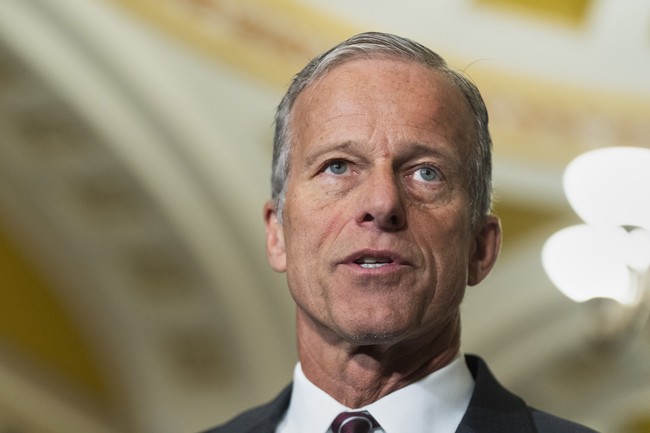
Senate Majority Leader John Thune (R-S.D.) is at the center of the debate, indicating that the Senate plans to consider the legislation through the standard legislative process rather than procedural shortcuts.
Thune has been facing pressure from President Trump and House Republicans to sidestep Democratic opposition by using a “talking filibuster,” which would force Democrats to speak continuously on the Senate floor to delay the bill. Once they cede the floor, Republicans could pass the measure with 51 votes.
But Thune has previously said a talking filibuster is “much more complicated and risky than people are assuming at the moment,” and has opted to advance the bill through regular order.
That approach might be unnecessarily cautious, especially during a period when national attention remains focused on foreign conflicts, economic recovery following the previous administration, and ongoing disputes surrounding illegal immigration.
Democrats keep arguing that the requirement for proof of citizenship creates hurdles for eligible voters who don’t have documents on hand, such as passports or birth certificates. However, the legislation includes alternative verification procedures and state assistance programs to help people receive the necessary documentation.
The broader debate reflects a continuing argument in Washington over how best to balance voter access with election security.
House Speaker Mike Johnson (R-La.) faces growing pressure from members urging him to maintain the standoff until the Senate acts. Republican lawmakers describe the strategy as a way to force action on legislation they believe has broad public backing, an approach that places additional attention on Senate leadership and raises the stakes for how quickly the chamber moves forward.
President Trump has continued encouraging the push from House Republicans, repeatedly emphasizing the importance of verifying voter eligibility in federal elections, and has urged lawmakers to advance legislation strengthening those requirements.
The SAVE Act now stands as a central issue in the broader debate over election law and federal oversight of voter registration.
Whether the Senate ultimately moves the bill quickly or allows a longer debate, the current standoff signals a rare moment of tight alignment among House Republicans. That alignment places pressure squarely on Senate leadership, ensuring the question of voter eligibility verification remains a major issue in the coming months.
PJ Media VIP members support independent journalism and gain access to deeper analysis, exclusive commentary, and a community focused on serious political discussion. Use promo code FIGHT for a 60% discount on a PJ Media VIP membership. Join today!