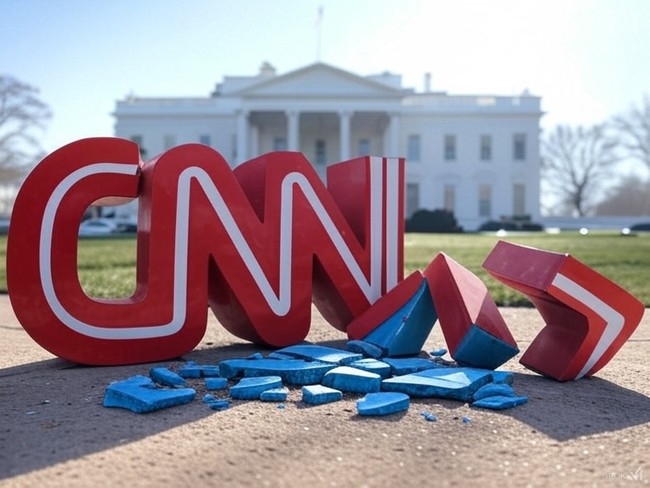
It’s not often that someone gets the chance to air grievances directly to an organization, and even less often when it’s live on television.
Yet the dozens of people watching CNN this weekend watched it happen.
As Newsbusters reported, former Israeli Ambassador to the United States Michael Oren confronted CNN’s biased reporting head-on during a live broadcast. CNN Chief Global Affairs Correspondent Matthew Chance reported from Beirut on Israeli actions in Lebanon, detailing civilian effects and damage without mentioning Hezbollah’s rocket attacks on Israel.
Oren called out the oversight, noting Hezbollah fired over 220 rockets at northern Israel in the previous five days, forcing thousands from their homes and killing or wounding many Israelis. Oren insisted that reporters had failed in their duty by ignoring these facts, catching CNN anchor Jessica Dean off guard and forcing her to pivot, defending Chance’s focus on Lebanon, though she conceded Oren’s point on Israel’s attacks.
Oren didn’t let up, highlighting the fact that a million Israelis are living under constant threat, with families dashing to shelters ten times daily from massive rockets that destroy homes. He stated that Israel must defend its people, even if ground invasions are needed.
Western media outlets screw Israel by downplaying threats for decades while slamming its responses. Hezbollah holds 150,000 rockets and missiles, many precision-guided to hit Israeli cities. Militants have launched tens of thousands of rockets at Israel since the early 2000s.
According to the latest public estimates, Hezbollah has around 150,000 rockets and missiles, most with a range of a few dozen kilometers. Various reports, however, say a substantial number can reach targets located hundreds of kilometers from Lebanon.
Hezbollah is the most heavily armed non-state actor in the world, concluded researchers from the Center for Strategic and International Studies in Washington in an extensive 2018 report on the lethal arsenal stationed just north of Israel. The group holds a large and diverse reserve of “dumb” rocket artillery alongside ballistic, anti-air, anti-tank, and anti-ship missiles, the report found.
In a conversation with Haaretz this week, Shaan Shaikh, one of the study’s authors, warned that Hezbollah’s intervention in Syria “raises concerns about its acquisition of more sophisticated standoff and precision-guided missiles, whether from Syria, Iran, or Russia.” Standoff missiles are long-range systems that can be fired from far enough away that the launchers remain protected.
In 2021, over 4,300 rockets targeted Israel in 11 days, killing 13 people, wounding hundreds, and displacing hundreds of thousands. These barrages force Israelis into shelters and disrupt lives, yet stories have always fixated on the other side’s hardships.
When the pattern repeats over decades, any belief in balanced coverage becomes nothing more than a whisper in the wind.
The United Nations hammers Israel relentlessly when it fights back. Since 2006, the UN Human Rights Council has adopted over 100 resolutions against Israel, far more than any nation. Israel stands as the only country with a permanent agenda item for scrutiny at every session.
Resolutions blast Israel’s actions while glossing over initial attacks.
In October 2023, UN Secretary-General António Guterres said that violence against Israelis doesn’t arise “without context.”
It is important to also recognize the attacks by Hamas did not happen in a vacuum.
The Palestinian people have been subjected to 56 years of suffocating occupation.
They have seen their land steadily devoured by settlements and plagued by violence; their economy stifled; their people displaced and their homes demolished. Their hopes for a political solution to their plight have been vanishing.
…
The relentless bombardment of Gaza by Israeli forces, the level of civilian casualties, and the wholesale destruction of neighborhoods continue to mount and are deeply alarming.
It’s beyond hypocrisy for the UN to focus on Israel’s countermeasures and ignore provocations, which ends up further weakening respect for a UN that really doesn’t have any.
After Iran’s aggression sparks pushback from neighbors, it might ease pressures on Israel. After the start of Operation Epic Fury, Iran launched waves of missiles and drones at Gulf states that host U.S. military bases. Saudi Arabia, the UAE, Qatar, Bahrain, and Kuwait reported extensive interceptions by air defenses, though some projectiles and debris still struck ports, civilian infrastructure, President Masoud Pezeshkian apologized to those nations, vowing to stop attacks unless they vow to cease operations.
Tehrani hardliners rejected this, and strikes continued. In response, Saudi Arabia and the UAE shared intelligence and allowed overflights for anti-Iran operations. Qatar’s prime minister, Sheikh Mohammid bin Abdulrahman Al Thani, labeled Iran’s actions a betrayal and called for calm.
Iran’s mistake in targeting its neighbors created a unity that cuts Iran’s sway, while reshaping alliances, favoring Israel.
The 2020 Abraham Accords, signed by Israeli Prime Minister Benjamin Netanyahu with leaders from the United Arab Emirates and Bahrain, boosted security ties against Iran.
Shared fears of Iran’s missiles and proxies fueled this bond, as cooperation grew through intelligence sharing, joint exercises, and defense deals. Morocco and Bahrain signed security pacts with Israel in 2021 and 2022, respectively.
Gulf states joined Israel in naval drills, steps that counter Iranian threats and strengthen regional defenses. As Gulf nations align more against Iran, Israel’s position improves with each ongoing conflict.
Oren’s live challenge spotlights how the media and the UN unjustly vilify Israel. Reports hype Israeli operations but downplay rocket salvos that start the cycles. For years, Israel has endured thousands of attacks, with 90% intercepted by the Iron Dome—a concept ridiculed by critics at the time President Ronald Reagan talked about the idea of Star Wars.
Headlines ignore the terror on Israeli families.
UN sessions target Israel five times more than Syria or Yemen. In 2025, Iran’s proxies fired 1,200 missiles at Israel, but condemnations hit Israel’s replies 70% harder. Now, with Gulf states like Jordan intercepting 99% of threats alongside Israel, new coalitions form to tackle mutual dangers. Oren’s justified outburst demands full stories on the chain of violence.
Media narratives are slipping, yet discrimination against Israel persists: UN reports from 2023 to 2026 detail 500 settler attacks on Palestinians, but skip 300 on Israelis. Stories emphasize Palestinian losses 80% more during fights. The 2026 Iranian strikes on Tel Aviv injured 50, yet coverage stresses broader effects over Israeli pain.
Bahrain and Oman downed drones, and Iraq engaged missiles, joint efforts that signal a turning point, reducing Israeli isolation.
Finally. I hope.
Independent reporting becomes even more important when major institutions shape narratives that millions of viewers accept without question. PJ Media VIP gives readers deeper analysis, exclusive investigations, and commentary that digs far beyond surface headlines. A VIP membership currently offers 60% off with promo code FIGHT.