So, there I was… Hanging from an inch-thick steel cable… About 6,000 feet above the valley floor… Dangling and swinging in the wind of a fast-blowing snowstorm… Staring at the fractured face of a well-exposed granodiorite pluton…
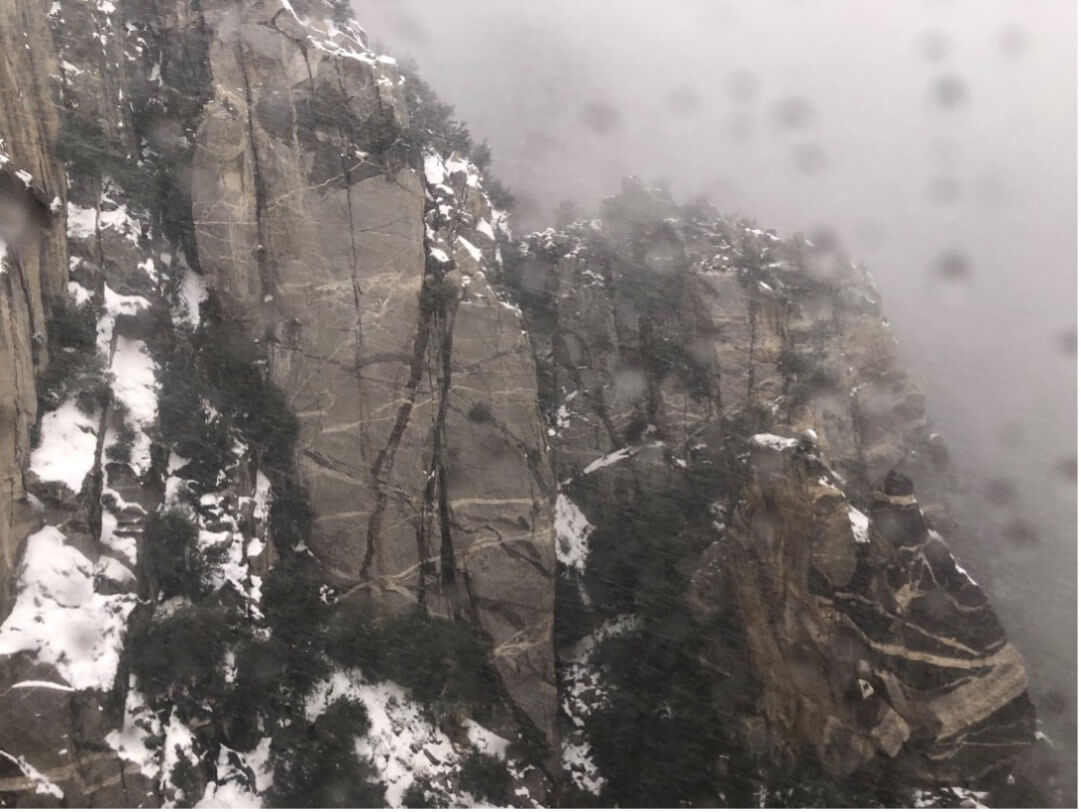
Veins & fractures in San Jacinto granodiorite-tonalite. BWK photo.
Below me was nothing but a one-mile drop along the steepest mountain face in the Lower 48 states, about a 65-degree slope… Just raw, exposed, weathered rock and a few hardy trees all the way down to the debris field far below…
And together, we belted out Neil Diamond lyrics: “Sweet Caroline, oh-oh-oh… Good times never seemed so good, so good, so good…”
If you’re wondering, I’ll tell you more about it towards the end of this note. But first, let’s discuss minerals, mines and making some money.
Get Prepped for PDAC
Last week (see here), I discussed an upcoming mines and minerals conference in Toronto known as PDAC, short for the Prospectors and Developers Association of Canada. Despite its nationalist name, this is among the world’s great international conferences on mining, perhaps the biggest anywhere. Absolutely, I’ll see companies with operations from across the globe.
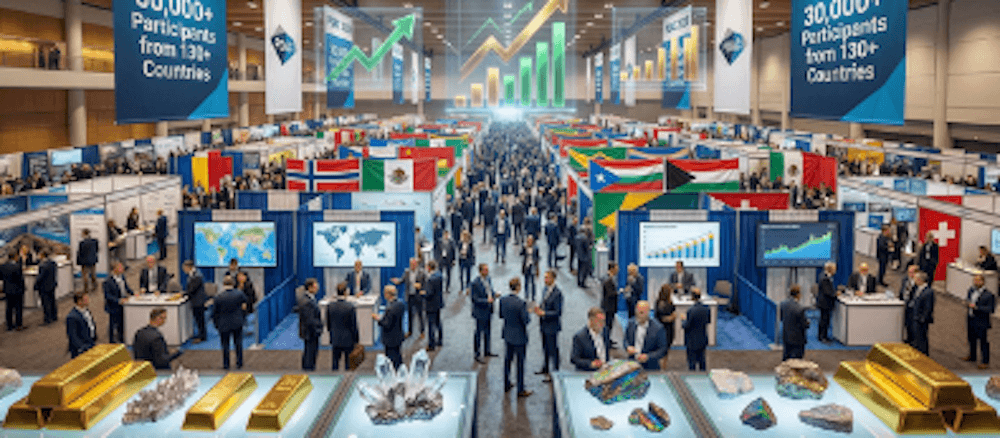
PDAC image. Courtesy DiscoveryAlert.com.au.
In years past and in busy times, PDAC has attracted as many as 30,000 attendees, of course with fewer attendees during down-years of the mining cycle. But this year I expect big numbers due to the surge of interest in mines, minerals and all the money that’s flowing into the hard-rock resource sector.
I’ll be there along with my Paradigm Press colleague and fellow geologist Matt Badiali. We’ll walk the floor, talk with company reps, watch presentations, look at rock samples, check out the “core shack” drilling exhibits, get the inside scoop from people who work right at the rock-face (so to speak), talk with other analysts and investors, and find great ideas for subscribers.
The big mining guys will be there, and they’re definitely worth a visit: Barrick (B), Newmont (NEM), Rio Tinto (RIO), Freeport McMoRan (FCX), BHP, Agnico Eagle (AEM), and many others on the hefty side, as these things go. Frankly, you could just attend the show, talk with large-cap reps, and come away with a solid stable of horses for this race.
Along these lines, I’ll mention a fund that I’ve held for many years in my personal 401(k) account, namely Invesco Gold & Special Minerals R6 (OGMIX). I’ve never traded in or out; just bought shares every month via bank deduction. And those shares have more than tripled in value over the past two years, from $21 to about $73 now. The fund’s largest holdings include:
- Newmont Corporation (NEM).
- Agnico Eagle Mines (AEM).
- Wheaton Precious Metals Corp (WPM).
- Barrick Mining Corporation (B).
- Kinross Gold Corporation (KGC).
- AngloGold Ashanti (AU).
- Franco-Nevada Corp. (FNV).
- Gold Fields Limited (GF).
- Pan American Silver Corp. (PAAS).
Any or all of these names are solid companies, each in its own way. They’re large and diversified across jurisdictions, ore bodies, operational execution, risk tolerance, corporate approaches to cash management and growth, and how they treat shareholders.
Collectively, this group of names has done well, which has made OGMIX an investment that’s pretty much “buy and forget.” Let the fund managers deal with any stock-picking headaches.
To explain this a bit more, both I and my decade-long colleague Jim Rickards have long been convinced that we’re in a strong, ongoing up-market for metals in general and precious metals in particular. And over the past couple of years the individual company names within OGMIX have gone up-up-up, in essence rising with the golden tide to deliver handsome returns.
Now, and understandably, one might think that all these gains are nice, but they are also history from the past two years. What about the future? Well, yes… What about the future?
Will prices for gold and silver (and copper, lead, zinc, rare earths, tungsten, antimony and most other metals…) keep rising? Or stated another way, will mining companies that produce these elements maintain their apparently steady, ongoing increase in value?
Hey… nobody has the perfect crystal ball. But from where I stand and what I see, it’s more than likely that past winners will continue to do well. They are winners for a reason. Their share prices rose because they spun cash and showed earnings.
Meanwhile, the value of what these companies produce – metals and related alloys – will hold up, if not increase. Just consider the long-term devaluation of the dollar, global de-dollarization, flight to hard assets, high demand for scarce metals, past under-investment in new mines and refining capacity, and much more. With mining plays, we see a beautiful setup for future gains, even from these current levels.
Also, and again to cite Jim Rickards, if you missed the move of gold from, say, $2,000 to its recent levels over $5,000, there’s still likely upside. We expect to see $6,000, $7,500, $10,000 gold, and higher.
Memo: If you’re not on the train, you really ought to get on the train.
Swinging for the Fences
As we see above, big names offer excellent growth with relatively low risk, considering the generally rising trends across the mining and metal space. But what about smaller names with more risk, but also phenomenal possible upside? Glad you asked…
In past years, I’ve found many great, knock-it-outta-the-park ideas while perusing that PDAC conference floor. Last week, I mentioned a copper-gold play in Papua New Guinea called K92 (KNTNF). I first heard the pitch back in 2017, about a “castoff” mine development project that Barrick (B) was divesting for an utter pittance. Barrick just plain wanted it off the books.
I liked the idea – and definitely, the geological talent – and recommended KNTNF to readers at about $0.37, and the rest is history. That is, shares moved up-down over time, and some days were better than others. But by now KNTNF has moved above $21, representing a current market cap over $5 billion. It’s been a 56-bagger over the past decade, which makes for life-changing gains to early and patient investors.
Up and Down the Aisles
In other words, PDAC offers some of everything across the broad outline of the global mining biz. Big, medium and small. Exploration, development, operational, and royalty angles. Every aisle has something, and of course some are better than others, with a few dogs mixed in as well. And it takes some knowledge to get the best out of it.
Last year, for example, I looked for companies with antimony metal in their mix because China had just embargoed almost all exports of that important element and its ores. Eventually, I found one particular, quite solid “gold mining” play that had high antimony in the ore body as well. And it has done well this past year.
Plus, last year I looked for companies that had tungsten in the resource base, again because China had just slapped an embargo on that metal and its ores. And sure enough, I found a couple of plays that fit the bill; they’ve done well also, this year.
Not everything is an instant winner, of course. With some ideas, you just have to accept the best efforts of management and technical staff and be patient. You must roll with the punches.
For example, I’ve long followed a smallish, Yukon-based company with a superb, high-grade gold-bearing body right at the surface. It’s surrounded by extensive placer mining in nearby streams; in essence, this is gold that eroded out of the hard rock deposit up the hillsides. Definitely, the gold is there.
In this case, last year at PDAC the company’s management was planning to excavate high grade ore from the site and direct-ship it to Korea for processing. That is: put rock in a truck, drive down the road to a port in Alaska, then load onto an ore carrier to Korea Zinc Company. Even with the costs of excavation, trucking and ocean shipping, the payback was eye-popping. But…
Yes, this is Canada, and the bureaucrats in Ottawa and Whitehorse just could not get permits in place during last year’s field season. So, no dice in 2025. But now, in 2026, we eagerly await word for how the plan will unfold this coming summer and fall. Because if the company’s mining-shipping plan was going to make money at, say $3,000 gold last year, it will make even more money at $5,000 gold this year. You get the picture, right?
About that Neil Diamond Thing
Okay, if you’ve read this far let’s now pick up on that literal cliffhanger with which I began the article. Me, dangling from a wire, looking at rocks, and singing Neil Diamond lyrics.
The background is that I spent much of the past two weeks out West, in southern Nevada and California. Last week, I mentioned how I was in the field, kicking rocks with some geologist pals in Nevada, north of Hoover Dam, and then in Death Valley, California.
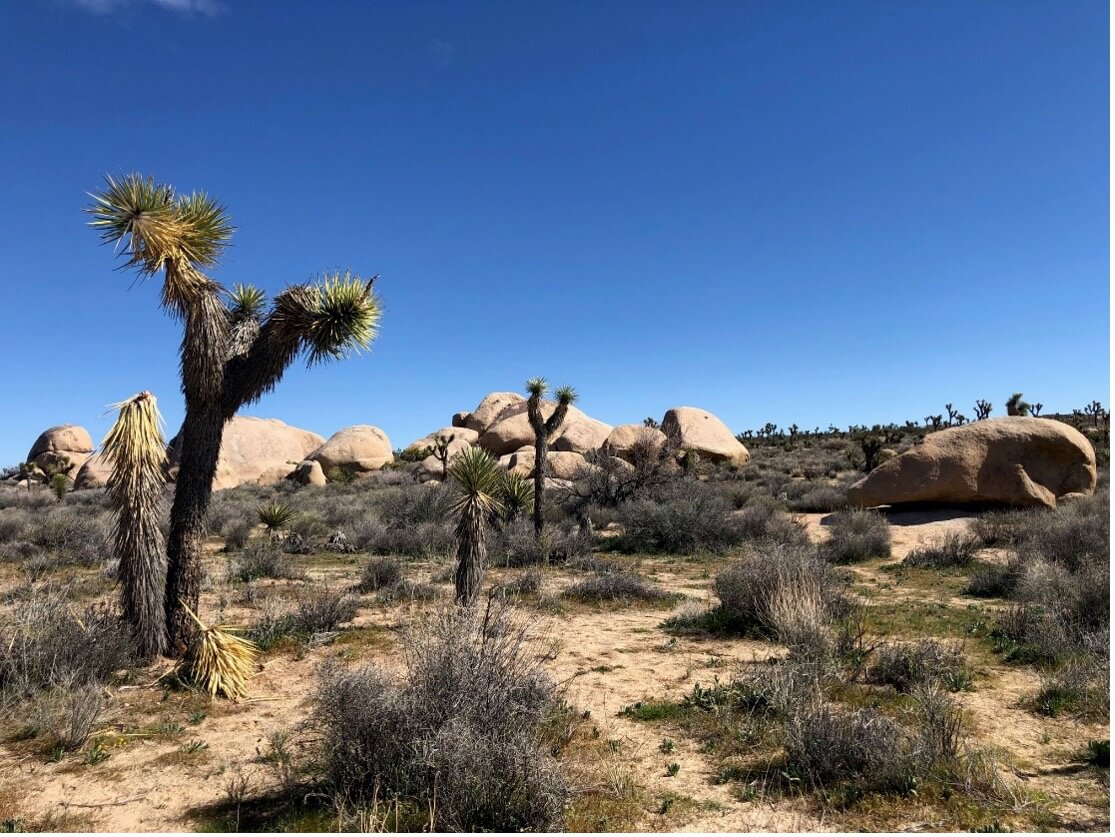
Ancient, weathered granite landforms and Joshua trees, Southern California. BWK photo.
Over the next few days, our field trip took us down I-15 past the Army’s National Training Center at Fort Irwin; then to the Marine Corps Air-Ground Combat Center at Twentynine Palms; then into Joshua Tree National Park; and onward to the upscale Mecca of Palm Springs.
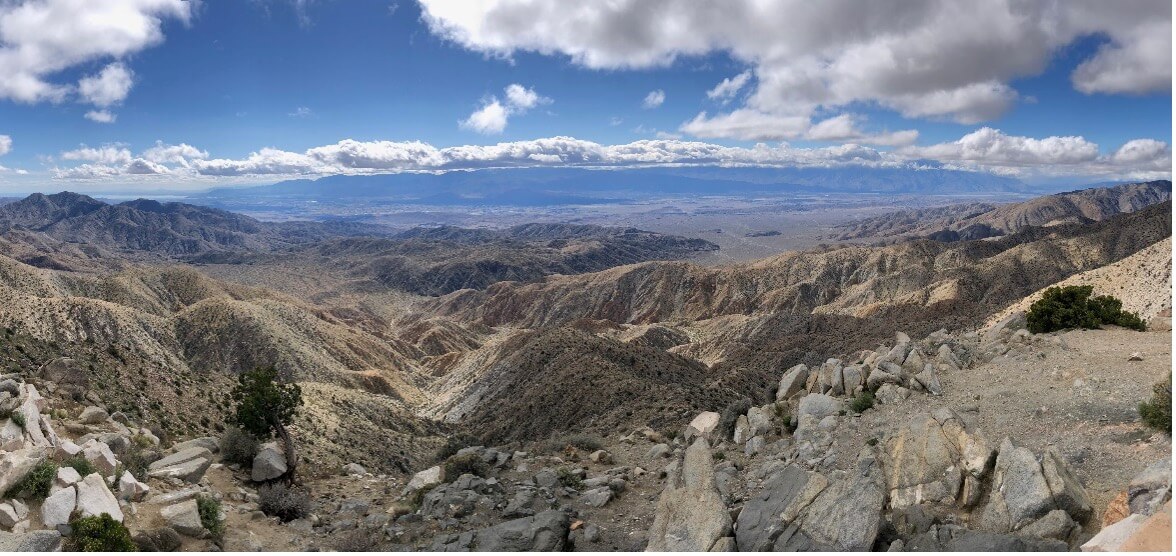
Southwest vista from atop Joshua Tree Metamorphic Complex, overlooking San Andreas Fault Zone towards San Jacinto Range. BWK photo.
As you can probably imagine, we saw lots of geology, which – along with I-10 West – took us to Palm Springs. It’s a delightful place, and charming in many ways. Founded in the mid-1800s, by the 1930s it was a hangout for movie stars because it was – way back then – about a 2.5-hour drive from the studios of Los Angeles. (Yeah, try doing that now!)
At any rate, also in the 1930s a young engineer named Francis Crocker had a dream of building a tramway from the Palm Springs foothills, elevation 2,643 feet, to the top of the adjacent San Jacinto mountains, highest peak at 10,834 feet.
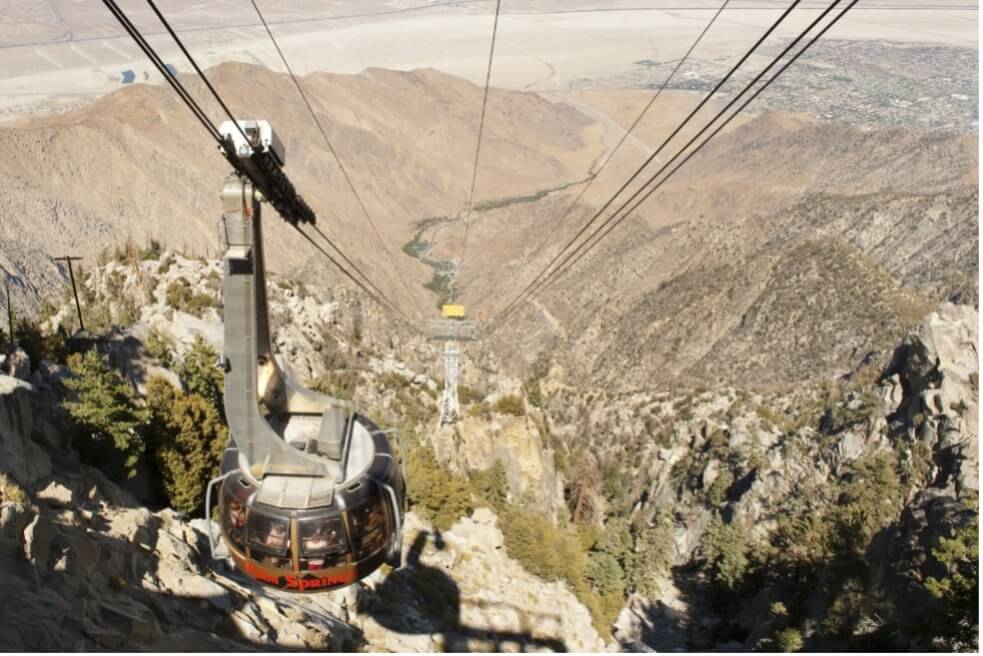
Palm Springs Aerial Tramway. Courtesy RoadTrip.com.
To make a long story short, Mr. Crocker accomplished his mission in the late 1950s/early-60s. After great efforts, he built a tramway up the side of the steepest mountain face in the Lower 48 states. It ends at a site called Mountain Station (elevation 8,516 feet).
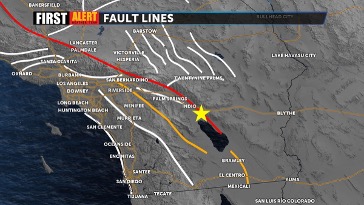
SoCal fault zones, showing fault along Palm Springs. Various sources.
Geologically, the valley where Palm Springs sits is a massive, northwest-southeast trending fault zone along the San Andreas system. The North American Plate is to the north and the Pacific Plate to the south. And the northwesterly movement of said Pacific Plate has faulted and pushed up the ancient rocks that form the San Jacinto complex; namely that mass of granodiorite-tonalite that I showed in the first photo above.

Your editor in the cold, wind and snow atop Mount San Jacinto. BWK photo.
For a modest fee you can take a tram ride up (and back down) the mountainside. It’s about 13,000 feet of travel each way and takes about ten minutes. And yes, looking out the windows of the tram has caused some people to get vertigo, if not sort of airsick.
The tram operators have figured out that it helps to distract passengers by playing music over the loudspeakers inside the cars. The tunes are well-known pop songs to which many know the words, such as Neil Diamond and Sweet Caroline. And thus, as we both ascended and descended the San Jacinto Range, the 40 or so people in the car were belting out the words and enjoying themselves greatly.
On my end, I sang along too because who doesn’t like Neil Diamond? But mostly, I looked out the snow-dampened windows at those gorgeous igneous rocks, with all the fractures and veins.
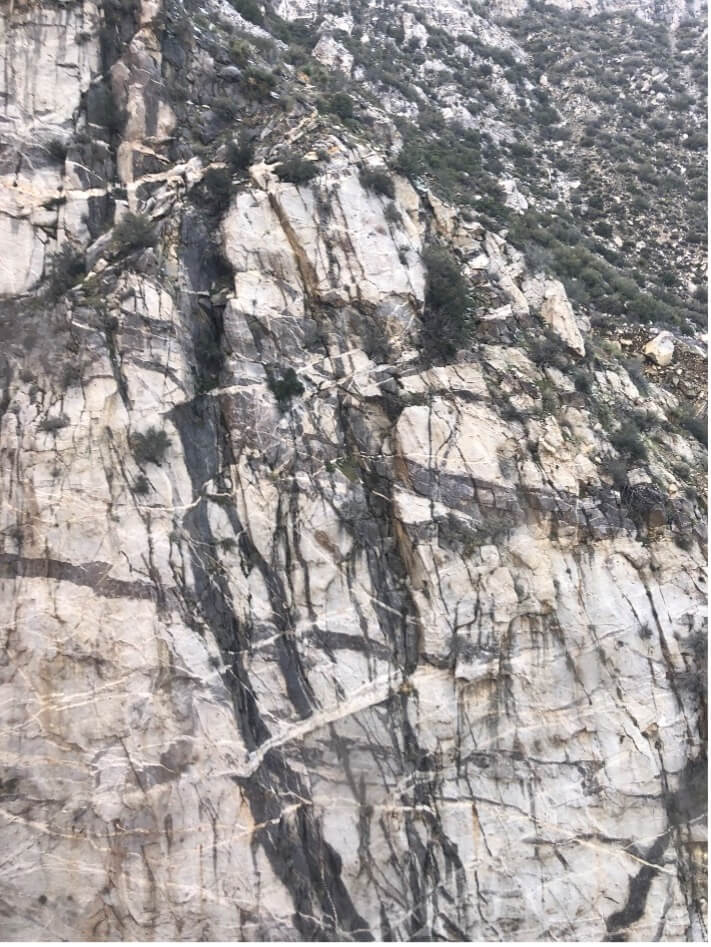
Fractures, intrusions and cross-cut veins in San Jacinto Complex. BWK photo.
My mind raced as I envisioned their geologic formation many millions of years ago, deep in the crust of the earth. Cuz to me, geology is like time travel in which you go back to the very beginnings, figure out what happened, and ponder where to look next.
And sorry to say, but that’s all for now, kids. PDAC next week. Plus, per custom and at direction of the lawyers downtown… I must advise that none of the companies mentioned here are official recommendations because, in this pub, we don’t track a portfolio. But if you’re interested, feel free to do some research, watch the charts, wait for down days in the market, use limit orders, and never chase momentum.
Thank you for subscribing and reading.