A watch can stop ticking without anyone noticing at first; seconds pass, then minutes and hours. Only later does confusion come in; by the time somebody looks down, time has already slipped away, while possible damage quietly follows.
That cloudy sense of drift defined the early days of the U.S./Iranian hostage crisis.
The Revolution That Opened the Door
Iran’s plunge into chaos began when Mohammad Reza Shah Pahlavi—the Shah of Iran—was overthrown, as his secular rule and alignment with the West drew deep resentment from clerics. The Ayatollah Ruhollah Khomeini returned from exile in February 1979 to reshape Iran into a revolutionary theocracy.
Then-President Jimmy Carter, who was always focused on moral signaling, was deeply uncomfortable with the Shah’s religious identity and governing style and let him enter the United States for medical treatment. As a response, Iranian radicals interpreted that decision as proof that Washington planned a counterrevolution.
On November 4, 1979, the crisis began when militant Iranian students, outraged that the U.S. government had allowed the ousted Shah of Iran to travel to New York City for medical treatment, seized the U.S. embassy in Tehran. The Ayatollah Khomeini, Iran’s political and religious leader, took over the hostage situation, refusing all appeals to release the hostages, even after the U.N. Security Council demanded an end to the crisis in a unanimous vote. However, two weeks after the storming of the embassy, the Ayatollah began to release all non-U.S. captives, and all female and minority Americans, citing these groups as among the people oppressed by the government of the United States. The remaining 52 captives remained at the mercy of the Ayatollah for the next 14 months.
The Embassy Seizure
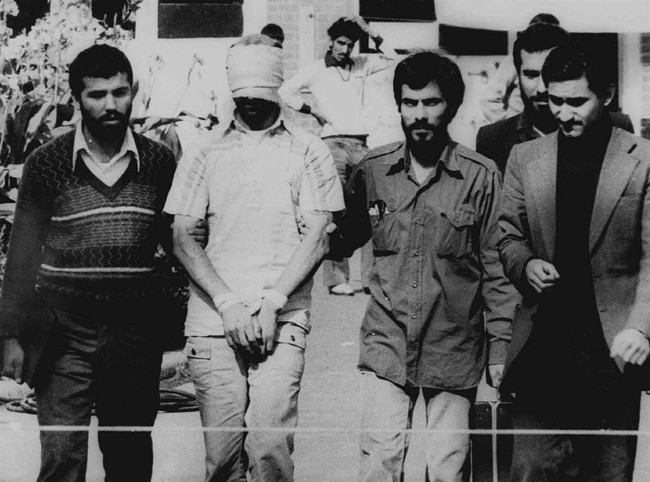
Militant Iranian students stormed the U.S. Embassy in Tehran on November 4, 1979, seizing 66 Americans as hostages. Fifty-two remained captives for 444 days, paraded blindfolded before cameras and used as a political weapon.
Forty-five years ago today, followers of Ayatollah Khomeini stormed the U.S. Embassy in Tehran, taking American diplomats hostage for 444 days. We will never forget both the service of the brave American diplomats held in Tehran and the abhorrent treatment that they were subjected to by the Iranian regime.
Khomeini quickly endorsed the takeover, converting criminals into state actors, and framed the seizure as righteous resistance, while American negotiators faced an adversary who thrived on humiliation and continuous delay.
Negotiations That Went Nowhere
From the start, diplomatic efforts stalled; Carter’s team pursued negotiations through intermediaries, economic pressure, and restraint. Iran exploited each pause, as each concession fed future demands.
The White House refused to take decisive action early in the crisis, fearing escalation. As families of the hostages watched calendars turn pages, Iran learned a lesson it would never forget: when drawn out, defiance worked.
Desert One and the Cost of Hesitation
In April 1980, Carter approved Operation Eagle Claw, a complex rescue mission led by the U.S. military planners that led to disaster from mechanical failures and a deadly collision at a desert staging area named Desert One, killing eight American servicemen.
If you could have a single example of Carter’s ineptitude, it would’ve been Desert One, where national confidence collapsed, exposing severe coordination failures among all military branches. Americans witnessed, in stark terms, what happened when the country neglected readiness.
Reagan Changes the Equation
Things changed, however, when Ronald Reagan was elected president. Iran suddenly faced a leader known for clarity and strength once Reagan prepared to take office. Without any public theatrics, Tehran moved to end the crisis.
Minutes after Reagan’s inauguration on January 20, 1981, the hostages boarded a plane, leaving Iranian airspace.
The Aftermath That Still Shapes Policy
America learned hard lessons during that period, adopting a firm stance against negotiating with terrorists, expanding Delta Force, and establishing the U.S. Special Operations Command, which emerged later from reforms sparked by that failure. As intelligence sharing improved, crisis response hardened.
Diplomacy never vanished, but illusion died, enemies noticed, alliances adjusted, and weakness no longer passed as a virtue.
Final Thoughts
A stopped watch can’t restart by itself; somebody must wind and repair it, while resetting priorities. The hostage crisis forced that reckoning.
Lost time carried a price, but resolve returned before any permanent damage occurred.
America learned the lesson that clarity deters, while hesitation invites attack.
PJ Media VIP supports long memory and clear-eyed history, especially when anniversaries tempt revision or softness. Join PJ Media VIP today to back work that remembers lessons paid for in days, lives, and resolve.