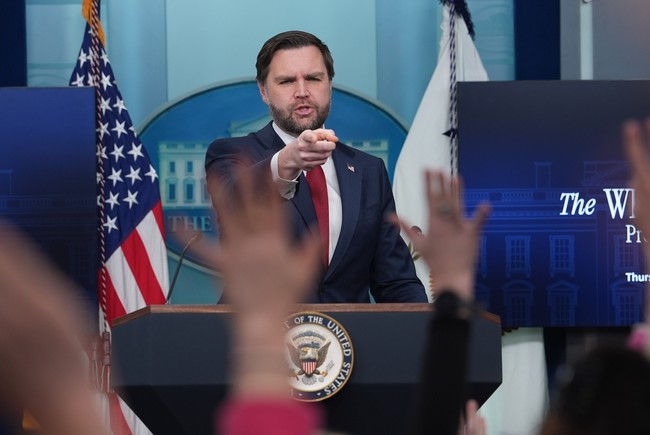
Iranian officials sent a quiet but pointed message through back channels on March 25: They want Vice President JD Vance to take the lead in negotiations; they would rather not deal with Steve Witkoff or Jared Kushner.
The request didn’t suddenly appear out of thin air; earlier talks involving Witkoff and Kushner collapsed just before coordinated U.S. and Israeli strikes hit Iranian targets. In their minds, it’s the sequence that matters, where Iranian officials believe commitments made in those discussions didn’t hold. The belief now shapes who they think they can work with going forward.
Yes, the regime that’s lied to the United States for decades, pinky-promised the Obama administration, along with a little bit of pocket cash, and swore on whatever comic book was handy that they’d stop work toward developing nuclear weapons, felt they couldn’t trust the team of Witkoff and Kushner.
Gulf sources told The Telegraph the Iranians would not sit down with Mr. Witkoff, the administration’s Middle East envoy, and Mr. Kushner, Mr. Trump’s adviser and son-in-law, given the military strikes that hit Tehran hours after they held talks in February.
JD Vance, who has remained largely absent from the conflict, is now being touted as chief negotiator should fresh discussions go ahead in Islamabad, Pakistan, later this week.
“Vance is preferred,” a Gulf source said of the Iranians. “They don’t want to work with Jared and Witkoff because they stabbed them in the back.”
Mr. Vance is widely viewed as a sceptic of “Operation Epic Fury.”
But his possible role as leader of a new US negotiating team signals the White House’s intent to head off further economic pain and de-escalate, even though the strategy for ending the war remains unclear.
The preference for Vance looks tactical. Vance doesn’t carry the same history from those earlier negotiations, where the Iranians may feel that he’s not on the same page as President Donald Trump, based on MSM reports of strategy agreements on Operation Epic Fury. Because of Vance’s direct approach, Tehran may feel he’d push for a faster resolution instead of extended rounds of talks that either stall or shift direction late in the process.
Another possibility may be Kushner’s Jewish faith, whether it plays a role in Iran’s positions, which may be moot.
Iran’s main objection centers on what it sees as a breakdown in prior negotiations and the rapid move to military action that followed. President Trump retains full authority over who represents the U.S. and has already confirmed that the current diplomatic effort has included Vance, Secretary of State Marco Rubio, Witkoff, and Kushner. That’s a structure that gives Trump flexibility; he can elevate Vance’s role without removing others, or he can keep the team as it is while ignoring Iran’s preference altogether.
There’s always the idea that the Iranian request is nothing more than a stalling tactic. Military pressure on Iran has steadily increased, and U.S. forces have targeted Iranian-linked activity in the Strait of Hormuz, including fast-attack boats tied to the Islamic Revolutionary Guard Corps.
Additional American troops in the form of the 82nd Airborne Division stand ready for deployment to the region.
Against that backdrop, signaling openness to Vance while rejecting other envoys creates space where Iran can appear willing to negotiate while slowing the process and buying time to adjust its military tactics and political positioning. That approach fits a pattern that often appears in high-stakes diplomacy, where selective engagement helps manage pressure without conceding ground.
At the same time, the outreach suggests that Iran still wants an off-ramp, and choosing Vance highlights a search for a channel that’s not already broken down. Even if the request carries strategic intent, it points to a recognition that continued escalation carries risk on multiple fronts.
Trump now faces a practical decision: he can test Iran’s preference by giving Vance more of a visible role, stick with the current team, or tell them to pound sand.
Personally, my first thought is to tell them to pick some sand and make a fist, but if it legitimately provides a quick capitulation that removes our amazing warriors from risk, I’m game.
Iran holds no cards; negotiations with or without Vance don’t matter if Tehran doesn’t take those talks seriously while maybe thinking they have a trick up their sleeve.
The situation doesn’t turn on personalities alone; it turns on leverage, timing, and credibility after a breakdown that both sides interpret differently. Iran’s push for Vance may open a door, or it may simply slow the clock while pressure builds. President Trump holds the final call, and the next move shapes whether talks gain traction or drift further unreachable.
Regardless, negotiating with a regime that slaughtered its people by the tens of thousands, paid proxies to attack the West, and has a relentless campaign to eradicate Israel may lead to a positive outcome.
I keep thinking that Tehran believes it can outlast the onslaught brought upon it by the U.S. and Israel, then rebuild and resume its terror of its people and the world, using its oil to pay for it.
But we have a new sheriff in town who is slowly and steadily securing the safety of the country he loves.
Readers who want more clear, fact-driven analysis can join PJ Media VIP today. Use promo code FIGHT to save 60% on a subscription.