
NEWS AND ANALYSIS:
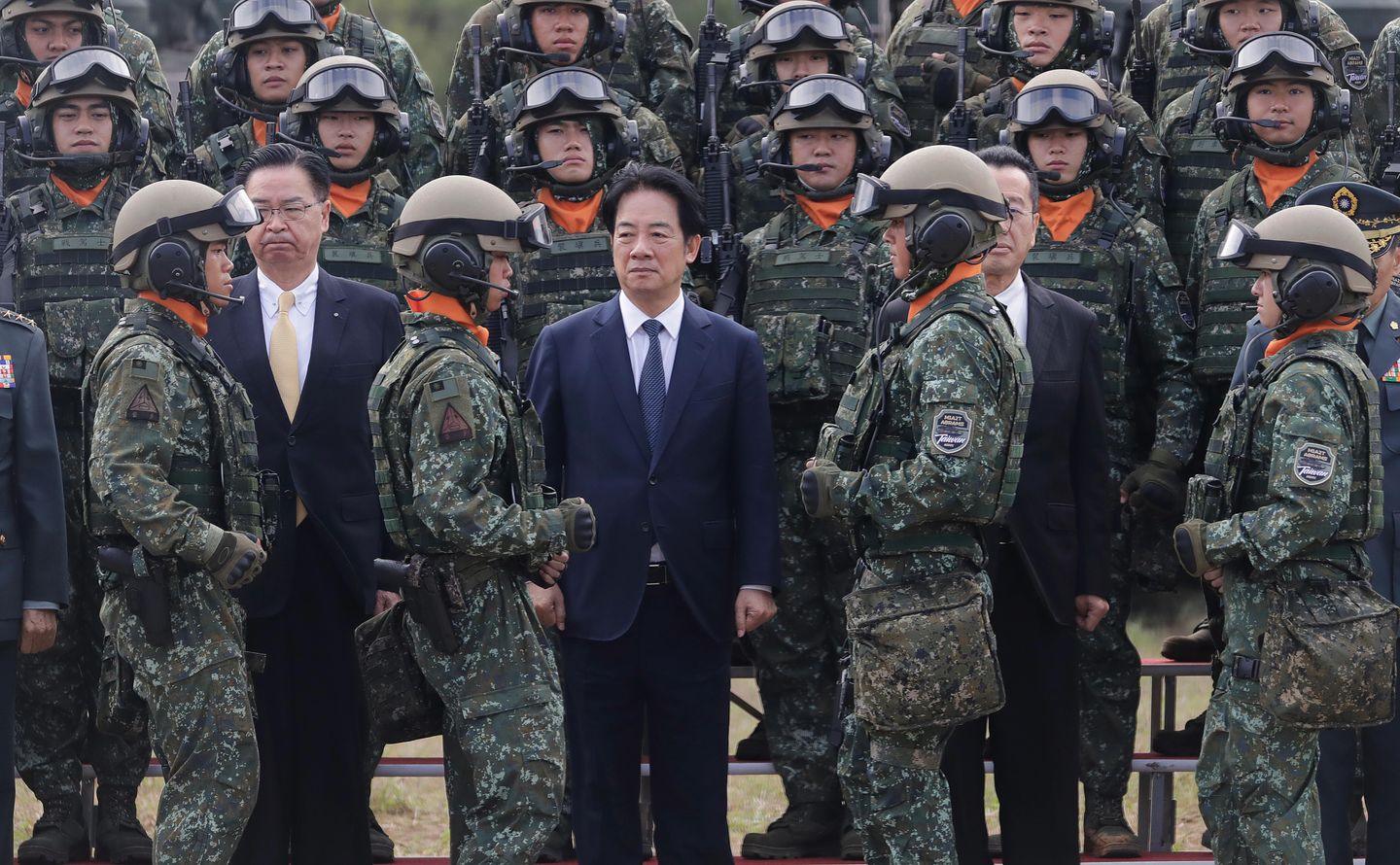
Increased U.S. military and political support for Taiwan is now codified in law through several provisions of a defense policy bill signed into law last week.
One of the most significant sections of the National Defense Authorization Act for fiscal 2026 on Taiwan is a Pentagon mandate to launch a joint program with Taiwan to deploy drones and counter-drone systems.
Section 1266 of the act, which authorizes $900 billion for the Pentagon through October, requires Secretary of Defense Pete Hegseth to begin the program with Taiwan officials with the goal of “fielding of uncrewed systems and counter-uncrewed systems capabilities, including co-development and co-production of such capabilities” for both the U.S. and Taiwan militaries.
The program will be carried out under the 1979 Taiwan Relations Act and comes amid growing concerns in Congress over threats of Chinese military attacks against the self-ruled island.
Robot weapons are a key element of a strategy aimed at denying China the ability to successfully annex the island militarily.
Adm. Sam Paparo, commander of the Indo-Pacific Command, has called the denial strategy a “hellscape” or drone warfare weapons — thousands of aerial and sea-based drones that would thwart a Chinese military assault across the 100-mile-wide Taiwan Strait.
The drone strategy involves the use of low-cost killer drones that can operate in swarms with the help of artificial intelligence, Adm. Paparo said during a recent defense conference.
“You need not fight for air or maritime superiority. All you need do is deny it to another,” he said of the use of advanced drone warfare.
The law now gives the Pentagon until March 1 to develop the drone deployment program that will include U.S.-Taiwan co-development and co-production.
Briefings to Congress’ defense oversight committees also are required within 180 days from Dec. 18, when President Trump signed the policy bill into law.
Those briefings will include details on the effort to deploy the drones and counter-drone systems, and whether additional resources will be needed to support the plan.
The law also requires a U.S.-Taiwan memorandum on reciprocal defense procurement, tight security for the protection of supply chains, and strong cybersecurity and an agreement to protect military information from unauthorized disclosure.
Taiwan is a major target of Chinese intelligence-gathering and Taipei in recent years has prosecuted a number of current and former military officials for spying for Beijing.
The Pentagon recently launched what it calls a “drone dominance” initiative that will seek to speed up deployment of small unmanned aerial vehicles. It also is working on larger aircraft crones, and drone submarines and surface vessels.
Another Taiwan section of the new law include a “sense of Congress” that the Pentagon should strengthen its partnership with Taiwan that will now be afforded similar treatment as other key allies such as Australia, Japan, the Philippines and South Korea.
Increased training by the U.S. Coast Guard of Taiwan coast guard also will take place under the law. The training is designed to enhance maritime security, law enforcement and deterrence capabilities by the Taiwanese forces.
An entire section of the defense act is called the Taiwan Non-Discrimination Act of 2025 that seeks to promote Taiwan’s membership in the International Monetary Fund.
Taiwan is not a member of the IMF, which recognizes the People’s Republic of China as the sole representative of China.
The act states that while not an IMF member, Taiwan has the world’s 21st largest economy and is the 10th largest goods trading partner of the U.S.
The act orders the U.S. governor of the IMF to “use the voice and vote of the United States to vigorously support” the admission of Taiwan as a member of the Fund.
Still another section of the new defense law requires Mr. Hegseth to report to Congress in six months to analyze how to protect Taiwan’s critical infrastructure, which includes among the most advanced semiconductor manufacturing facilities, from a Chinese blockade or invasion.
A draft section of the defense bill that called for creating a U.S.-Taiwan strategic partnership on defense industry priorities was removed from the final bill in conference.
However, a report on the final defense bill stated that the Pentagon’s Defense Innovation Unit, which leverages technology for military use, is encouraged by Congress to open an office in Taiwan.
Congress killed legislation adding Taiwan to Rimpac naval drills
Bicameral support in Congress for adding Taiwan’s military to the large-scale international naval exercises called the Rim of the Pacific did not survive a House-Senate conference on the National Defense Authorization Act.
A Dec. 8 report on the act said both House and Senate drafts of the act contained sections requiring the Pentagon to invite Taiwan’s navy to join drills called Rimpac. However, the measure was cut from the final bill despite the broad support.
Instead, a joint House-Senate explanatory report on the NDAA stated: “We note that the commander, U.S. Indo-Pacific Command, has the authority to invite the naval forces of Taiwan to participate in the Rim of the Pacific exercise, as appropriate.”
A spokesman for the command had no immediate response when asked if Taiwan’s navy will take part in the naval drills set for the coming summer in waters around Hawaii.
Analysts suspect the White House pressed congressional Republicans on the defense committees to remove the Rimpac provision as part of the administration’s policy of scaling back criticism of China.
President Trump has toned down criticism of Beijing in pursuing what he hopes will be a U.S.-China trade deal.
The Navy’s Third Fleet earlier this month held a planning meeting for Rimpac 2026. The biennial exercise will involve tens of thousands of troops and scores of warships and warplanes from 37 nations.
“This is the largest RIMPAC ever with 37 invited countries,” said Navy Capt. Brian Jamison, the RIMPAC 2026 exercise director, in an online report on the meeting.
Specific dates and the identification of participating militaries will be disclosed at a future date, the report said.
Leak from China says CCP shifting narrative on Western social media
A document purportedly based on a recent speech by a Chinese Communist Party official outlined aggressive online targeting of overseas Chinese communists in a bid to tamp down what the official said is “anti-government” social media posts.
The speech was given by Liu Yongjie during a meeting of the Public Security Bureau on Dec. 6. The bureau is part of the massive Chinese state political police and intelligence system.
Specifically, the document originated from a meeting of the Office of the Overseas Web Security Coordination Working Group in Shaanxi Province.
It was posted online on the dissident Chinese X account The Great Translation Movement. Inside the Ring could not verify the authenticity of the document but one China expert said the document may reflect a transcript of the speech and that it appeared to be an official leak.
Mr. Liu reported that levels of overseas opposition to the CCP had “stabilized.”
“Whether it is from antigovernment media or from so-called ‘opinion leaders,’ these voices are clearly experiencing a downward trend,” he stated.
Still, the CCP’s internet security coordination working group is battling what it said were regime opponents from the “white paper revolution” period.
The revolution he referred to is the public protests that emerged in China during the COVID-19 pandemic. The protest arose after authorities imposed harsh, “zero COVID” controls that prompted opponents to appear in public holding blank white sheets of paper that were a sign of opposition to police coercion and repression.
Mr. Liu stated that in targeting opinion leaders online, CCP propaganda “did not spread as much as we wanted, and 80-90% of it was wasted, mainly because they were not people who attracted attention anymore.”
The online propaganda team did not expose their scandals and “missed opportunities to grasp the narrative.”
“There are also some ‘independent media’ that have already established favorable relations with us, or even bought by us,” he said.
The special online propaganda teams need to improve both the specificity and effectiveness of their work and use strategies that match the situation, he stated.
The operations now will be based on a principle of “one strategy for each country, group, and individual” and “suppressing the reputation and influence of hostile forces as much as possible,” Mr. Liu said.
The CCP official bemoaned the fact that some overseas influencers thought to be supportive of the CCP had “committed betrayal” and exposed confidential information related to propaganda operations. That caused serious disruption in several special teams.
“Last but not least, I hope you are not afraid of hardships and fatigue, and that you are willing to analyze the situations of overseas social media platforms and infiltrate into their communities,” he said.
Successful CCP propaganda operations touted in the speech included infiltrating the Li Coin cryptocurrency used by dissidents and causing its value to fall. A second success involved a Tibetan freedom advocate in Changsha that Mr. Liu said was countered with help from “undercover agents” who provided large amounts of information.
“I hope everyone works hard, in order to fulfill the directives of comrade Li Kuo and solve issues in public opinion work, creating a favorable environment on overseas social media,” he said.
China is stepping up propaganda and influence operations around the world to challenge and supplant the U.S.-led international system that the CCP is opposing as limiting its power.
Beijing in September announced its Global Governance Initiative that seeks to promote the Chinese communist system around the world.
• Contact Bill Gertz on X @BillGertz.