Iran, as a nation-state, is failing. Technically, it is only on its deathbed. The coup de grace is yet to come.
The signs have been unmistakable since the beginning of 2025, when Donald Trump began his second term and re-imposed sanctions on Tehran that Joe Biden had stupidly lifted. The following September, the rest of the industrialized world joined the U.S. in sanctions when Iran refused to stop enriching uranium, building ballistic missiles, and allow inspectors from the International Atomic Energy Agency (IAEA) to ensure compliance with international law. A devastating joint attack by Israel and the U.S. preceded the sanctions, setting the stage for the current war.
In less than a year, those sanctions, and the chronic mismanagement and corruption of the Iranian clerical-fascist regime, brought Iran to its knees. The rial lost half its value, unemployment and inflation soared, and most importantly, the people lost all hope that things would get better. They took to the streets, and the ensuing slaughter of at least 30,000 Iranian protesters sealed the regime’s fate.
The Iranian government still has a monopoly on terror. They have the guns; most of the people do not. However, the 1979 revolution that brought the mullahs to power came about when millions of Iranians took to the streets, driving the shah into exile. There were other factors at work, including the mutiny of much of the regular army, which refused to fire on protesters, and the shah being a tired, sick old man. None of that mattered as much as people protesting for what they thought would be a more democratic Iran.
Today, Iran is once again ready for change. The Group for Analyzing and Measuring Attitudes in Iran, a unique polling effort explained here, found some startling numbers on the people’s support for the regime.
Haviv Rettig Gur writng in The Free Press, notes that “There are unavoidable selection biases at work in these polls, but they’re the best data we have, and they’re in line with a great many other data points about the deep shifts in Iranian public opinion in recent years, not least the mass protests and the murderous crackdowns they drew from the regime.”
After the 12-day war with Israel, support for Khamenei and the principles of the 1979 revolution collapsed to 11 percent. Seventy percent of respondents said they wanted the regime gone. Nearly two-thirds said the war with Israel last year had nothing to do with Iran’s national interests—it was the regime’s war, not theirs. Sixty-nine percent want the regime to stop calling for the destruction of Israel—not because they love Israel, but because the Muqawama’s forever war has gutted the country they actually live in.
“Muqawama,” or “resistance,” is the essence of the Iranian regime. It’s not just resistance against Israel. It’s the entire Islamic world’s resistance to entering the modern world. The Iranian Shiite clerics see themselves as a revolutionary vanguard, continuing the work of other Islamist revolutionaries of the 20th century. This “resistance” is why they are disinclined to give up. They will stay in power until someone physically kicks them out or until the vast majority of Iranians refuse to be governed by them.
What has followed is something that looks less like ordinary protest and more like the early stages of an ideological revolution; a counterrevolution. Protesters in the streets of Tehran in early 2026 chanted slogans that read like a precise surgical dismantling of Khomeini’s founding arguments. “Neither Gaza nor Lebanon, my life for Iran”—a direct repudiation of Khomeini’s insistence that Iranian nationalism was “idolatry,” that Islam had no borders, that Iran’s wealth existed to fund the global resistance. “Our enemy is right here; they lie that it’s America,” protesters shouted. In the Grand Bazaar, traders chanted: “They take our bread to buy rockets for Lebanon.”
“A system built around a few critical chokepoints can survive disruption only if it has spare routes, spare capital, and rapid repair capacity,” writes Iran expert Umud Shokri, a Visiting Fellow at George Washington University.
“State failure does not begin only when regimes collapse, but rather, when governments lose the ability to protect infrastructure, raise revenue, keep trade moving, coordinate institutions, and deliver basic services,” Shokri writes in the Middle East Forum. Various “chokepoints” are mileposts that can illuminate the regime’s inevitable collapse.
Iran still produces about 3 million barrels of oil a day, but it has to sell it at a huge discount to a limited number of customers. A couple of well-placed drones on Iran’s Kharg Island, wherre 90% of the country’s oil is prepared for international shipping, would cripple the regime’s primary source of revenue for a long time. Iran has an extremely limited ability to effect repairs.
Another chokepoint is “logistical capacity,” according to Shokri. “When war complicates transport and raises transaction costs across the region, the government must spend more effort to move fewer goods,” he writes. “That reduces its ability to manage supply chains, stabilize markets, and maintain routine administration.”
A lack of “administrative capacity” is also a sign of a regime on the ropes. “When ministries can no longer stabilize prices, regulate commerce, or allocate scarce resources consistently, the state governs less through routine administration and more through improvisation.”
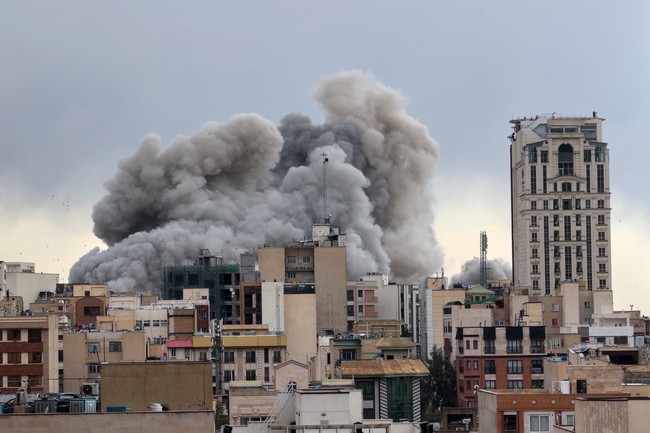
Iran, therefore, does not need to experience immediate regime collapse to move deeper into failed-state dynamics. The key question is not whether the state can still coerce. It is whether it can still govern effectively. After February 28, 2026, that capacity looks weaker. The strikes damaged concentrated infrastructure, tightened fiscal pressure, disrupted logistics, and pushed the state toward more reactive and less effective administration. The regime may still hold the center, but holding the center is not the same as maintaining state capacity. If this trajectory continues, Iran may remain politically intact while becoming fiscally thinner, administratively weaker, and functionally less capable. That is how states begin to fail.
Under these scenarios, Iran doesn’t collapse as much as it expires from being choked to death by its own internal inconsistencies, corruption, and economic weakness.
I certainly hope Trump finishes the job, but it’s looking like the regime’s “resistance” philosophy will make getting the regime to fold a very difficult proposition.
PJ Media will give you all the information you need to understand the decisions that will be made this year. Insightful commentary and straight-on, no-BS news reporting have been our hallmarks since 2005.
Get 60% off your new VIP membership by using the code FIGHT. You won’t regret it.