
We need to talk about the difference between physical gold and gold miners.
Physical gold, the actual metal, is insurance. Unlike a country’s currency, gold is an asset without being someone else’s liability. That means it can’t be frozen or sanctioned by another country. That makes it the asset of choice for financial institutions when there is risk of currency debasement and inflation.
Inflation steals the value of currencies. That means it takes more currency to buy the same amount of hard assets like food, real estate, and gold. It’s important to note that central banks (like the U.S.) want to keep inflation around 2%.
That means they intend to allow the purchasing power of the dollar to fall 2% per year…
It’s a system designed to make it cost a little more every year for stuff like bread, cars, candy bars, and precious metals.
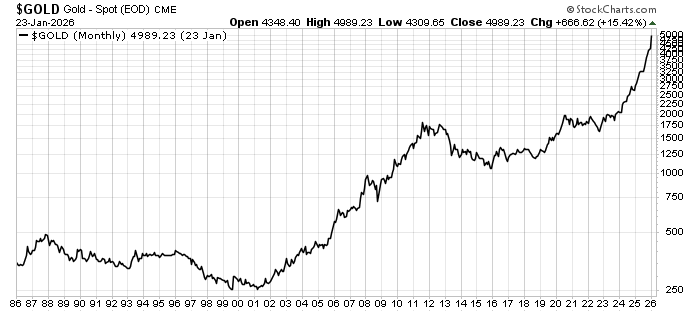
And that fueled the long-term bull market in gold. In dollar terms, it’s just a chart of the devaluation of the dollar due to inflation:
The dirty secret about currencies is that they aren’t backed by any assets. The U.S. dollar is backed by the “Full Faith and Credit” of the U.S. government.
There is an old saying that gold is money and everything else is just credit. In other words, gold is an actual payment. Paper is a promise to pay you later. That’s an important distinction. The value of paper money relies on all of us agreeing that it is worth something. That’s true for all currencies today…dollars, yen, euros, etc. It’s all just a wink and a nod that it’s worth something real.
The risk is that we stop believing. And that’s what’s happened today…not in the dollar, but in the system. And the rising gold price is a symptom of that. It’s the canary in the coal mine of a potential currency drama. And the problem is Japan.
A quick note here, bond yield moves opposite bond prices. Rising yields mean the prices of the bonds are going down. In other words, people are selling long-term Japanese bonds.
The 10-year bond yield broke 2.3%. That’s its highest level in 100 years. The ultra long bond yields are also ripping higher. The Japanese 20-year yields reached 3.4%, the 30-year yield broke 3.6%, and 40-year yield hit 4%. The last time we saw this was in 2007, right before the global financial crisis.
Investors bailed out of these bonds due to worries about government spending and inflation. More importantly, investors fear that this problem is contagious. That the fears around the yen could spread to other currencies like a virus.
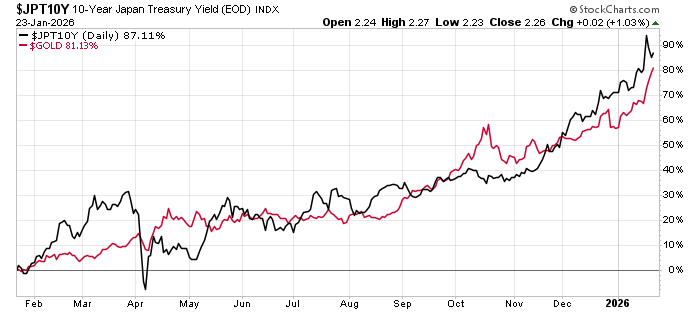
And that is driving the price of gold higher. You can see that the gold price moved in lockstep with the Japanese 10-year bond yield. The yield was near zero just four years ago. It doubled since May 2025. That’s an incredible (and troubling) run. As investors sell and drive up the yield, the price of gold goes up:
Here’s what analysts at Australia’s TMGM trading desk say about this trend:
From 20–21 January 2026, Japan’s long-dated government bonds suffered a massive selloff. The 40-year JGB yield broke above 4%, marking its highest level since 2007. At the same time, the 10-year JGB yield briefly climbed to 2.330%, a peak not seen since February 1999, signaling that the Japanese government’s cost of financing its enormous debt pile is rising sharply.
That’s enough to shake the foundations of a global economy that still remembers 2008 quite well.
That’s why gold is doing so well right now. The world’s major banks and governments are watching Japan’s banks and worrying. So, they buy gold as insurance against a repeat catastrophe.
There is a real chance that, if Japan can get its house in order, the rise in gold price will stop and even fall. If that happens, it will impact miners. So, we’ll need to watch that.
But right now, gold miners look very (very) good.
Companies that were nearly insolvent a year ago are now forecasting huge profits. The giant mining companies are starting to buy up smaller companies. Today, China’s giant gold miner Zijin Mining Group agreed to buy Canadian gold miner Allied Gold for $5.5 billion (all cash) or $44 per share.
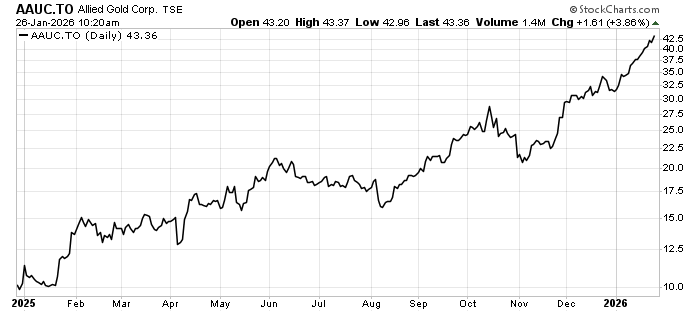
It was a $9 stock about a year ago. That’s a huge win for shareholders.
Gold miners are companies that produce gold. They should trade for some multiple of earnings. And when their expenses are based on $2,000 per ounce, then they should make ridiculous profits at the current price.
That’s the difference between physical gold and gold miners. Physical is insurance against financial collapse. Miners are businesses. And when the price of the product soars, but costs stay the same, profits soar too. And that means gold miners should trade at some multiple of earnings.
Today, the VanEck Gold Miners ETF (GDX) trades at 23.4 times forward earnings. The current price to earnings ratio for the S&P 500 is 31.2 times. So the S&P 500 is priced higher than gold miners when we know that the value of the stuff these miners produce is at all time highs.
It makes no sense, so that’s our opportunity.