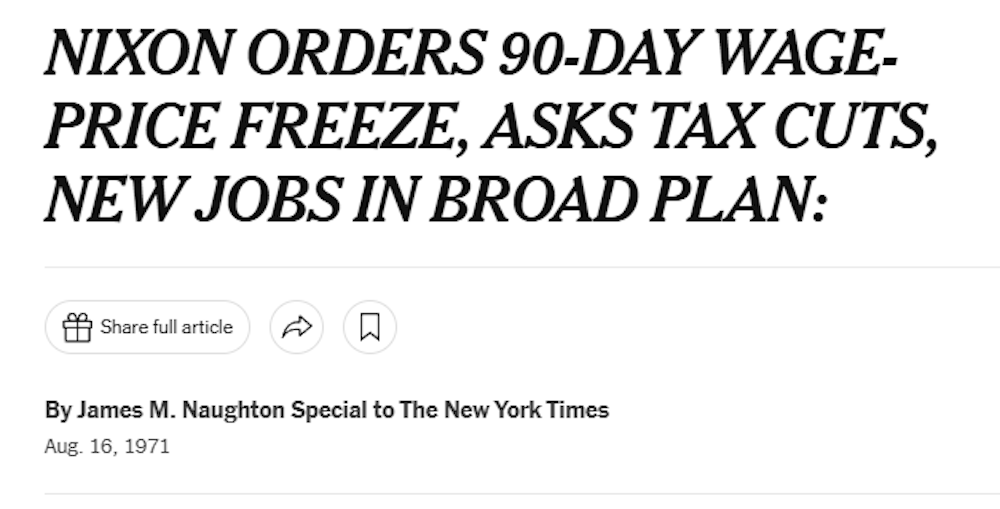
In August of 1971, President Nixon announced the end of the Bretton Woods system and the gold standard.
In that same speech, he introduced a 90-day price freeze. Companies were legally forbidden from raising wages and costs.
That was phase one of the price controls. It was extremely popular, with 75% public approval.
Nixon was eager to lower inflation ahead of the 1972 election. And for a while, it worked.
But the market was silently being distorted. Adam Smith’s invisible hand was being stabbed with a rusty screwdriver.
Phase Two – Govt Sets Prices
In phase two, lasting from late 1971 to 1973, companies had to apply to government boards to raise prices and wages.
Shortages started to show up. Ranchers didn’t want to sell beef at a loss, so they held onto cattle. Beef and other meat became scarce.
Companies found loopholes and ways to raise prices on certain items. For example, car companies would make small changes to a model and call it a “new” product at a different price point.
Quality began to suffer. Low quality ingredients were substituted. For example, instead of butter, food companies began to use soybean and other seed oils.
Service suffered too.
By late 1973, price controls were loosened due to ineffectiveness.
Oil Shock + Price Controls = Shortages
In 1973 the Arab oil embargo caused gasoline prices to soar in the U.S. But due to price controls, oil and gas sellers couldn’t raise prices to keep up with the market.
So rationing was implemented. Long lines formed at stations that had gas.
Eventually, all the price controls failed.
And due to the market distortion, prices soared once they were gone. Price controls had disincentivized new production.
Will We See Price Controls?
Back on March 5th, we got rumors that the Treasury Department was considering “action” in oil futures markets. Reuters:
The U.S. Treasury Department could announce measures as soon as Thursday to address rising energy prices, potentially including action in the oil futures market, a senior White House official said.
This would essentially mean the government is considering shorting oil futures in order to depress the price.
Price manipulation is a dangerous road to go down. Since then, a Trump administration official has anonymously denied that it would act. But the steep $35 selloff in oil yesterday did look a bit suspicious.
Of course, the official explanation is that oil fell so sharply because Trump said the war was nearly over. But he’s reversed that stance since, and Iran shows no indication of quitting.
So is it possible the government is already attempting to decrease oil prices by selling futures? Yes, but it’d be difficult to prove.
My concern is that if oil and related prices stay elevated, the government will be tempted to institute price controls, export freezes, or other measures that will distort natural market signals.
Because while high oil prices are painful, they do encourage less consumption and more drilling. If we keep prices artificially low, it will eventually blow up in our faces.
Oil companies won’t drill as many new wells if oil prices are low. Consumers won’t be incentivized to avoid unnecessary trips.
As Rick Rule famously says “the cure for high prices is high prices”.
The only sustainable way to control prices is to let the market work.
A Bit Like COVID…
Other than the brief spike in oil to $120/barrel, the market’s reaction to this war has been muted. Stocks are barely down.
In some ways, it reminds me of the early days of COVID. Remember “15 days to slow the spread”?
The market reacted to COVID tamely at first. For a while, the market didn’t do much. Until it did.
From February 19 to March 23, 2000, the S&P 500 dropped 34%. Hot stocks fell much more.
I worry we could see a similar reaction here. If this war drags on, and more oil infrastructure gets hit, oil could easily spike back above $120. And stocks could crash.
I’m not saying it’s definitely going to happen. But we shouldn’t get complacent here.
What we have today is a potential inflationary catalyst like few we’ve seen in history. If the Strait of Hormuz stays closed, it won’t just be oil that spikes. Fertilizer, petrochemicals, plastics, metals, and much more.
Hopefully we get some sort of resolution soon. If we don’t, I worry things could get inflationary, fast.
All the editors at Paradigm are paying extremely close attention to the situation. We’ll keep you well updated.