MIAMI — The gilded ballrooms of the Trump National Doral golf resort are only a few miles down Miami’s 36th Street from the austere war rooms of the U.S. Southern Command headquarters.
But in traveling that short five-minute drive across this glitzy Florida city, it’s all too easy to underestimate the far-reaching consequences of the Trump administration’s shift of U.S. security policies to focus on the Western Hemisphere.
President Trump has framed international narcotics traffickers not as domestic criminals but as invading armies whose activities pose a direct threat to the United States. They should be dealt with on the battlefield, not in a courtroom, the administration argues.
On Saturday, Mr. Trump hosted the Shield of the Americas Summit to promote “freedom, security, and prosperity” in the region. It was particularly significant because the event was the first major multilateral meeting the president held with Latin American leaders since his return to the White House.
He released a proclamation during the summit, pledging to address the “grave dangers” posed by the cartels using “any necessary resources,” including the armed forces.
“The United States will train and mobilize partner nation militaries to achieve the most effective fighting force necessary to dismantle cartels and their ability to export violence and pursue influence through organized intimidation,” the president wrote.
The guest list included the leaders of a dozen countries who are thought to be aligned with his administration’s agenda.
Officials from Mexico, Colombia, and Brazil — whose left-wing administrations have frequently clashed with the White House — were noticeably missing from both the Doral summit and the earlier “Americas Counter Cartel Conference” at Southern Command.
Jean Daudelin, a Latin America specialist at Carleton University in Canada, said he was struck particularly by the absence of Mexico: America’s southern neighbor is the main source of fentanyl in the United States.
“Colombia is the top producer of cocaine, and exports have been exploding in recent years. Brazil has South America’s richest cartel — Sao Paulo’s [Primeiro Comando da Capital],” he said. “It is the biggest local market and, now that Venezuela is a bit out of the game, most likely the main transit route for cocaine to Europe.”
The summit came just two months after President Trump ordered Operation Absolute Resolve, a special operations mission that resulted in the capture of Venezuelan leader Nicolas Maduro and his wife in Caracas.
They were flown to the United States, where they now face drug conspiracy charges.
Mr. Trump called Mexican President Claudia Sheinbaum a “very good person,” but was scathing toward her government’s approach to narcotics trafficking. He said that “the cartels are running Mexico,” calling the country “the epicenter” of drug-related bloodshed in the Western Hemisphere.
He said the U.S. is prepared to do “whatever is necessary” to protect its national security if the “chaos” continues to spill over the border, regardless of whether Mexico City extends a formal invitation for force.
“Criminal cartels and foreign terrorist organizations in the Western Hemisphere should be demolished to the fullest extent possible consistent with applicable law,” according to the summit proclamation.
Mr. Trump vowed to reassert U.S. dominance in the Western Hemisphere and push back on years of Chinese economic encroachment in America’s backyard. The administration’s national security strategy features the “Trump Corollary” to the Monroe Doctrine, which sought to ban European incursions in the Americas by targeting Chinese military cooperation and infrastructure projects in the Western Hemisphere.
He urged countries in Latin America and the Caribbean to band together to combat violent narco-trafficking cartels across borders if necessary. The president was characteristically blunt, saying national sovereignty isn’t a protective shield for criminal organizations.
“These international entities control territories and commerce, extort political and judicial systems, wield arms and field military capabilities, and use assassinations and terrorism to achieve their ends,” Mr. Trump said in the “Commitment to Countering Cartel Criminal Activity” proclamation.
Countries unable or unwilling to protect their people from narco-traffickers have effectively ceded their national authority and shouldn’t be surprised if the U.S. intervenes, he said.
“The only way to defeat these enemies is by unleashing the power of our military,” Mr. Trump said. “We have to use our military [and] you have to use your military.”
Prime Minister Mark Phillips of Guyana said his country has a strong and expanding strategic partnership with the U.S. Threats from terrorism and narcotics trafficking demand coordinated intelligence-sharing and operational cooperation.
“These networks undermine the rule of law, weaken institutions and threaten the safety and economic well-being of our citizens,” Prime Minister Phillips said Thursday at the Southern Command conference. “It is essential that we work together to protect critical infrastructure, strengthen national institutions, and enhance our resilience to evolving security threats.”
Henry Ziemer, an associate fellow with the Americas Program at the Center for Strategic and International Studies think tank, said countries like Mexico and Brazil aren’t as susceptible to pressure from Washington to attend the summit, unlike places such as Trinidad and Tobago or the Dominican Republic.
“Mexico still has some cards to play because it’s the United States’ number one trading partner and super-closely integrated into the U.S. economy,” he said. “Brazil has been content to eat 50% tariffs for several months.”
By holding the Doral summit only a few miles from Southern Command, which has operational control over all U.S. military forces in Latin America, the White House signaled to countries that fail to heed the warning against drug cartels that they might face U.S. sanctions or unilateral military action.
“As we achieve a historic transformation in Venezuela, we’re also looking forward to the great change that will soon be coming to Cuba,” Mr. Trump said. “Cuba’s in its last moments of life as it was. It’ll have a great new life, but in its last moments of life, the way it is.”
If the Shield of the Americas summit set the political agenda of the Trump administration’s approach to safety and security in Latin America, the Americas Counter Cartel Conference at Southern Command focused on how the mission would be carried out.
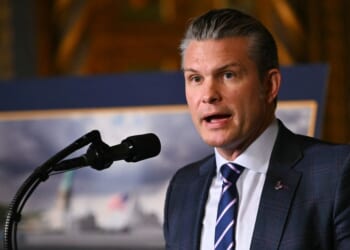
On Thursday, Secretary of Defense Pete Hegseth told regional military officials at the Southern Command conference that the U.S. is prepared to take on transnational drug gangs by itself, if necessary.
“However, it is our preference … that we do it all together, with you, our neighbors, and with our allies who are eager, willing, and capable,” he said.
The Trump administration announced the Operation Southern Spear campaign in September 2025. It resulted in a major naval buildup in the Caribbean and the Pacific, and the targeting of suspected drug-smuggling vessels linked to Venezuela and cartels like Tren de Aragua.
“Last month, we went a few weeks without targeting a single boat. Why? Well, because we couldn’t find a whole lot of boats to sink,” Mr. Hegseth said. “The whole point is to establish deterrence from narco-terrorists who have been able to traffic almost unfettered.”
The foreign officials at the Southern Command conference confirmed that they were on board with the Trump administration’s military-focused strategy to take on drug cartels. Francisco Marin, the defense minister of Belize, said his country is fully aligned with the new regional security framework.
“For Belize, this is not abstract. We sit along key maritime and overland routes exploited by criminal networks,” he said. “These networks traffic narcotics, weapons, and human beings. They undermine governance, distort economies, fuel corruption, and erode the safety and confidence of our citizens.”
Mr. Marin said his country is striving to make its defense and security more professional, but noted that no country can alone confront the threat of well-armed criminal gangs.
“The Western Hemisphere is interconnected by trade, travel and shared democratic values. When criminal networks destabilize one country, the effects ripple across us all,” he said.
Mr. Ziemer said the U.S. conflict with Iran led some officials in the Western Hemisphere to wonder if the Trump administration’s declaration that the Americas are its priority national interest would be short-lived. The violence and the metastasizing problem of organized crime have reached a breaking point in some of these countries, he said.
“The [Southern Command] conference and the Shield of the Americas summit with a bunch of regional presidents goes to show that the focus on the Western Hemisphere is here to stay,” he said. “The United States’ messaging of ‘taking the fight to the cartels’ actually does resonate more than you might expect.”