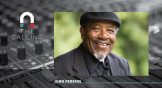
John M. Perkins, a bold evangelical voice who proclaimed the gospel against racism, died on Friday at the age of 95.
Perkins challenged Christians—especially white evangelicals—to repent of safe, narrow, and self-serving interpretations of the message of Jesus. He preached that opposition to racism was not a supplemental or optional activity but was core to living out the truth that would bring renewal and restoration to “the places long devastated” (Isa. 61:4).
“If it’s a holistic biblical ministry,” Perkins said in 1987, “I think that makes a difference between whether or not that church is an action church or whether it’s just become a self-centered worshipping congregation. And I think most churches are sort of self-centered worshipping. They see the church as ‘meeting my need, meeting my need,’ and the church doesn’t have a ministry, and a concept of ministry, and a philosophy of ministry, and a statement of mission to the world.”
His work influenced generations of white evangelicals wrestling with whether concerns about inequality, poverty, and injustice were distractions from a life of faith. Charles W. Colson called him a prophet. Russell Moore said few lived the gospel as fearlessly as Perkins. Shane Claiborne wrote, “He opened my eyes and set my heart on fire.”
Perkins developed a philosophy and methodology for Christian social engagement, which he explained as “relocation, reconciliation, and redistribution.” First, following the model of Christ’s incarnation, the church needs to go to the place of need: relocation. Second, because the gospel is “stronger than my race and stronger than my economic interests,” Christians should form new communities: reconciliation. Third, like the church in Acts 2:44–46, Christians have to voluntarily share what they own until no one is in need: redistribution.
Perkins founded the Christian Community Development Association (CCDA) as a network of churches committed to this vision, which he explained to Christianity Today in 2007 as “my old-fashioned reading of the Bible.”
Born into Mississippi segregation
Perkins didn’t see this interpretation of the Bible in the churches of his youth. He was born in 1930 to a Black family of sharecroppers in segregated Mississippi. The white churches wouldn’t welcome him or his family through their doors, and the Black churches seemed, to the young Perkins, like all they did was “wave and wail.”
His mother died when he was seven months old, and his father left soon after. His grandmother and extended family raised him. They eked out a living growing cotton on shares and working for the white landowners who had owned them until the Civil War. The family made extra money illegally, making whiskey and operating a lottery.
When Perkins was 16, a white police officer killed his older brother Clyde. Fearing police would kill him too, Perkins’ family raised money to send him to Southern California. He was one of about 50,000 African Americans who left Mississippi in the Great Migration, which historian Isabel Wilkerson called “the first mass act of independence by a people who were in bondage in this country for far longer than they had been free.”
Though he had only a third-grade education, Perkins found work in a foundry and quickly learned the trade, becoming a skilled laborer and union representative. He met and married Vera Mae Buckley, and they started a family.
Looking back at that time, Perkins said his only aim was making money. Then his young son Spencer invited him to attend Sunday school. There, Perkins recalled in an interview with the Wheaton College Billy Graham Center Archives, he came to think about his value in a different way. He was converted from the belief that “money and success” would bring him happiness.
“I realized I was loved by God,” Perkins said. “And if a God in heaven loves me, and if this God who is creator and Lord of the universe loves me, then I’m loved by a very significant person. And that person who loves me that much loves me enough to be concerned about my well-being.”
Perkins went on to study to be a minister and a Bible teacher with two white evangelical leaders who had popular radio ministries: J. Vernon McGee and Jack MacArthur (John MacArthur’s father). In 1960, MacArthur’s church gave Perkins financial support to return to Mississippi and start a church. Perkins called it Voice of Calvary Ministries, the same name as MacArthur’s radio program.

John and Vera Mae Perkins started teaching Bible classes, offering Sunday school, and holding the occasional tent revival. They started a church and a Bible college, but struggled to get incorporation papers. Perkins had to ask the National Association for the Advancement of Colored People (NAACP) to help—and that connection, along with his growing sense that God cared for all human needs, not just spiritual ones, led Perkins into social activism and the civil rights movement.
In 1965, he helped with a voter registration effort that registered more than 2,000 African Americans to vote in the rural areas outside of Jackson. His support from white California churches ended without explanation. Perkins pressed on, organizing a housing co-op, a farmer’s co-op, and a food co-op. A few years later, he led an effort to desegregate the public schools and started a boycott of white-owned businesses that refused to serve black customers.
Brutally beaten by a county sheriff
In February 1970, Perkins led more than 100 demonstrators in a 45-minute march protesting the segregated businesses, chanting, “Do right, white man, do right.” On the way home, authorities arrested several protesting college students for “reckless driving” and took them to the county jail. Fearing the men would be lynched, Perkins and two other boycott leaders went to the jail.
At the jail, they found sheriff’s deputies drinking corn whiskey. The deputies had forcibly shaved the protestors’ heads and were pouring the liquor over their raw scalps. “Then,” as one of the law enforcement officers later testified under oath, “a general fracas broke out.”
Sheriff Jonathan Edwards—named for the great Puritan minister—hit Perkins with a blackjack until the minister went down. Then he kicked Perkins on the ground, brutally and repeatedly, stopping only to retuck his shirt. Done with the beating, Edwards made the minister get up and mop his blood off the jail floor. Edwards later testified that Perkins threw an unprovoked punch at him but missed (though no one else saw it) and had a pistol in his car (though he didn’t get it out).
Recovering from the near-fatal beating in the hospital, Perkins thought about racism, his life, his mother’s death, his brother’s death, and now almost his own: “I came to the conclusion, the hard conclusion that Mississippi white folks [were] cruel. And they [were] unjust. And the system was totally bankrupt. … I stayed with the idea that it had to be overthrown.”
But the only thing that was powerful enough to overthrow it, Perkins decided, was the gospel. Only through the work of Christ and the power of the Holy Spirit could hate be replaced by love and enemies transformed into friends.
“It’s a profound mysterious truth—Jesus’s concept of love overpowering hate,” he later wrote. “The problem is spiritual: Black or white, we all need to be born again.”
Making a different kind of white Christian
Perkins took that message to the organizers of a Billy Graham crusade when they came to Mississippi in 1975. At Graham’s insistence, Black and white ministers were working together to plan a racially-integrated crusade. At an early planning meeting, Perkins asked the white pastors what they would do if a Black person converted at the crusade showed up at their church the next Sunday. Wasn’t their policy to turn Black people away?
In response to his question, the Graham association put him on the steering committee. They began to promote Perkins as an evangelical minister with an important message for Christians. The next year, Baker Books published Perkins’s first book, Let Justice Roll Down, making him a household name among evangelicals.
In the book, Perkins lamented that evangelicals had “surrendered their leadership” in the civil rights movement. He described his sadness “seeing those that I knew as brothers and sisters in Christ insist on a Sunday religion that didn’t sharpen their sense of justice.”
He then wrote other books: Beyond Charity, With Justice for All, Welcoming Justice (with Charles Marsh), Follow Me to Freedom (with Shane Claiborne), and One Blood: Parting Words to the Church on Race.
related

In his writing and ongoing work proclaiming the gospel, Perkins developed his philosophy of relocation, reconciliation, and redistribution. In 1989, Perkins and his wife founded the CCDA to bring together people committed to living out those principles of applying the gospel. The first year, 37 congregations joined. Today the network includes more than 600 Christian groups, from the Root Cellar in Lewiston, Maine, to the Tucson Coalition of Compassion Ministries in Arizona.
“It makes my blood run hot when I think that this God of heaven came down, redeeming a third-grade dropout, brought me into his Kingdom, gave me this opportunity to be working together with him in his redemptive purpose,” Perkins said in 2015. “I can do that, and we all can do that.”
Honored by white evangelicals
In the last decades of his life, Perkins received honorary degrees from 16 evangelical colleges and universities, including Wheaton College, which awarded him his first doctorate. In 2009, the Christian indie rock band Switchfoot’s song, “The Sound (John M. Perkins’ Blues),” was the No. 1 Christian rock song and the No. 7 alternative rock song on Billboard magazine’s charts. Two universities and two seminaries—Seattle Pacific University, Calvin University, Wesley Seminary, and Northern Seminary of Illinois—started programs in his name.
Perkins continued to push white evangelicals on the issue of racism, even urging them not simply to condemn riots in Black communities but to see them as opportunities to “authenticate the gospel.” In 2014, in response to one of the first major Black Lives Matter protests, Perkins called on Christians to recognize that racism will not be solved by people learning to be nice. Instead, he said, people need to be transformed by the gospel.
“We as Christians have to take some responsibility for that hostility [in Ferguson, Missouri], and affirm the love God has for all people,” Perkins said. “We minimize the gospel. We are supposed to be new creations in Christ Jesus, a peacemaking force. We have to come back to brotherhood and sisterhood.”
Perkins is survived by his wife, Vera Mae, and seven children: Joanie, Derek, Wayne, Deborah, Philip, Priscilla, and Elizabeth. His son Spencer died at age 43 in 1998.
The post Died: John M. Perkins, Who Lived and Preached Racial Reconciliation appeared first on Christianity Today.