
I found this chirpy, optimistic take on a site that enthusiastically advocates for “green energy.’
‘Don’t worry about a thing with those big old wind turbine blades,’ it seems to say. They’re basically ‘non-toxic fiberglass,’ and besides, if they’re not a terrific business opportunity for recycling, they’re safe in your local landfill.
No one will even know they’re there.
And the Clean Grid Alliance, whose mission is to ‘advance Renewable Energy in the Midwest,’ then uses a quote from a fellow named Don Lilly. He’s one of those green energy entrepreneurs they’re touting who are the answers to recycling ills.
I have taken the liberty of highlighting that and the ‘business opportunity’ claim on my screengrab.
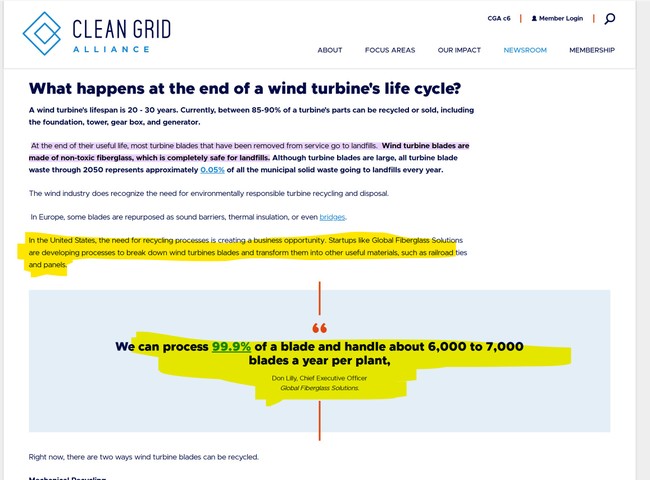
While it’s true that many of the turbine’s parts can find their way back into a second life, reconstituted as something else, that has never really been the sticking point with most people’s objections. The ‘yeah, but‘ is going to be what you hear from wind supporters every time the subject of blades is broached.
Note: While blades are hard to recycle, roughly 85-90% of the entire wind turbine (steel towers, copper wiring) is recyclable.
Yeah, blades are a pain, BUT look at the rest of the cheap, clean, zero-carbon, recyclable turbine!
It’s been the blades, which have now grown to an enormous lengths, some of them nearly 400 feet, that still have a finite lifetime in the best conditions, yet exist and operate in the worst. For every wind farm development, there are three blades to a turbine, and hundreds, often upwards of a thousand turbines. That blade math per farm alone is impressive, given that blades will need to be retired within years. This does not account for failures and accidents that require replacements.
What to do, what to do?
To repeat, the Clean Grid Alliance asserts that blades are made of ‘non-toxic fiberglass,’ which is the green-grifting version of a white lie. While true, it’s only one ingredient in the lamination process that produces a turbine blade.
And it’s the rest of the witch’s brew that composes the blade materials that are the problem with ‘safe for landfills.’
- Thermoset Resin: The blades are cured in a way that creates a permanent, cross-linked polymer network. It cannot be melted and reshaped once hardened, behaving more like a “cooked egg” than a recyclable plastic.
- Complex Composition: Blades are made of complex combinations of fiber-reinforced polymer composites, including glass fibers, carbon fiber, balsa wood, and plastic foam, which are hard to separate.
- Designed for Durability: They are engineered to endure extreme, 20-25 year, high-stress lifespans, requiring materials that are intensely strong and not designed to break down easily.
- Size and Logistics: Blades can be longer than a 747 wing, making them difficult to transport and handle for disposal.
In 2020, a landfill in Casper, Wyoming, became a blade burial ground, and the pictures of massive sections of windmill blades being buried caused quite a stir at the time.
Center of the American Experiment has been at the forefront of exposing the short lifespan and enormous cost associated with decommissioning wind turbines at the end of their 20 year useful life. Well, a recent article from Bloomberg had some stunning pictures of wind turbines filling up landfills in Wyoming.
According to the article:
A wind turbine’s blades can be longer than a Boeing 747 wing, so at the end of their lifespan they can’t just be hauled away. First, you need to saw through the lissome fiberglass using a diamond-encrusted industrial saw to create three pieces small enough to be strapped to a tractor-trailer.
The municipal landfill in Casper, Wyoming, is the final resting place of 870 blades whose days making renewable energy have come to end. The severed fragments look like bleached whale bones nestled against one another.
Tens of thousands of aging blades are coming down from steel towers around the world and most have nowhere to go but landfills. In the U.S. alone, about 8,000 will be removed in each of the next four years. Europe, which has been dealing with the problem longer, has about 3,800 coming down annually through at least 2022, according to BloombergNEF. It’s going to get worse: Most were built more than a decade ago, when installations were less than a fifth of what they are now.
By 2023, the landfill was heading towards 1200 blades.
what about the Windmill blade dump in Casper??
“According to city documents, the Casper Regional Landfill has received 1,124 turbine blades from across Wyoming.”https://t.co/c65XcEMPpu pic.twitter.com/TewepOJU2L
— 𝕊𝕋𝔸ℝ𝕋ℂℍ𝔸ℕ𝔾𝔼ℝ𝕀 #🟦✨ (@startchangeri) December 11, 2023
What about those golden business opportunities for recycling, and the thousands of wind turbine blades Mr. Lilly claimed each of his company’s plants could handle?
It didn’t seem to be working out so well in Iowa for Mr. Lilly’s Global Fiberglass Solutions. By last year, they were fighting off a lawsuit over ‘junked’ blades, and Mr. Lilly, even though he was CEO of the company, was arguing he shouldn’t be part of the lawsuit because, well…Mr. Lilly’s never been to Iowa.
Company executives fight lawsuit over junked wind-turbine blades
The top executives of a company accused of abandoning junked wind-turbine blades across Iowa say they shouldn’t be held liable for their companies’ actions.Last fall, the State of Iowa sued a Washington-state company and its executives for allegedly dumping tons of old wind-turbine blades around Iowa, in violation of the state’s solid-waste laws.
The lawsuit alleges that for over seven years, Global Fiberglass Solutions failed to properly dispose of decommissioned wind-turbine blades and stockpiled them at multiple locations in Iowa. The lawsuit, filed in Iowa District Court for Jasper County, seeks payment of civil penalties and a court injunction to prevent any additional violations of the state’s solid-waste laws.
Global Fiberglass Solutions and its CEO, Donald Lilly, are named as defendants in the case, as is Ronald Albrecht, one of Global’s corporate officers.
In recent court filings, attorneys for Lilly and Albrecht have argued the two men should be dismissed from the case, saying the court lacks jurisdiction in the matter because the two have never been to Iowa and were not “personally involved in the transactions and conduct” at issue.
Allegations of some havey-cavey kind of business going on and some big blades that never got recycled.
...MidAmerican and General Electric paid Global “millions of dollars,” the lawsuit alleges, to cut up, transport, and recycle the blades. Typically, such blades are about 170 feet long and weigh roughly 16 tons.
Rather than recycle the blades, the lawsuit claims Global instead dumped roughly 1,300 of them at four locations around the state: Newton, Atlantic, and a site in Ellsworth that was used to store blades that were originally dumped in Fort Dodge.
In December 2020, the lawsuit alleges, Global agreed to a consent order obligating the company to “take a number of concrete steps to purchase, install, and commence using recycling equipment” to process a certain percentage of the blades according to a series of deadlines.
And a fight with Lilly’s ‘recycling’ company over dumped blades that had been stretched out for five years, at the point when the state finally went after the company executives.
…The state’s lawsuit against Global was filed in September 2024, three years after that referral. It seeks a civil penalty of up to $5,000 per day for each day the company was out of compliance with Iowa’s solid-waste laws.
Hang on, though, because this is not a one-off.
Sweetwater, Texas, is also having a time with the business opportunist, once so promising in turbine blade recycling. The same company sold them a song and dance routine, and now the town’s been told it could cost up to $54M to move the blades that Global Fiberglass Solutions dumped on them ten years ago, with promises of green renewal to come.
For nearly a decade, residents of Sweetwater have been confronted by a jarring sight as they leave and enter this small West Texas town: thousands of used wind-turbine blades.
The blades take up nearly 1 million square feet in a field off Interstate 20. Hundreds more occupy a second site nearby. Originally up to 200 feet long — nearly the wingspan of a Boeing 747 — the blades have been cut into thirds, exposing gaping openings. Locals complain they’re a haven for rattlesnakes, collect water that attracts mosquitoes and pose a threat to children living nearby.
The town has repeatedly asked the company that left the blades there to remove them, with no success.
“It’s really ugly,” says Samantha Morrow, the city attorney. She’s received quotes to remove the blades, but they range from $13 million to $54 million, beyond the city’s budget.
Mr. Lilly says it’s not his fault that no one wants what his company was selling.
…This is a story about an entrepreneur who believed he could make millions from old wind-turbine blades but, by many accounts, got in over his head. The upshot: angry citizens, mounting debt and an array of legal troubles.
The entrepreneur, Don Lilly — chief executive officer of Global Fiberglass — said he hasn’t dumped anything and remains interested in recycling the blades. In an interview for this story late last year, he described a vicious circle of acquiring old blades but being unable to find buyers for recycled material, leading to a growing stockpile.
Texas Attorney General Ken Paxton has recently filed his own lawsuit against Lilly and the company, and Lilly, among others associated with Global, is presumed to be under indictment by the Nolan County District Attorney.
…Texan officials have had enough. Attorney General Ken Paxton last month filed a civil lawsuit against Global Fiberglass Solutions, the recycling company that left the blades in Sweetwater.
Four people have been indicted for illegal dumping and theft of property. The Nolan County District Attorney is seeking significant jail time and says more charges are likely.
…Officials haven’t announced the names of the people under indictment, but Lilly and Albrecht are among them, according to two people familiar with the matter, speaking on condition of anonymity. Lilly and lawyers for him and Albrecht didn’t respond to requests for comment about the indictments.
The Bloomberg article is a litany of underhanded dealings with the little recycling produced only for propaganda purposes. There was no plant and ‘operation.’
A take-the-money-and-run Theranos cure with turbine blades.
This only emphasizes yet again the scale of the problem the country is facing. With this one company alone, states are fighting over blades that came out of service going on ten years ago and here they are, still lying on the ground in Texas and Iowa. Or buried in a field in Wyoming. And there are more all the time coming off, built of newer tougher compsoites that are going to make it even more difficult to dispose of them
Vurt the furk are we doing?
Europe has virtue signaled itself into a ‘no landfill ban’ for retired turbine blades, but guess what? They have yet to come up with a viable alternative.
This is the language they’re using in releases touting the ban (and, of course, the ‘yeah, but’)… and what they hope to have ready to handle the blades that keep their lights on. It’s all EU argle-bargle about ‘circularity hubs,’ new waste management practices ‘EMERGING’ (IOW not actually viable and proven yet), more and more companies ‘getting involved,’ and the always deadly ‘creative and innovative solutions.’
…This sustainability approach includes the decommissioning and recycling of wind turbines. Around 90% of a wind turbine’s mass is recyclable using established waste management practices. The last remaining challenge on the way to circular wind turbines are the blades which are made of durable and hard to separate composite materials. Many of these blades are not recycled yet after decommissioning.
So where do blades go when they are taken down? Landfilling these blades is not an option. The European wind industry has committed to a self-imposed landfill ban for wind turbine blades effective as of 1 January 2026. Over the last years the industry has proactively developed new methods to reuse, repurpose, recycle, and recover decommissioned wind turbine blades.
Of the 290 GW of wind energy capacity installed in Europe today around 80 GW will reach the end of their theoretical operational lifetime by 2030. Many will be able to continue operating. But an increasing number will be decommissioned. WindEurope estimates that the annual volume of decommissioned blade material will increase to 55,000 tonnes a year by 2030. This increase from around 20,000 tonnes in 2025, is mostly driven by decommissioning in established wind energy markets like Germany and Spain.
This number poses a big challenge: the European wind industry has to scale up its circularity efforts. And it is doing just that. With the increasing volumes of decommissioned blades, new waste management practices are emerging. More and more companies are getting involved in reusing, repurposing, recycling, or recovering wind turbine waste. A new part of the wind energy value chain is in the making, creating new job profiles and employment opportunities.
New circularity hub
WindEurope has set up a new circularity hub to showcase the latest solutions, making the vision of circular wind energy a reality. European companies are investing in new facilities and championing creative and innovative solutions for decommissioned blades. The different examples illustrate sustainable second-life solutions that are already available today.
I mean, it’s a PR document selling what they want, not what they have. Their ‘Circularity Hub’ videos are like a series of Shark Tank contestant spiels. Yay – we make manhole covers!
Come on.
None of them is a viable industrial solution for the sheer volume of blade waste they are going to have to deal with, which is exponentially more than our own.
YEAH, BUT 90% OF THE TURBINE IS RECYCLABLE!
Good luck with that.
I’ll touch briefly on the other problem that’s coming and has been another exercise in propaganda over reality.
On March 11, a tornado touched down in Wheatfield, Indiana. It destroyed multiple houses…and a solar farm.
Solar panels at a solar farm in Wheatfield, Indiana, were destroyed as severe storms, including tornadoes, moved through the area on Tuesday night. pic.twitter.com/jUADSxNieA
— AccuWeather (@accuweather) March 11, 2026
These panels weren’t simply smashed by hail as we’ve so often seen in Texas and other places. They were torn up and thrown far and wide by what the National Weather Service has determined to be a low-intensity EF-1 tornado.
There is serious concern now about the toxic chemicals contained in each and their potential to leach into the soil.
…It directly hit the “Dunns Bridge I & II” solar projects, destroying a significant portion of the facility. According to Report 24, approximately 2.4 million solar modules were damaged or destroyed. Aerial footage showed rows of panels ripped from the ground and twisted metal frame.
The facility is valued at approximately $1 billion. According to sources, manufacturer warranties often exclude tornado damage, potentially leaving the operator (NIPSCO) or customers with a massive bill for reconstruction, unless the government steps in with a bailout plan.
Report24 highlights the “toxic risks” of the destruction, suggesting that broken panels could leak heavy metals or other hazardous substances into the soil and groundwater.
Bits and toxic pieces of 2.4 million damaged panels everywhere.
The article does note that a coal-fired power plant operating nearby was unscathed by the tornado’s passing.
All I can do is be grateful that November 5, 2024, saved us from further Green-mandated madness, as we are going to have our hands full now trying to deal with the fallout of what we do have.
I just remember the one fellow from a story a while back who, when a lithium-ion battery storage facility fire forced him from his house, asked so plaintively, ‘Why didn’t anyone think about how to put this out before they built it in my backyard?’
It’s always the same answer.
Cultists don’t care because it’s never their backyard.
Editor’s note: If we thought our job in pushing back against the Academia/media/Democrat censorship complex was over with the election, think again. This is going to be a long fight. If you’re digging these Final Word posts and want to join the conversation in the comments — and support independent platforms — why not join our VIP Membership program? Choose VIP to support Hot Air and access our premium content, VIP Gold to extend your access to all Townhall Media platforms and participate in this show, or VIP Platinum to get access to even more content and discounts on merchandise. Use the promo code FIGHT to join or to upgrade your existing membership level today, and get 60% off!