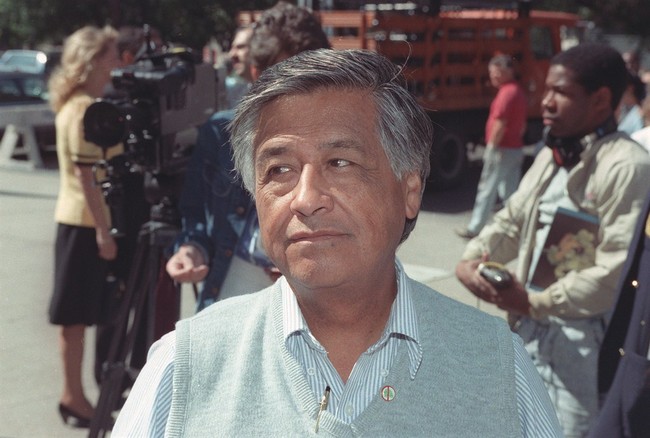
Cesar Chavez, a civil rights icon and Mexican-American saint, had a dark past that many of his contemporaries knew about but refused to act upon.
Chavez liked underage teen girls. He took several of them to his private office about 100 miles outside of Los Angeles, where he would molest and rape them, some as young as 12 years old. He also assaulted and raped adult women.
Everyone who knew kept quiet to avoid tarnishing the icon’s reputation or hurting the cause he fought for.
The shocking revelations were printed in the New York Times on late Wednesday afternoon and sent a shockwave through the liberal community. The five-year Times investigation interviewed more than 60 people and examined thousands of pages of personal papers, union board meeting notes, and dozens of tape recordings.
Chavez fought for the most underrepresented, abused workers in America: farm workers. They were subject to few labor laws, most of them were illegal, they lived and worked in slave labor conditions, and they were paid a pittance. Chavez started his United Farm Workers’ Movement in the 1960s. There was fierce resistance, some of it from the farm workers themselves.
Gradually, Chavez attracted the support of white liberal politicians like the Kennedys and labor leaders like Walter Reuther, the president of the UAW. Eventually, the union was recognized and achieved modest gains for workers. A grape strike in 1970 ended with workers getting a raise to $1.80 an hour, plus a piece rate for every box packed. The passage of the 1975 California Agricultural Labor Relations Act of 1975 was key. It guaranteed farmworkers the right to secret-ballot elections to choose their union, granted farmworkers the right to bargain with employers collectively, and created the Agricultural Labor Relations Board (ALRB) to oversee disputes and prevent unfair labor practices.
His accomplishments were real. He improved the lives of hundreds of thousands of workers and their families. He was one of the original political organizers of Mexican-Americans, creating a solid voting block that Democrats depended on for generations. Schools, streets, public buildings, parks, and other civic structures are named for him.
All of that is disappearing since the revelations landed like a nuclear bomb on Democrats and the radical left.
The questions raised by The Times about Mr. Chavez, one of the most consequential figures in Mexican American history, immediately prompted organizations with ties to him to try to distance themselves. The U.F.W. canceled its annual celebrations honoring Mr. Chavez, a response to what the union he once led called “profoundly shocking” accusations.
Marches to honor Mr. Chavez were called off in Austin, Texas; Tucson, Ariz.; and elsewhere. Officials in multiple states said they would consider renaming the scores of streets and schools named in his honor. “None of us knew,” Gov. Gavin Newsom of California said on Wednesday, noting that he planned to discuss with legislators whether to rename Cesar Chavez Day on March 31.
Those closest to Chavez have the most to answer for.
A handful of Mr. Chavez’s relatives and former U.F.W. leaders have been aware for years about various allegations of sexual misconduct, but there is no evidence that they made efforts to fully investigate the accusations, acknowledge the victims or apologize to them. Instead, many of the women say they were discouraged from speaking out in order to preserve Mr. Chavez’s public image.
Internal emails dating back over a decade show union members discussing Ms. Murguia’s claims of abuse and the impact it had on her life. One of Ms. Murguia’s relatives confronted Mr. Chavez while he was still alive, in the 1980s. According to the relative, Mr. Chavez offered no defense and responded only by clearing his throat.
Ninety-six-year-old Dolores Huerta, Chavez’s closest advisor, tells the Times, “Mr. Chavez drove her out to a secluded grape field, parked and raped her inside the vehicle.” Huerta, who was 36 at the time, said “she chose not to report the assault to the police because of their hostility toward the movement, and she feared that no one within the union would believe her.”
Several young girls ended up as victims of Chavez, who used his power and the girls’ hero worship of him to abuse them.
Ana Murguia was 13 when the labor organizer cornered her and molested her.
Ana Murguia remembers the day the man she had regarded as a hero called her house and summoned her to see him. She walked along a dirt trail, entered the rundown building, passed his secretary and stepped into his office.
He locked the door, as he always did when he called her, and told her how lonely he had been. He brought her onto the yoga mat that he often used in his office for meditation, kissed her and pulled her pants down. “Don’t tell anyone,” he told her afterward. “They’d get jealous.”
For someone who always admired Chavez for his courage and skill at getting what he wanted for farm workers, I was hit hard by the news of his deviant proclivities. Liberals think that hiding his sins by taking his name off the thousands of places that honored him will somehow erase his sins.
It won’t. Chavez was a mortal man with human weaknesses. Like Martin Luther King’s serial adultery and other sins that were exposed in American icons after their death, they tarnish their legacy but do not lessen their accomplishments. Those are real and lasting.
Honor what the man did, not the man himself.
Related: Mamdani Compares Irish Experience in America to Palestinian ‘Oppression’
PJ Media will give you all the information you need to understand the decisions that will be made this year. Insightful commentary and straight-on, no-BS news reporting have been our hallmarks since 2005.
Get 60% off your new VIP membership by using the code FIGHT. You won’t regret it.