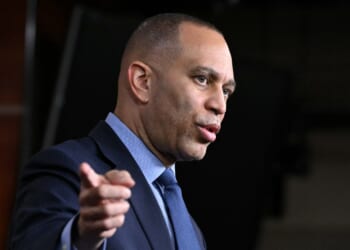


LEBANON, N.J. — Tom Kean Jr.’s political pedigree dates to 1776, when one of his ancestors became New Jersey’s first leader after the United States declared independence. His great grandfather was a senator, his grandfather was a congressman and his father was a governor.
But the family lineage may not be enough to protect Kean in this year’s midterm elections. The Republican congressman is among his party’s most endangered members as Democrats try to capitalize on President Donald Trump’s unpopularity and regain control of the U.S. House.
If Kean and other Republicans in competitive races cannot retain their seats, it will be an early sign that a blue wave is washing across the country.
Kean represents New Jersey’s 7th Congressional District, a scenic mix of bedroom communities and farming towns perpetually on the shifting front lines of American politics. Two previous incumbents were ousted during midterm elections over the past decade: Kean defeated Democrat Tom Malinowski in 2022, after Malinowski beat Republican Leonard Lance in 2018.
“I don’t think that Congressman Kean is taking anything for granted,” Lance said. “He recognizes that this is a highly competitive district.”
The district has become slightly more Republican since being redrawn nearly five years ago. Kean is counting on voters rewarding him for tax cuts that Trump signed into law last year.
Kean, however, risks being saddled with other parts of Trump’s agenda that have been unpopular in the area. The Republican administration wants to turn a local warehouse into an immigration detention facility, which Democrats and a GOP-controlled town council sued to stop on Friday. Also, Trump has tried to cancel a new rail tunnel that would make it easier to commute into New York City.
Kean is keeping a low profile, sticking to virtual events instead of town halls that can turn into shouting matches with angry constituents. But there is little chance of Kean avoiding Trump’s shadow in a district including the president’s golf club in Bedminster, and the congressman seems to know that. Kean has pinned a message on a social media account thanking the president for his endorsement.
‘Career politician’ or a guy ‘voters trust’?
Ever since Democrat Bill Clinton was president more than three decades ago, the party that controls the White House loses control of the House in the midterm elections. That political circle of life leaves lawmakers such as Kean trying to hold on when there is no White House race to generate more enthusiasm at the ballot box.
This year, Kean is one of 44 lawmakers whom Democrats hope to oust, more than enough to give them a majority. The Democratic field in Kean’s district remains unsettled, with a half-dozen candidates competing in the June 2 primary. Democrats are already attacking him over Trump’s tariffs, the rail tunnel and the proposed immigration detention facility.
Kean said he is working on a “workable solution” for the facility.
“Career politician Tom Kean Jr. has come to represent everything that people hate about a broken and corrupt Washington,” said Democratic Congressional Campaign Committee spokesperson Eli Lake.
Republicans said they can defy history and save Kean’s seat.
“Voters trust Kean Jr. because they know his record, and they’re fired up to send him back to Washington,” said National Republican Campaign Committee spokesperson Maureen O’Toole.
Kean’s spokesperson did not respond to requests for an interview.
Tax cuts central to Kean’s pitch
Kean is hinging his reelection on a potent, perennial issue in New Jersey politics – property taxes, which are among the highest in the country. Trump’s signature domestic legislation, a package of spending and tax cuts, expanded the state and local tax deduction, known as SALT.
Some Republicans did not want to make the change, complaining that it would help subsidize high-cost blue states. But it was a high priority for lawmakers in competitive seats.
“Congressman Kean has proven himself an independent leader who delivers for his district,” said campaign consultant Harrison Neely. “He was a cornerstone of the coalition that fully restored the SALT deduction for middle-class families, providing meaningful tax relief.”
Deductions were capped at $10,000 under legislation signed by Trump in his first term, but the new law raised the limit to $40,000. It eventually will drop to $10,000 in 2030.
Kean’s supporters say the tax change, however temporary, will help address affordability concerns.
“Having the ability to write off your property taxes is a huge benefit for homeowners,” said Douglas Thomson, who leads the New Jersey Realtors.
Not ‘blasting out tweets’
Another challenge for Kean has been controversy over the Gateway Tunnel, which will add new rail tracks under the Hudson River to alleviate congestion.
Trump tried to block federal funding, which would have been a setback for commuters in towns such as the ones that Kean represents. A judge ordered the administration to restore money for the project last month after Democratic leaders in New Jersey and New York went to court.
Greg Lalevee, business manager for International Union of Operating Engineers Local 825, said Kean had been helpful behind the scenes.
“I don’t see him blasting out tweets,” he said, unlike “somebody who’s just craving attention.”
Kean’s family lineage is well known in the district. His father, Tom Kean, was a moderate Republican governor who later lead the 9/11 Commission.
Mark Oliver, a retired architect, said he thought the elder Kean would be considered a Democrat by today’s standards. Now the party has shifted.
But he also acknowledged the district’s significant Republican presence, saying “you see the Trump signs up on the farms..”
He plans to support the eventual Democratic candidate because “rich people have so much power and so much influence that it’s got to be counterbalanced.”
Democrats criticize Kean for not doing in-person town hall meetings.
In 2018, during the midterms of Trump’s first term, Lance’s events attracted critics of the president who occasionally drowned out the soft-spoken congressman. Asked if he would do them again, Lance said he would.
“Each of us has to determine for himself how best to reach constituents,” he said.