
President Donald Trump has shown bold leadership by rejecting the radical global climate agenda. But now some lawmakers, including a handful of Republicans, have set out on a path that, if followed, will undermine the president’s accomplishments.
Those accomplishments have been substantial. The president has withdrawn the U.S. from the United Nations Framework Convention on Climate Change and helped dismantle the Inflation Reduction Act’s Green New Deal subsidies. Also, the Environmental Protection Agency (EPA) under his watch rescinded the endangerment finding that made it possible for the EPA to regulate greenhouse gas emissions.
The Trump administration has also made it clear that any nation supporting the United Nations’ International Maritime Organization’s global carbon tax on shipping will face severe penalties. In a press release, the administration didn’t mince words, stating, “The United States will be moving to levy these remedies against nations that sponsor this European-led neocolonial export of global climate regulations.”
Congress shouldn’t undercut these successes, but that’s exactly what has happened. Buried within a House report that accompanied the enacted energy and water development spending bill is language that enables the radical global climate agenda.
The language directs the Department of Energy to study the carbon intensity of domestic and foreign goods. The goods must include all items subject to the European Union’s (EU) carbon border tax, which the EU calls a carbon border adjustment mechanism.
While technically not law, agencies tend to comply with such report language. This language would help establish the framework necessary for the U.S. to impose our own carbon border tax and eventually even a domestic carbon tax.
Last Congress, this type of measuring scheme was introduced in legislation called the PROVE IT Act. Conservatives joined together in huge numbers to fight and eventually kill off this legislation. After proponents of the PROVE IT Act didn’t get what they wanted in a transparent, straightforward manner, they sneakily included language in a report that most lawmakers likely didn’t even know existed.
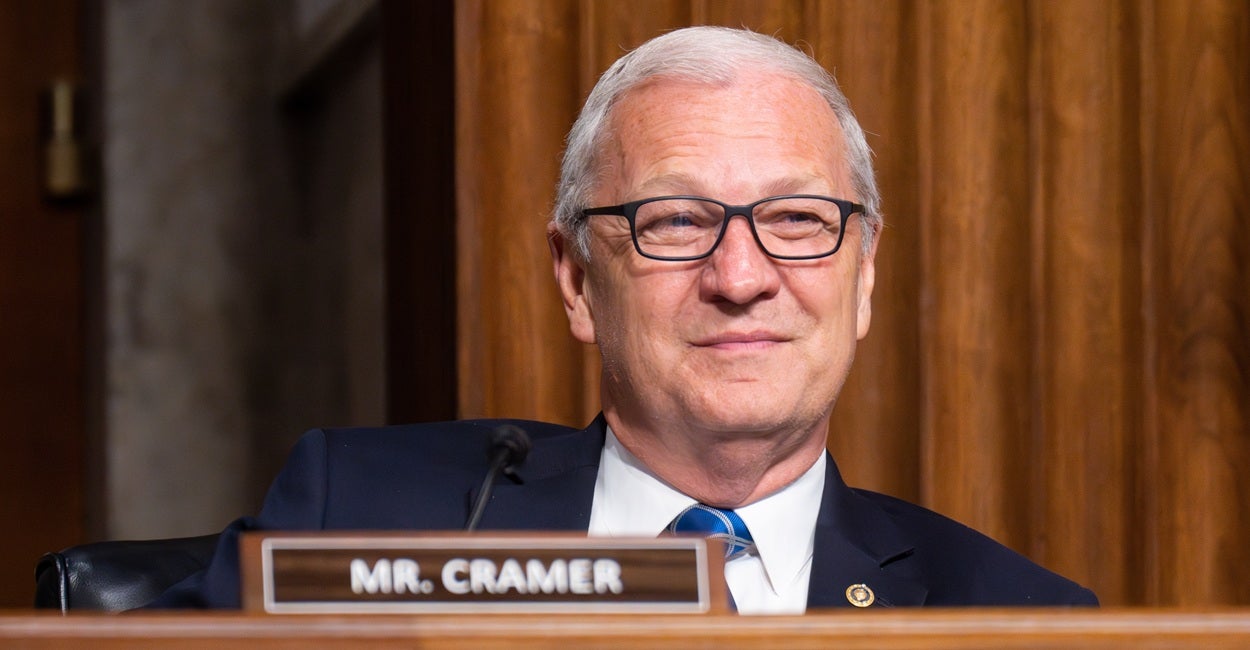
Senator Kevin Cramer, R-N.D., has stated the report language was his “legislation” and bragged how he kept the report language a secret for a long time and, reportedly, never mentioned it to the White House or Department of Energy. But undermining the Trump administration’s fight against the global climate agenda in an underhanded way shouldn’t be a bragging point. We should be fighting the EU and carbon border taxes, not caving to EU political pressure.
The arguments for a carbon intensity measuring scheme seem to be constantly changing. One recent claim is that measuring the carbon intensity of goods would help ensure EU numbers are accurate. Why don’t we instead just ensure Americans are not taxed by the EU in the first place? Cramer claims that his carbon measuring scheme would fit into Trump’s America First trade doctrine. But in fact it puts the EU and the global climate agenda first.
The Trump administration made it clear the U.S. wouldn’t tolerate a global carbon tax when it comes to the shipping industry. So, we certainly shouldn’t tolerate Europe’s arguably more egregious carbon tax on the global community.
For anyone supposing data collection is no big deal, consider that information collected through the EPA’s greenhouse gas reporting program was just used by Democrats through passage of the Inflation Reduction Act to create a methane tax. This new measuring scheme would inevitably be abused in the same manner.
It should also be noted that many proponents of the PROVE IT Act have not been shy in admitting that such a scheme would lead to carbon taxes of some kind. Senator Cramer has argued in the past that the U.S. should work in collaboration with the EU on a carbon border tax.
President Trump and many other conservative leaders have been fighting the Green New Deal and global climate efforts to ban or regulate reliable energy sources out of existence. They understand that we need affordable and reliable energy. Yet this report language would start a process that offsets the good already done to reject the global climate agenda. After all, it doesn’t help if the Department of Energy is being required to lay the foundation for carbon taxes.
To the extent possible, the Department of Energy should avoid setting up the framework necessary for carbon taxes. Practically, any legitimate and workable measuring scheme may be impossible to create anyway. Further, Congress should remedy this problem, such as by prohibiting funds in the next energy spending bill from being used to finalize such a study.
Our country is finally pushing back against climate extremism, in large part due to President Trump. Congress needs to make sure that these efforts are not in vain.
We publish a variety of perspectives. Nothing written here is to be construed as representing the views of The Daily Signal.