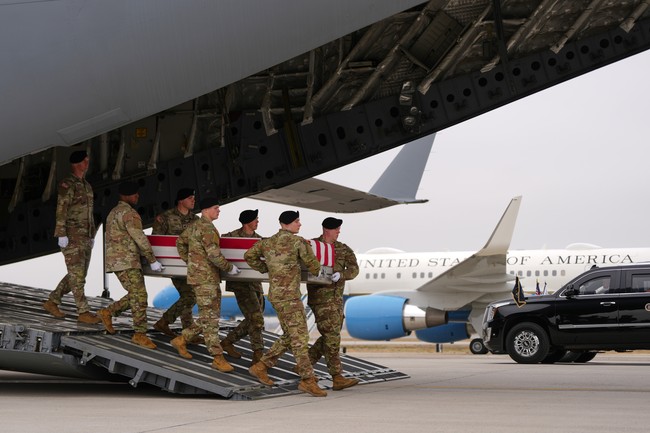
President Donald Trump stood quietly at Dover Air Force Base in Delaware as the remains of six American soldiers returned home from the war in Iran. The ceremony followed a long-standing military tradition known as a dignified transfer, where the flag-draped cases of fallen service members are carried from a military aircraft to waiting transport teams.
Trump attended the ceremony to honor the soldiers and to stand with the families who had gathered to receive them.
Each dignified transfer carries powerful symbolism inside the U.S. military. Service members move with careful precision while carrying the remains of those who died in uniform. The process reflects the military’s commitment that no fallen warrior returns home without honor. Dover Air Force Base has served as the primary arrival point for fallen American troops for decades, making the ceremony one of the most solemn traditions in the armed forces.
The dignified transfer, a ritual that returns the remains of U.S. service members killed in action, is considered one of the most somber duties of any commander in chief. During his first term, Trump said bearing witness to the transfer was “the toughest thing I have to do” as president.
“It’s a very sad day,” Trump told reporters on Air Force One as he returned to Florida later Saturday afternoon, saying that he was “glad we paid our respects.” He said the relatives of the deceased are “great people, great parents, wives, family,” and said that the “parents were so proud.”
Both Trump and Vice President JD Vance were present for the transfer, as were their spouses. A host of top administration officials were in attendance, including Defense Secretary Pete Hegseth, who wrote in a social media post Friday of “an unbreakable spirit to honor their memory and the resolve they embodied”; Attorney General Pam Bondi, White House chief of staff Susie Wiles, special envoy Steve Witkoff, and Tulsi Gabbard, the director of national intelligence.
Also present for the solemn event were governors and senators from Iowa, Minnesota, Nebraska, and Florida.
Trump briefly spoke with relatives who waited near the runway as the aircraft doors opened. families often stand only a short distance away during a dignified transfer, watching as militarypersonnel move the flag-covered cases from the cargo hold.
Trump described the six soldiers as “great heroes in our country,” words delivered in a subdued tone as the ceremony unfolded. The president’s role during the event centered on honoring the sacrifice of those who lost their lives and acknowledging the grief carried by their families.
The six members of the Army Reserve, who were killed by a drone strike at a command center in Kuwait, were all from the 103rd Sustainment Command based in Des Moines, Iowa, which provides food, fuel, water, and ammunition, transport equipment, and supplies. They died just one day after the U.S. and Israel launched their military campaign against Iran.
“These soldiers engaged in the most noble mission: protecting their fellow Americans and keeping our homeland secure,” Republican Sen. Joni Ernst of Iowa, a combat veteran, said earlier this week after the six were identified. “Our nation owes them an incredible debt of gratitude that can never be repaid.”
During the ritual, transfer cases draped with the American flag and holding the remains of the fallen soldiers are carried from the military aircraft that transported them to an awaiting vehicle to take them to the mortuary facility at the base. There, the service members are prepared for their final resting place.
Military leaders and casualty assistance officers coordinate every detail of the process. Teams from the Air Force Mortuary Affairs Operations unit oversee the arrival, while Army personnel assist with handling the remains when soldiers are involved. Officers assigned to casualty assistance remain with each family, guiding them through the difficult days following the notification of a loss. Their responsibilities include helping families understand benefits, funeral arrangements, and military honors that will follow in the coming days.
Dover ceremonies often unfold in near silence. Military transport aircraft land under carefully coordinated timing. Honor guard teams position themselves beside the aircraft before the cargo doors open. As the flag-draped transfer cases appear, the honor guard carries them slowly down the ramp and across the flight line. Families sometimes step forward during the moment, standing quietly as the remains of their loved ones begin the final journey home.
Presidents from both political parties have attended dignified transfers over the years. The appearances rarely involve speeches or political messaging. Instead, the president’s presence signals national recognition for the sacrifices made by service members and their families. The ceremony represents one of the few moments when the full weight of military loss becomes visible to the country.
The six soldiers who returned to Dover gave their lives during ongoing operations connected to the conflict in Iran. Military officials have continued investigating the circumstances surrounding their deaths, while maintaining contact with their families. The names of the fallen often become public only after the next of kin receives official notification.
For the families who gathered at Dover, the ceremony marked the beginning of a painful chapter that continues through memorial services and burial.
For the soldiers who carried the transfer cases and the officers who guided the families, the moment reinforced a central promise of military service: the nation remembers those who gave everything in defense of it.
The quiet scene on the runway reflected that promise: no cheers filled the air, no speeches dominated the moment, only the slow movement of honor guard teams and the steady presence of families waiting beside the aircraft.
President Trump stayed near the families until the final transfer case left the flight line. The ceremony ended as it always does at Dover, with the fallen beginning the final trip home under the protection of the flag they served.
Most voices across the political spectrum treated the moment with restraint. The return of six fallen soldiers created a rare pause in Washington’s constant arguments, with many leaders and commentators focusing on the sacrifice of the service members and the grief carried by their families.
Yet the Connecticut-based Hartford Courant couldn’t resist pulling the ceremony back into campaign politics.
Trump vowed as a presidential candidate to refrain from involving the U.S. in wars, campaigning on an “America First” policy that resonates with his political base. The conflict in the Middle East is testing that support.
The president has said the U.S. attacks could last weeks and on Friday demanded Iran’s “unconditional surrender.” While polls suggest most Republicans largely back the war, an increasing American death toll could test that support.
The framing stood in sharp contrast to the scene unfolding at Dover Air Force Base, where the moment belonged to six fallen Americans and the families who waited beside the runway.
Moments such as a dignified transfer exist to honor sacrifice, not to serve as a backdrop for election analysis.
PJ Media continues covering the deeper realities behind national events and the men and women who shape them. Readers can support that work through PJ Media VIP membership. A 60% discount is available when using the promo code FIGHT at checkout.