
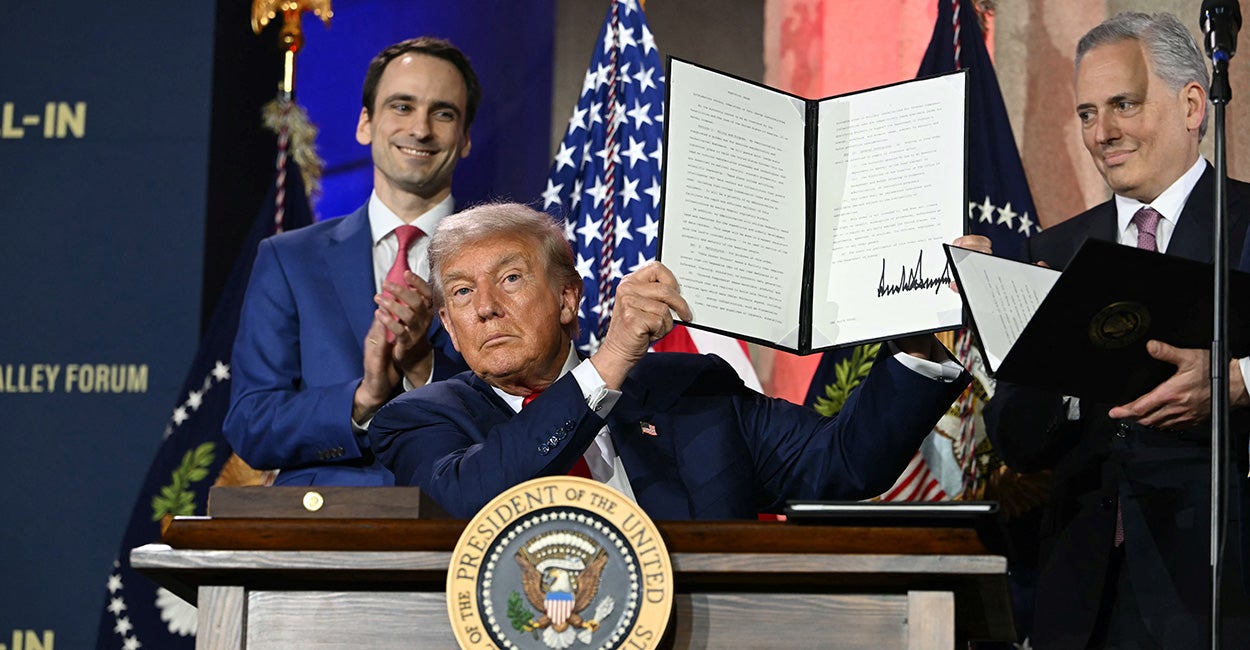
Now that the White House has passed the baton to Congress to codify a National Framework on Artificial Intelligence, an advocacy blitz is underway to shape the future of American tech policy.
President Donald Trump previously directed Michael Kratsios, his science and technology adviser, and David Sacks, former AI czar, to recommend federal AI legislation preempting state laws in conflict with the administration’s policy.
The White House unveiled its AI framework on March 20, advising Congress “to ensure a minimally burdensome national standard consistent with these recommendations, not fifty discordant ones.”
The child-first tech coalition and the AI accelerationist movement are now seeking to conform the framework to their agendas. The child safety coalition wants the strongest possible protections for children, while accelerationists want to impose minimal restrictions on AI innovation.
The White House framework is largely open-ended, giving Congress agency in crafting legislation to accomplish the president’s goals. Nathan Leamer, executive director of the pro-AI advocacy group Build American AI, says this was intentional.
“It’s kind of open-ended to allow it to be cognizant of many of the changes and recommendations that conservative activists have been calling for,” Leamer said.
Pro-Family Lobbying
A new nonprofit, which launched March 23 and is investing at least $10 million to fight for online protections for children, has already held 15 Capitol Hill meetings urging lawmakers to institute strong protections.
“The framework is everything,” Janet Vestal Kelly, CEO of Alliance for a Better Future, told The Daily Signal.
“The White House framework is an excellent start,” Kelly said. “It sets the direction on kids’ safety, and we’re pleased to see protections like age verification.”
Kelly said she was encouraged by how many lawmakers expressed interest in addressing child safety concerns, particularly Sen. Marsha Blackburn, R-Tenn., Sen. Josh Hawley, R-Mo., and Rep. Erin Houchin, R-Ind. She would like to see Blackburn’s Kids Online Safety Act and Hawley’s Guidelines for User Age-Verification and Responsible Dialogue Act included in the final framework.
Despite tech companies launching a lobbying push in Washington, D.C., Kelly is confident public opinion is on her side.
More than 80% of likely voters said they supported government guardrails on AI, according to a recent poll from OnMessage Strategies. Only 10% supported the idea that companies should innovate without restrictions.
On March 23 and 24, juries in New Mexico and Los Angeles found social media company Meta liable for intentionally harming young people’s mental health. Kelly believes that, for parents who lost children to suicide due to online abuse, these rulings will empower them to fight to protect other children.
“They have more lobbyists,” she said of tech companies, “but we have leverage.”
Pro-AI Lobbying
Tech companies are also dedicating time and resources toward preventing the codification of barriers to AI acceleration.
Build American AI, the advocacy arm of the $100 million pro-AI super PAC Leading the Future, plans to continue “education efforts” through meetings with legislators, panel events, and regular communication with policymakers, according to Leamer.
“Our mission is to aggressively support Congress in adopting a comprehensive national AI framework in partnership with the administration and responsible leaders across the AI industry,” Leamer told The Daily Signal. “This national framework is essential to ensure that the United States remains the global leader in innovation, job creation and user safety.”
The AI advocacy group will also deploy a “digital army of activists” to call and email lawmakers.
A new pro-AI group called Innovation Council Action announced Sunday it plans to spend $100 million to oppose AI regulation. The group is backed by David Sacks and Taylor Budowich, former White House deputy chief of staff.
Both sides of the AI debate will have to make deals for the framework to pass the House and Senate.
Many child safety advocates criticized the current guardrails for placing the duty of care for children on parents instead of Big Tech companies.
However, Neil Chilson, head of AI Policy at the Abundance Institute, thinks those advocates must be willing to negotiate.
“The art of the deal here will be finding out how everybody can claim to have won something while getting it across the line,” he told The Daily Signal. “And I think that that’s possible here, but it’s going to take some willingness to negotiate from all parties.”
Leamer said that including child safety protections in the framework is the only way tech accelerationists will be able to get that coalition on board with preemption of state AI laws.
“Not only are kid protections good policy,” he said, “but it’s also smart politics.”
The framework features “the realism and pragmatic approach we’ve been pushing for,” Leamer said.
Senior Advisor at American Principles Project Jon Schweppe believes members like Blackburn who introduced child safety policies can use the framework to secure policy wins.
These include “website-level age verification for adult content, via the SCREEN Act, and app store-level age verification, via the App Store Accountability Act,” as well as empowerment for parents and protection for kids from AI chatbots.
If the framework has these elements, it will continue to earn support from pro-family groups like American Principles Project, Schweppe said.
“We just have to make deals,” he said.