
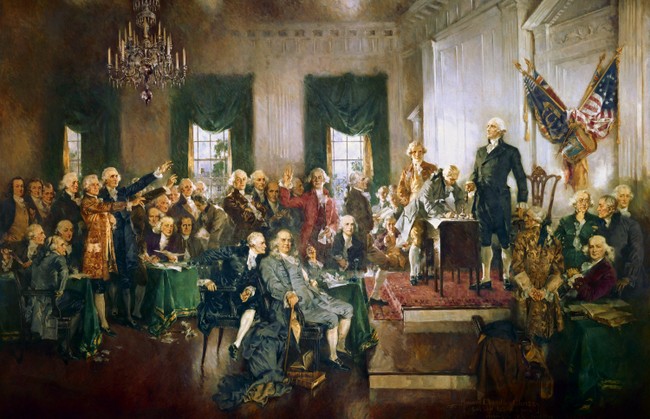
“We must take human nature as we find it.” —George Washington to John Jay, 1787
Why is it that the American founding seems as though it was built upon the proverbial rock, whereas other revolutions eventually washed away, as if built upon the proverbial sand? It is because our founders took account of immutable human nature, whereas other revolutions, thinking of mankind as Rousseau’s tabula rasa, set out to erase that nature. This is an impossible task. Mankind is made in the image of God (imago Dei), yet we are fallen (original sin). No man-made arrangements can fundamentally alter that state.
James Madison, in Federalist 51, put it this way:
Ambition must be made to counteract ambition. The interest of man must be connected with the constitutional rights of the place. It may be a reflection on human nature, that such devices should be necessary to control the abuses of government. But what is government itself, but the greatest of all reflections on human nature? If men were angels, no government would be necessary. If angels were to govern men, neither external nor internal controls on government would be necessary.
Being made in the image of God gives us our exercise of reason and the discernment of virtue, so that as long as our fallen side can be restrained, we need not suffer under tyranny:
As there is a degree of depravity in mankind which requires a certain degree of circumspection and distrust, so there are other qualities in human nature which justify a certain portion of esteem and confidence. Republican government presupposes the existence of these qualities in a higher degree than any other form. Were the pictures which have been drawn by the political jealousy of some among us faithful likenesses of human character, the inference would be, that there is not sufficient virtue among men for self-government; and that nothing less than the chains of despotism can restrain them from destroying and devouring one another. —Madison, Federalist 55
There was a time when every schoolchild in America could give you the basics of how the founders went about this task of allowing man’s better nature to flourish, while controlling his baser instincts. They could tell you there are three equal and distinct branches of government, legislative, executive, and judicial, and each has checks and balances over the others. For as Madison pointed out in Federalist 47, “The accumulation of all powers, legislative, executive and judiciary, in the same hands, whether of one, a few, or many, and whether hereditary, self-appointed, or elective, may justly be pronounced the very definition of tyranny.”
Think hard upon those words, dear reader, when encountering a federal bureaucracy that has combined all three and is virtually accountable to no one.
The schoolchild of yesteryear could also tell you that we have a federal system, under which power not expressly given to the federal government is reserved to the states or to the people. The Bill of Rights gets all the press, but they were amendments – afterthoughts. The twin bulwarks against tyranny are the separation of powers and the enumeration. How many folks that you encounter every day know that while state power is plenary (they can do what they wish as long as it does not violate the federal constitution or their own), federal power can only be derived from an expressly enumerated provision of the Constitution? Pitifully few, I suspect. It is why proponents of the expansion of federal power have so expanded the interpretation of the commerce clause that it is barely a limitation at all.
We need to return to understanding these principles ourselves and get back to teaching them to our children.
Consider also this: The Federalist Papers were written in haste, off-the-cuff, as newspaper columns arguing in favor of ratifying the Constitution. Compare them to much of what passes today for commentary and try to avoid weeping. Can it not also be suggested that such a confluence of brilliant men in this cause was an act in itself of Divine providence?
There may be those who would admire the work of our founders in accounting for man’s nature, but do not wish to base this upon theological underpinnings. For them, I offer the wisdom of two stoics, both west and east.
The first is Marcus Aurelius and his Meditations, which are succinct, profound thoughts, written originally as notes to himself, “This thou must always bear in mind, what is the nature of the whole, and what is my nature, and how this is related to that, and what kind of a part it is of what kind of a whole.”
Then there is Miyamoto Musashi, whose grasp of reality was forged in over sixty sword duels, most to the death. At the end of his life, he wrote the twelve precepts of his Dokkodo, or “Way of Waking Alone.” Like much of Japanese culture, his first principle is beautiful in its simplicity: “Accept everything AS IT IS.”
That is precisely what our founders did when accounting for human nature over two centuries ago.
The culture doesn’t take a day off—and neither do we. PJ Media VIP gives you exclusive access to original reporting, sharp commentary, and voices that won’t bend the knee. For a limited time, get 60% off your VIP membership with the promo code FIGHT. Join PJ Media VIP and stand with independent conservative media.