By Donald Jeffries
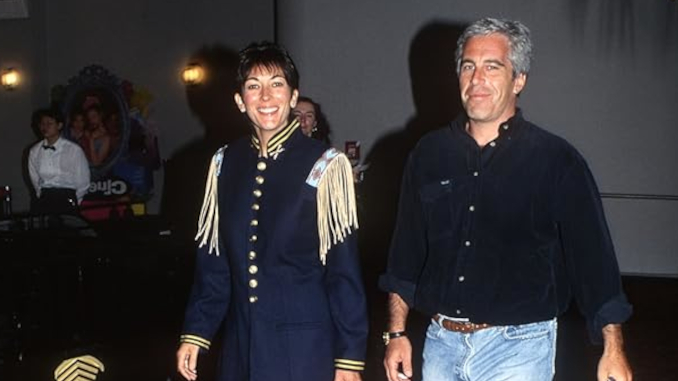
We are just learning that the Drug Enforcement Agency (DEA) opened a secret investigation into sex-trafficker Jeffrey Epstein and others in 2015. This grew out of a longstanding probe into organized crime, beginning when an informant reported that Epstein was involved in the distribution of “club” drugs like ecstasy, ketamine (used in date rape), and methamphetamines.
Click the Link Below to Listen to the Audio of this Article
The DEA investigation apparently relied upon information provided by Epstein’s accountants and attorneys, and European women who were employed as his assistants or were fashion models.
It’s unknown just how much the investigation revealed, because, in customary fashion, the complete files haven’t been released. This raises questions about how much the authorities knew about Epstein before he was finally arrested in 2019.

The Department of Justice (DOJ) has estimated that by that time, Epstein had victimized more than 1,000 individuals. A heavily redacted document released in January 2019 revealed that, even as Epstein connected with some of the world’s wealthiest and most powerful people, including royalty, federal officials were keeping a close eye on him. Documents show that officials tracked Epstein’s movements, and followed his money that went into offshore accounts.
Eventually, the Organized Crime Drug Enforcement Task Forces (OCDETF), comprised of hundreds of prosecutors and thousands of intelligence and law enforcement personnel, became involved. This meant plenty of funding and resources, including a fusion center, which the Department of Justice has called “the single largest repository of federal and foreign investigative reporting throughout the federal government.”

However, in 2025, the Trump administration shut down the OCDETF as part of its very limited spending cuts. Among OCDETF’s accomplishments was the 2019 capture of the notorious Mexican cartel leader Joaquin “El Chapo” Guzman. OCDETF’s responsibilities were mainly redirected to task force units with the Department of Homeland Security. OCDETF had launched an operation called Chain Reaction in 2011, which resulted in the prosecution of people in New York, including associates of the Genovese crime family. Racketeering charges included loan sharking, drug trafficking, and illegal gambling.
One police officer in Suffolk County, N.Y. was prosecuted for extortion, distribution of narcotics, and counterfeiting. In a twist, one suspected drug trafficker became an informant and told federal agents that Epstein had been involved in the funding and distribution of ecstasy, ketamine and methamphetamines. He also alleged that Epstein ran a prostitution ring.
In April, 2015, the DEA requested that OCDETF’s fusion center prepare a “target profile” on Epstein, 12 other individuals and two businesses. A DEA agent told OCDETF that the agency needed the information to support an investigation into money laundering, drug trafficking and the procurement of Eastern European prostitutes for high-profile clientele.
The investigation was led by the DEA’s Special Operations Division, which works in concert with 34 agencies, including the Central Intelligence Agency, Federal Bureau of Investigation (FBI), National Security Agency, and the Department of the Treasury. At length, a 69-page target profile was produced, involving “illegitimate wire transfers which are tied to illicit drug and/or prostitution activities occurring in the U.S. Virgin Islands and New York City,” according to the heavily redacted copy released by the DOJ.
Recently, Democratic Sen. Ron Wyden (D-Ore.) requested that the DEA provide an unredacted copy of the document along with additional details about its “mystery investigation.”
The identities of the 12 individuals and two businesses were redacted from the document released by the DOJ. However, website “Bloomberg” claims to have learned that the individuals include Epstein’s attorney, Darren Indyke; his brother Mark Epstein; and his accountants, Bella Klein, Harry Beller and Richard Kahn. Indyke and Kahn were the co-executors of Epstein’s estate after Epstein was killed in prison while in federal custody in August 2019.

“Bloomberg” identified the two businesses as Wagging Tail Entertainment and Ossa Properties Inc. Peggy Siegal, entertainment publicist and friend of Epstein’s, did business for Wagging Tail, according to multiple emails in the trove of Epstein Files. Ossa is a real estate company owned by Mark Epstein. Anthony Barrett, who was an executive with Ossa Properties, was also named in the target profile.
Some of Epstein’s victims have alleged in civil lawsuits that they were sexually abused in a building managed by Ossa Properties. Siegal declared that she was never questioned by the DEA or FBI, is no longer affiliated with Wagging Tail and denied knowledge of any investigation. Mark Epstein and lawyers for Indyke and Kahn, claimed not to “ever be aware of any DEA investigation.” The document found that Epstein and other individuals were associated with numerous suspicious activity reports, totaling nearly $50 million.
Longtime OCDETF Director Thomas Padden rather incredulously claimed not to be aware of any probe into Epstein. Considering that Trump has dismissed the Epstein Files as a “hoax,” and the distraction of the Iran war, further meaningful revelations are unlikely.