Warren Buffett once quipped: “When the tide goes out, you can see who is swimming naked.”

It’s all fun & games, until… Courtesy HitManJohnny
Buffet was referring to banks, companies and even investors that appear solid on the surface, but behind the scenes are unprepared for when things go south: entities with poorly thought-out business models, too much debt, not enough cash, weak internal controls and the like. In many cases, they don’t even realize it themselves until the moment that stress arrives.
With that in mind, consider where we stand today. We’re four weeks into the Iran war, and Buffett’s observation applies to an unsettling number of players — including, in important ways, the United States.
The Decision That Set It All in Motion
First, a very basic question: Why did President Trump authorize the use of American military power against Iran?
No doubt, there’s a substantial classified record behind that decision, and much of it will remain out of view for years. But at least one public thread offers insight: statements by Steve Witkoff, Trump’s Iran nuclear negotiator, who described his discussions with Iranian representatives and what he conveyed back to the President.
According to Witkoff, by late February, Iran was just weeks away from possessing enough highly enriched uranium to assemble roughly eleven nuclear weapons. This is what the Iranians themselves conveyed. They also presented data indicating that, within a relatively short period, they could construct dozens more — potentially as many as 75 additional devices.
From Trump’s perspective, the choice was straightforward: act promptly to degrade Iran’s nuclear capability, or risk being “that guy,” meaning the president on whose watch Iran went nuclear. Perhaps unsurprisingly – at least, in keeping with what we know about Trump – it was bombs away.
Since then, the media, pundit class and numerous retired military voices have been quick to criticize the decision. “No plan.” “No strategy.” “Historic blunder.” Indeed, all of a sudden, everybody is Carl von Clausewitz — the 19th-century Prussian theorist of war — or at least playing one on television.
Typically, these instant experts have little to offer beyond self-serving hindsight and academic jargon. Particularly, they fault Trump for somehow “not anticipating” that Iran would restrict transit of ships through the Strait of Hormuz.
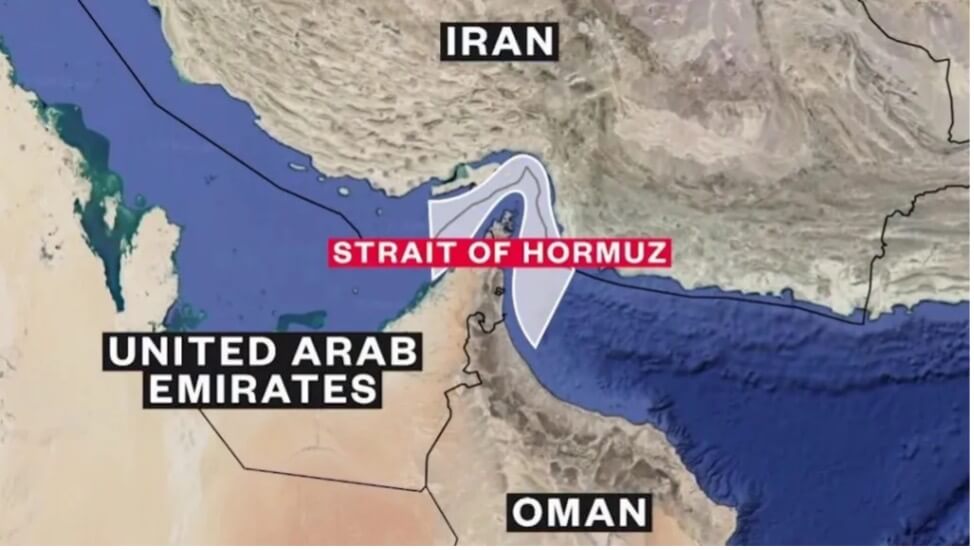
Strait of Hormuz. Courtesy LogisticsInsider.in.
What tends to be overlooked in all of this is something quite basic. Namely, that security of maritime transit through the Strait of Hormuz has been a core element of U.S. war planning since the 1940s, when the Navy first began operations in the region. In fact, during World War II, Hormuz was a key maritime corridor for U.S. ships that carried Lend-Lease materials to Iran, destined for shipment north to the Soviet Union.
In other words, for the past 80-plus years, and in any Gulf conflict scenario, the security of Hormuz is not a secondary consideration; no, it has been ItemNumberOne.
In every planning scenario, the security of Hormuz is always assessed, always briefed and always accounted for. There are no exceptions.
To me, at least, it’s inconceivable that Trump somehow “failed to plan” for Hormuz. Far more likely, he was fully briefed, understood the risks and chose to proceed anyway and, in effect, manage developments as they unfolded.
Which brings us to Iran.
Thirty Seconds That Changed the War
Since the 1990s, Iran has invested enormous resources — hundreds of billions of dollars — into building a layered military system.
Iran built extensive underground missile complexes, hardened bunkers, tunnel networks, proxy forces across the region and a nuclear program that achieved near-weapons-grade enrichment. None of this occurred by accident. It was the result of sustained effort, planning and coordination across decades, with support from counterparts including Russia, China and even North Korea.
And then the tide went out.
Iran’s air defense system appears to have failed in roughly the first 30 seconds of the conflict, degraded by U.S. cyber and space-based operations before it could respond in a meaningful way. Within hours, the airspace above Iran was effectively open.
Since that point, U.S. and Israeli forces have conducted sustained aerial operations across the country, delivering more than 18,000 air strikes, according to the Wall Street Journal. Every day of the conflict, aircraft ranging from legacy platforms to advanced fighters, along with drones and long-range missile systems, have struck a vast array of Iranian targets.
Iranian naval and air capabilities have been severely degraded. The country has lost its navy and air force, while land-based systems have absorbed extensive damage. Key industrial facilities have been hit. Personnel losses at senior levels have been significant.
Everything the regime constructed over multiple generations has been stress-tested in real time. And much of it has failed, although the Iranian regime remains “in power,” in a manner of speaking. For now, the rulers of Iran possess enough residual capacity to fire their remaining stockpiles of missiles and drones at U.S., Israeli and Gulf state targets. But they’re up against a relentless clock that delivers over 600 air strikes per day.
How long can they endure? We’ll have to wait and see…
Precision and Power, but Also Structural Limits
We could go on about Iran, but it’s also worth turning the Buffett test inward.
The United States has spent decades building military capability based on a power projection model that emphasizes technological superiority, precision targeting over distance, and high-performance systems. This is, in many respects, an “American way of war” — one that favors quality over quantity and seeks to deliver decisive effects through advanced capabilities.
This approach has advantages, particularly in the opening stages of a conflict; but it also carries structural limitations.
Top-shelf systems like, say, the B-2 bomber or F-22 fighter, are expensive, complex and maintenance-intensive. They’re not designed for prolonged, high-intensity campaigns that require sustained output over extended periods. And increasingly, that constraint is becoming visible.
Meanwhile, ammunition stockpiles are not as deep as they should be, not for this war and not considering other regions where conflict could break out. America’s warehouses are not full because past procurement decisions prioritized performance over volume, leaving gaps across multiple categories: cruise missiles, interceptors, air-to-air systems, guidance kits and more.
And replenishment is not a simple matter…
The Materials Bottleneck Nobody Can Ignore
Modern weapons systems depend on long lead-time inputs: rocket motors, warheads, internal electronics and a range of specialized materials. These inputs are not easily or quickly sourced. And the materials issue, in particular, runs deep.
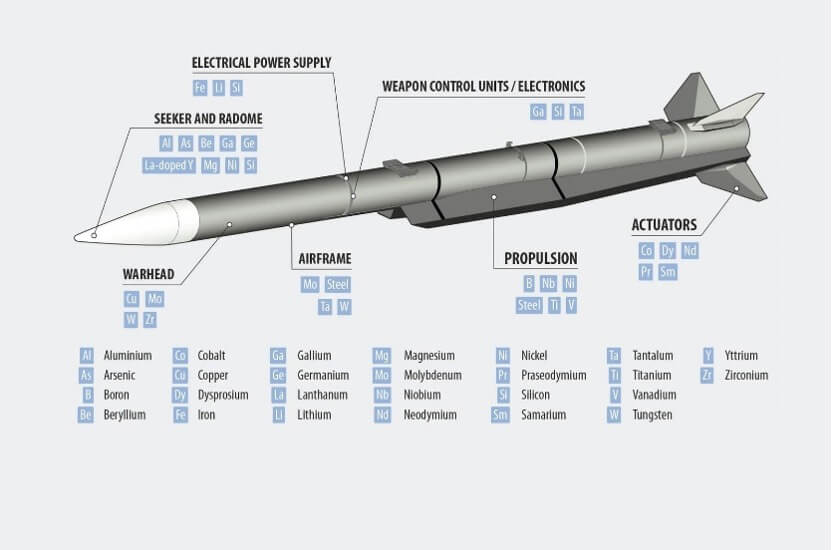
Primary raw materials used in a notional guided missile. Courtesy AWST.com.
The image above highlights numerous elements and materials inside a “notional” guided missile. Meaning not any particular make or variant. But in general, this is what’s there. We see 27 distinct items, and these are not all! Meanwhile, lack of any single one of these materials could become a choke point in the production cycle.
For example, antimony is essential for explosives and solid rocket motors, but is largely sourced from China which, since the end of 2024, has restricted exports. Tungsten presents similar story of scarcity and Chinese control.
Add gallium and germanium to the list, both critical for radar systems, electronics and guidance technologies. China controls those supply chains, all the way down to the ore in the ground.
Then there’s the issue of rare earth elements, used throughout modern defense manufacturing in magnets, electronics and other components, again with major dependency on China, a strong geopolitical competitor.
At larger scale, constraints on U.S. military power become more visible. Right now, the U.S. lacks sufficient shipyard capacity to expand naval production rapidly, and the same goes for aircraft. Workforce limitations affect the ability to build ships and aircraft, engines, electronics and other critical systems. Production bottlenecks are not theoretical; they are practical constraints.
Energy adds another dimension, certainly on the West Coast where refinery capacity has declined significantly over the past several decades; California had 42 refineries in the early 1980s, and today has but six, entirely due to the state’s regulatory and economic pressures.
Follow that chain of primary materials, production facilities and energy, and the pattern extends far beyond the United States.
A World of Exposed Supply Chains
Let’s take the Buffett bathing suit test overseas, where NATO allies love to virtue signal, but when Trump asked for help with Iran the answer was a collective “Umm… no.”
With characteristic snark, numerous nations characterized their unwillingness to assist in terms of general objections to the Iran conflict. But the truth is more foundational; namely, many NATO nations simply lack the ability to contribute meaningfully to sustained operations. Overall, NATO offers limited naval capabilities, airlift, and/or deep logistical support.
Let’s single out the United Kingdom, Canada, Australia and New Zealand for collective military weakness. Together, they have zero ships ready to sail to the Middle East, and even Britain could only release one destroyer, after several weeks of preparation, to go to Cyprus in the relatively friendly and protected Mediterranean area.
On the other side of the world, vulnerabilities are similarly structural. Right now, Australia faces extreme shortages of motor and aviation fuel as global shipping routes shift, while domestic capacity is constrained. In fact, Oz has but two oil refineries in the entire, continent-sized nation, and imports significant refined products from China (well, not for long because China is shutting them off).
Meanwhile, New Zealand maintains no refining capability and must import essentially all of its fuels and lubricants. And truly, New Zealand is at the far end of everyone’s logistical tail. (Good luck, guys!)
Further north, both Taiwan and South Korea depend heavily on imported oil and natural gas, particularly from Qatar and Saudi, as well as helium inputs necessary for their respective semiconductor fabrication businesses. Hmm… What were they thinking?
Again, we could go on with examples, but these illustrations don’t demonstrate isolated weaknesses. No, they highlight embedded dependencies, now starkly revealed under stress.
The Tide Is Revealing
Looking ahead, where do things go? Trump claims that his reps are negotiating with the Iranians. Officially, the Iranians deny that, and declare that they will never deal with the Great Satan. Okay, we’ll see.
But sooner or later the Iran war will end, whether through negotiation, escalation or exhaustion, and the underlying vulnerabilities will remain. Supply chains, industrial capacity, energy infrastructure and material dependencies are not short-term issues. They are structural realities built over decades.
And of course, there will be opportunities in the rebuilding process. But first, it requires clear thinking — and a realistic assessment of what this moment has exposed.
Thank you for subscribing and reading.