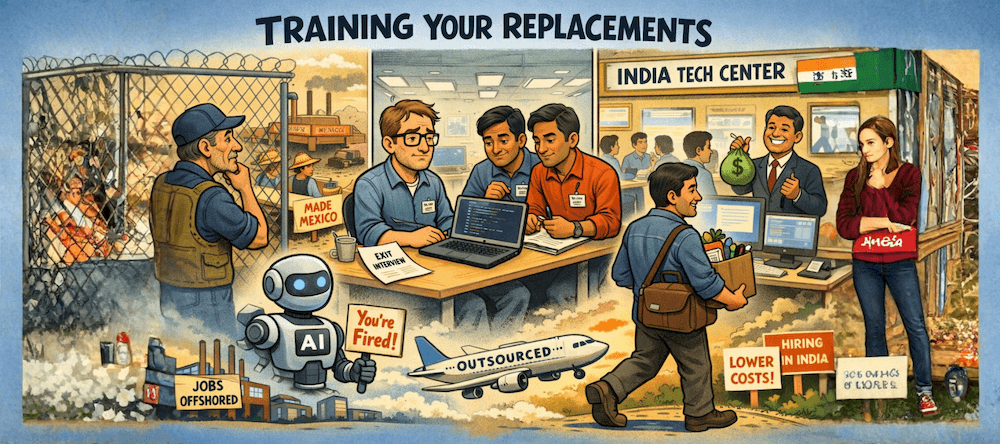
In the 1990s, NAFTA moved the factories south. Towns lost their plants, their tax base, and, most lamentably, their kids. The elites called it “efficiency.” The workers called it a gut punch.
Now the same film is playing again, but in a different, equally important industry.
This time, the soon-to-axed workers aren’t on the assembly line. These workers write the code to build our apps. They earn six figures, live in places like Austin and Seattle, and think their skill set makes them immune to government policy.
Are they immune? Far from it. Right now, Ross Perot’s “sucking sound of American jobs” can be heard throughout Silicon Valley.
Meta Delenda Est
Meta cut more than 21,000 workers between 2022 and 2023. Google, Microsoft, and Amazon followed with their own waves of pink slips. The presstitutes called it “restructuring.” The CEOs called it a “pivot to AI.”
Fine. Companies trim. It happens.
But here’s what they didn’t want you to notice.
While the layoffs were hitting American engineers, the same companies kept filing H-1B visa applications. And they kept building engineering centers in Bangalore, Hyderabad, and Gurgaon. They kept posting jobs that looked remarkably like the ones they had just declared “no longer needed.”
If you can ship the factory to Mexico, you can ship the code to India. In fact, it’s even easier.
Same logic. Different victims.
And if you think I’m being alarmist, watch this Palmer Luckey clip.
The Visa That Became a Pipeline
The H-1B visa was sold as a tool to fill gaps. When you genuinely cannot find an American with the right skills, you bring in someone from abroad who does. If anything, the incoming foreigner should be training his American replacement one day.
That isn’t what it became.
Today, roughly 70% of new H-1B approvals go to Indian nationals. China is a distant second. Everyone else fights over what is left.
Again, there’s nothing wrong with Indian engineers. Many are excellent. The problem isn’t the people. The problem is the structure.
When one country completely dominates a visa channel, you no longer have a global talent program. You have a single-nation pipeline, with its own universities, its own recruiters, its own referral chains, and its own body shops feeding workers into American firms at scale.
Once those networks take root inside a company, they shape who gets hired and who gets promoted. No conspiracy required. Just normal human behavior: you hire who you know, and you know who you trust, and you trust people from your own world.
The American engineer who never got in the door never knew what he missed.
Disney Was the Warning. Nobody Listened.
A few years ago, Disney made the news for a jaw-dropping reason. The company forced its American IT workers to train their own H-1B replacements before being walked out the door. Southern California Edison did the same.
The press covered it. Congress held hearings. Nothing changed.
Big Tech learned from that episode. They got subtler.
- Phase 1: Grow a base of H-1B contractors and build giant engineering centers offshore.
- Phase 2: Use a downturn or a “strategic pivot” to cut the expensive Americans.
- Phase 3: Backfill the work offshore or with visa workers who cannot easily walk away.
- Phase 4: Tell the press it’s all about AI and efficiency.
The optics are cleaner. The result is the same.
The Visa as a Restraint
An H-1B worker is legally tied to his sponsor. If he quits, he risks his entire life in America, including his visa, his green card application, and his family’s status.
(Incidentally, I had all those restraints placed on me whenever I moved to a foreign country for work.)
A domestic worker can quit on a Tuesday and have three interviews by Friday.
That gap in leverage is a feature of this insidious system.
Companies get compliant workers who won’t push back on bad conditions, low raises, or long hours. The worker’s vulnerability is built into the employer’s profit margin. Unfortunately, Congress built that into law and has shown zero interest in fixing it.
Meanwhile, the laid-off American engineer, who has no such constraints and thus costs more, is left wondering why the “meritocracy” didn’t work in his favor.
What NAFTA Did to Steel, H-1B Is Doing to Silicon
NAFTA didn’t destroy American manufacturing in a single blow. It changed the rules. Executives responded to those new rules in a Hemingway-like fashion: slowly at first, then all at once. A generation later, entire regions had been hollowed out.
The H-1B and offshore model is running the same play against the tech sector.
Wage arbitrage is real. A senior engineer in California costs two to three times as much as a comparable engineer in India. Every CFO sees that number and does the math.
Capability flight follows the work. When enough senior roles move offshore, the mentorship moves with them. The spin-offs. The institutional knowledge. The next generation of talent.
The U.S. stops being where cutting-edge work happens. It becomes a client.
We spent thirty years learning that lesson about manufacturing. We’re now on track to spend another thirty relearning that lesson in software.
What Fixes This
Blaming Indian engineers is wrong and lazy. They’re doing what anyone would do: responding to the incentives in front of them.
The incentives are the problem. Congress built them. Congress can fix them.
Three things would help immediately.
First, ban direct replacement. Any company that lays off American workers in a given role should be barred from hiring H-1B workers or offshore contractors for the same role for three years. Enforce it with audits and robust fines… that kind that actually mess with the bottom line.
Second, tie federal money to American jobs. Companies receiving CHIPS Act funds or large federal contracts should be required to retain a high share of core engineering roles in the United States. You want the subsidy? Hire the Americans.
Third, make visa workers mobile. Let H-1B holders switch employers easily. The more mobile they are, the less any one network can control them, and the less a single in-group can lock out everyone else.
Worse Than Onshoring H1Bs: Offshoring
Before I wrap up, I want to show you something worse than hiring H1Bs: outsourcing Americans’ jobs to India altogether.
Google’s moves show how naked this new devilry has become: in 2024, it cut at least 200 people from its U.S. “Core” teams, including engineers in Sunnyvale, while internal documents and press reports said many of those same roles would be rehired in India and Mexico as a cost-saving measure.
IBM axed thousands of U.S. jobs while ramping up hiring in India, increasing the number of open positions from fewer than 200 in early 2024 to nearly 4,000 by late 2024. Employees reported they were told certain roles could “only” be filled in India, and managers asked laid-off staff to train their Indian replacements.
Microsoft has followed a softer version of the same script: it had announced successive waves of layoffs hitting U.S. engineering roles in 2023 and 2025. But it continued to advertise large numbers of developer openings in India. Industry insiders have concluded the company quietly swapped higher-paid American coders for lower-cost India-based teams while blaming the cuts on “AI transformation.”
Wrap Up
For thirty years, the elites told factory workers to “learn to code.” Now the coders are under the gun, and the elites are saying the same thing in different clothes: adapt, upskill, compete globally.
But a country that won’t protect its industrial base isn’t a serious country.
A country that won’t protect its technological base isn’t a leading one.
The H-1B system doesn’t need to be abolished. It needs to be put back in its proper place: filling genuine gaps in American talent, not replacing American talent altogether.
Until that changes, American engineers will keep training their replacements.
And one day, they’ll realize they trained away the country’s future as well.