This morning’s Gospel reading is John 9:1-41:
As Jesus passed by he saw a man blind from birth. His disciples asked him, “Rabbi, who sinned, this man or his parents, that he was born blind?” Jesus answered, “Neither he nor his parents sinned; it is so that the works of God might be made visible through him. We have to do the works of the one who sent me while it is day. Night is coming when no one can work. While I am in the world, I am the light of the world.” When he had said this, he spat on the ground and made clay with the saliva, and smeared the clay on his eyes, and said to him, “Go wash in the Pool of Siloam”—which means Sent—. So he went and washed, and came back able to see.
His neighbors and those who had seen him earlier as a beggar said, “Isn’t this the one who used to sit and beg?” Some said, “It is,” but others said, “No, he just looks like him.” He said, “I am.” So they said to him, “How were your eyes opened?” He replied, “The man called Jesus made clay and anointed my eyes and told me, ‘Go to Siloam and wash.’ So I went there and washed and was able to see.” And they said to him, “Where is he?” He said, “I don’t know.”
They brought the one who was once blind to the Pharisees. Now Jesus had made clay and opened his eyes on a sabbath. So then the Pharisees also asked him how he was able to see. He said to them, “He put clay on my eyes, and I washed, and now I can see.” So some of the Pharisees said, “This man is not from God, because he does not keep the sabbath.” But others said, “How can a sinful man do such signs?” And there was a division among them. So they said to the blind man again, “What do you have to say about him, since he opened your eyes?” He said, “He is a prophet.”
Now the Jews did not believe that he had been blind and gained his sight until they summoned the parents of the one who had gained his sight. They asked them, “Is this your son, who you say was born blind? How does he now see?” His parents answered and said, “We know that this is our son and that he was born blind. We do not know how he sees now, nor do we know who opened his eyes. Ask him, he is of age; he can speak for himself.” His parents said this because they were afraid of the Jews, for the Jews had already agreed that if anyone acknowledged him as the Christ, he would be expelled from the synagogue. For this reason his parents said, “He is of age; question him.”
So a second time they called the man who had been blind and said to him, “Give God the praise! We know that this man is a sinner.” He replied, “If he is a sinner, I do not know. One thing I do know is that I was blind and now I see.” So they said to him, “What did he do to you? How did he open your eyes?” He answered them, “I told you already and you did not listen. Why do you want to hear it again? Do you want to become his disciples, too?” They ridiculed him and said, “You are that man’s disciple; we are disciples of Moses! We know that God spoke to Moses, but we do not know where this one is from.” The man answered and said to them, “This is what is so amazing, that you do not know where he is from, yet he opened my eyes. We know that God does not listen to sinners, but if one is devout and does his will, he listens to him. It is unheard of that anyone ever opened the eyes of a person born blind. If this man were not from God, he would not be able to do anything.” They answered and said to him, “You were born totally in sin, and are you trying to teach us?” Then they threw him out.
When Jesus heard that they had thrown him out, he found him and said, “Do you believe in the Son of Man?” He answered and said, “Who is he, sir, that I may believe in him?” Jesus said to him, “You have seen him, and the one speaking with you is he.” He said, “I do believe, Lord,” and he worshiped him. Then Jesus said, “I came into this world for judgment, so that those who do not see might see, and those who do see might become blind.”
Some of the Pharisees who were with him heard this and said to him, “Surely we are not also blind, are we?” Jesus said to them, “If you were blind, you would have no sin; but now you are saying, ‘We see,’ so your sin remains.”
“I am the light of the world, says the Lord; whoever follows me will have the light of life.”
That passage (John 8:12) is today’s Gospel acclamation at Mass. Today’s readings are all about light and darkness, both physical and spiritual, and the consequences of living in a fallen world of sin and disobedience. We are called to come to Christ and walk in His light, a call that mainly emphasizes the spiritual. However, it also speaks to our blindness in other ways, including our interpretation of the physical world and how our own appetites warp our vision.
To that end, and with our first reading from 1 Samuel in mind, let’s turn to C.S. Lewis’ The Screwtape Letters, which has an excellent discourse on how disordered appetites warp our perception of the physical. In Letter 20, Screwtape advises Wormwood to tempt his “patient” with women modeled after the current fad of beauty, whatever it mght be. At the time Lewis sets this passage, Screwtape notes that the current age has made the fainting-couch Victorian model of beauty passé, and that the Jazz Age allows them to “teach men to like women whose bodies are scarcely distinguishable from those of boys.”
The end result of this fetishization of youth and impossible body standards, Screwtape comments, allows demons to be “more and more directing the desires of men to something which does not exist—making the rôle of the eye in sexuality more and more important and at the same time making its demands more and more impossible. What follows,” he writes, “you can easily forecast!” It serves as a distraction from the point of sexual attraction, which is sacramental marriage founded in virtues, such as a woman “readily mixed with charity, readily obedient to marriage, coloured all through with that golden light of reverence and naturalness which we detest[.]”
Lewis has a more specific theme in mind in Letter 20, but the general lesson applies to today’s readings as well. In our first reading, the Lord sends Samuel on a mission to Bethlehem to find the next king of Israel. Samuel attempts to judge the prospects of Jesse’s sons by the standards of beauty and strength of that time, but the Lord warns him: “Do not judge from his appearance or from his lofty stature, because I have rejected him. Not as man sees does God see, because man sees the appearance but the LORD looks into the heart.”
Not as man sees does God see. Why? The Lord is the Light in our darkness, and not just spiritually. The fallen world has its own darkness, or rather, our own sins and appetites blind us to stark reality. In today’s Gospel reading, Jesus heals the blind man, but the Pharisees are blinded by what seems like a challenge to their authority. Others are blinded to the miracle because they assumed the man’s blindness to be a consequence of sin. They rejected the reality of this miracle and the clear sign of authority it represented.
Even the Pharisees saw enough, however, to realize that Jesus had spoken about their willful blindness. They had the capacity for sight, as do we all, but the Pharisees rejected the Light of Jesus despite the miraculous healing they had seen for themselves. Had they been actually blind, Jesus says, there would be no sin in missing it, but they saw and refused to accept the truth.
This is what sin does – it warps our sight to the point of blindness. We allow our appetites for power, control, and domination over Creation to blind us to the reality God sees. Lewis’ Screwtape explains this in the context of sexual attraction and marriage, while Jesus explains it in the exercise of charity and healing. It’s not that we choose darkness from a lack of options, but that we choose it because it suits our desires and distorted will.
When Jesus warns us that He is the Light of the World, He does not just mean spiritually. He is instructing us that we have made ourselves blind in every aspect of our lives through sin, and that only by setting aside our appetites and desires can we reorder them to what is good in His sight and in His light. As Paul writes to the Ephesians in our second reading today, we must choose the light over the darkness to awaken to our salvation:
You were once darkness, but now you are light in the Lord. Live as children of light, for light produces every kind of goodness and righteousness and truth. Try to learn what is pleasing to the Lord. Take no part in the fruitless works of darkness; rather expose them, for it is shameful even to mention the things done by them in secret; but everything exposed by the light becomes visible, for everything that becomes visible is light. Therefore, it says: “Awake, O sleeper, and arise from the dead, and Christ will give you light.”
Our Lenten journey is the process that we must use to succeed in this task. This season calls us to sacrifice that which blinds us to Christ’s light, and to awaken from the bondage of sin so that we may see the world as it truly is, in the Light of the Lord. Only in that light can we make the choices necessary to live the life to which Christ calls us.
I am the light of the world, says the Lord. He is also our light in the world, before us at all times to lead us to eternal life. Time to allow our eyes to be fully opened.
Previous reflections on these readings:
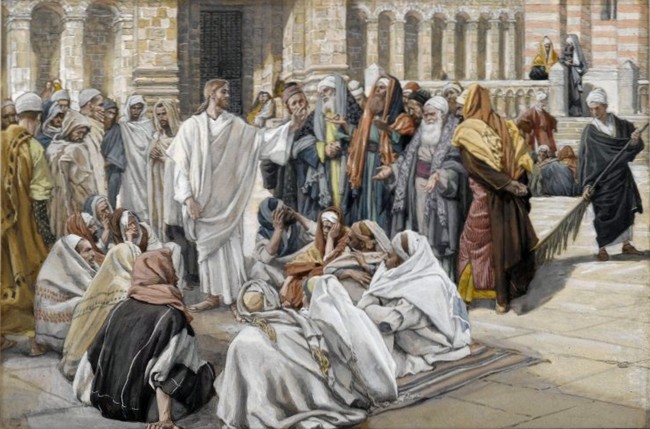
The front page image is “The Pharisees Question Jesus” by James Tissot, c. 1886-94. On display at the Brooklyn Museum. Via Wikimedia Commons.
“Sunday Reflection” is a regular feature that looks at the specific readings used in today’s Mass in Catholic parishes around the world. The reflection represents only my own point of view, intended to help prepare myself for the Lord’s day and perhaps spark a meaningful discussion. Previous Sunday Reflections can be found here.
Editor’s Note: Our Sunday Reflections are free to all readers, but our VIP members help keep this platform going for everyone. Join the effort by using the promo code FIGHT to get 60% off new memberships and upgrades to VIP Gold and VIP Platinum!