The war in Iran is the most important thing in the world today. It’s the equivalent of an economic nuclear war. And while everyone (including myself) watch oil prices tick higher minute by minute, there will be fallout.
One of the most important is nitrogen fertilizer.
Nitrogen fertilizer (primarily urea) is a critical part of modern agriculture. With sufficient nitrogen, grain production increases 50% to 100%. That’s far more than any other single nutrient application. The good news is that urea is plentiful, (normally) cheap, easy to transport, and apply.
However, the limiting factor is what we use to make urea…and that’s natural gas.
Natural gas is 90% of the cost of making nitrogen fertilizer. That means natural gas price spikes have a huge impact on the price of nitrogen fertilizer.
The last time natural gas prices spiked, the price of urea exploded from $200 per metric ton in 2020 to $1,050 per metric ton in April 2022. That spike came from a natural gas shortage due to the Russian invasion of Ukraine.
It shut down 70% of Europe’s urea production…
As I wrote here, Iran targeted Qatar’s giant Ras Laffan natural gas complex. That massive industrial area includes the world’s largest urea production facility. It can produce six million metric tons per year (about 12% of the world’s supply). Saudi Arabia produces about 17.2 million metric tons per year. And Iran also produces about nine million metric tons per year.
In total, those three states account for nearly half of the world’s annual urea production. And all three are offline right now. Urea prices are now up 25–35% since the start of the war. It will only get worse from here.
Natural gas prices rose slightly in the U.S., up 14% since the end of February 2026. But they are ripping higher in Europe. Dutch natural gas prices soared 65% after the Strait of Hormuz closure hit QatarEnergy’s ability to ship natural gas.
In 2022, companies like BASF and Yara took a beating. Both rely on natural gas to produce fertilizers and other products:
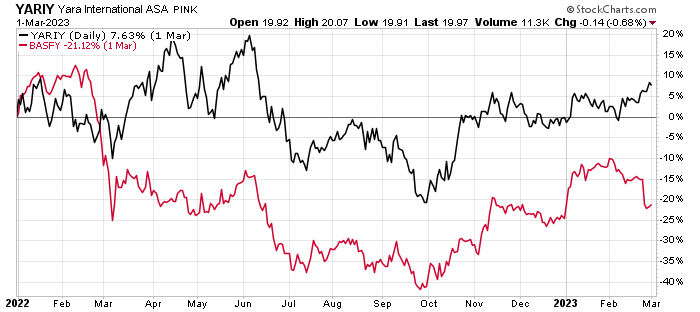
As we can see, BASF fell over 50% and Yara fell 40% in that crisis. However, that isn’t the case today. The market thinks Yara is bullet proof in the current crisis:
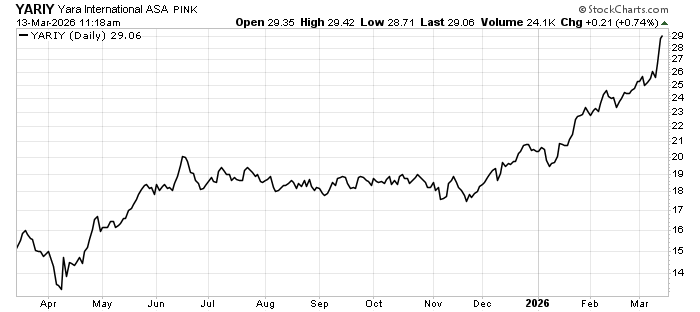
BASF isn’t quite as robust, but the stock hasn’t fallen much at all. That’s because in 2022, the three middle eastern companies kept producing, which kept the fertilizer price low. Today, the price of fertilizer is soaring, so it will offset some of the cost of natural gas.
That said, natural gas prices can reach the point where Yara can’t produce urea at a profit. That happened in 2022. I expect it to happen again in 2026. At that point, Yara’s shares will plummet.
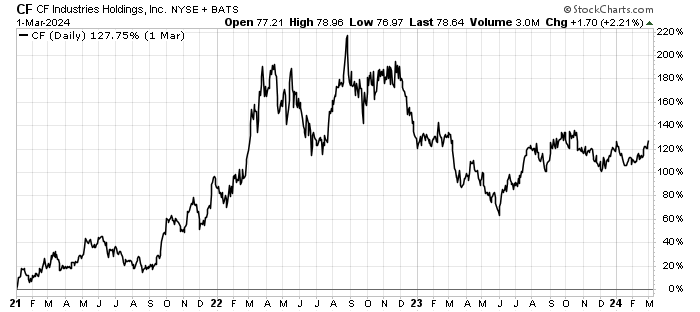
At the same time, a big winner from 2022 reemerged with the current crisis. U.S. based nitrogen fertilizer maker CF Industries (NYSE: CF) soared 180% from August 2021 to early 2022:
And investors piled in again in 2026:
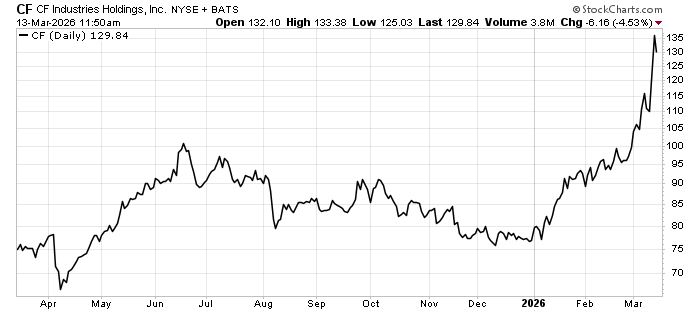
This trade has room to go higher, as the real damage to urea prices hasn’t settled in yet. However, as I suggested in the last essay, it may be better to simply buy natural gas ETFs:
There are several simple ways to speculate on natural gas prices. The U.S. Natural Gas Fund (NYSE: UNG) tracks the price of natural gas through futures. For those who want a little juice in the trade, there’s the ProShares Ultra Bloomberg Natural Gas Fund (NYSE: BOIL). BOIL provides a 2x leveraged return on natural gas futures prices.
Both speculations remain the best opportunity to play rising natural gas prices. And make no mistake, we will see higher gas prices this year.
That means higher heating costs for many. And the shortage of nitrogen fertilizer will make food significantly more expensive, too.