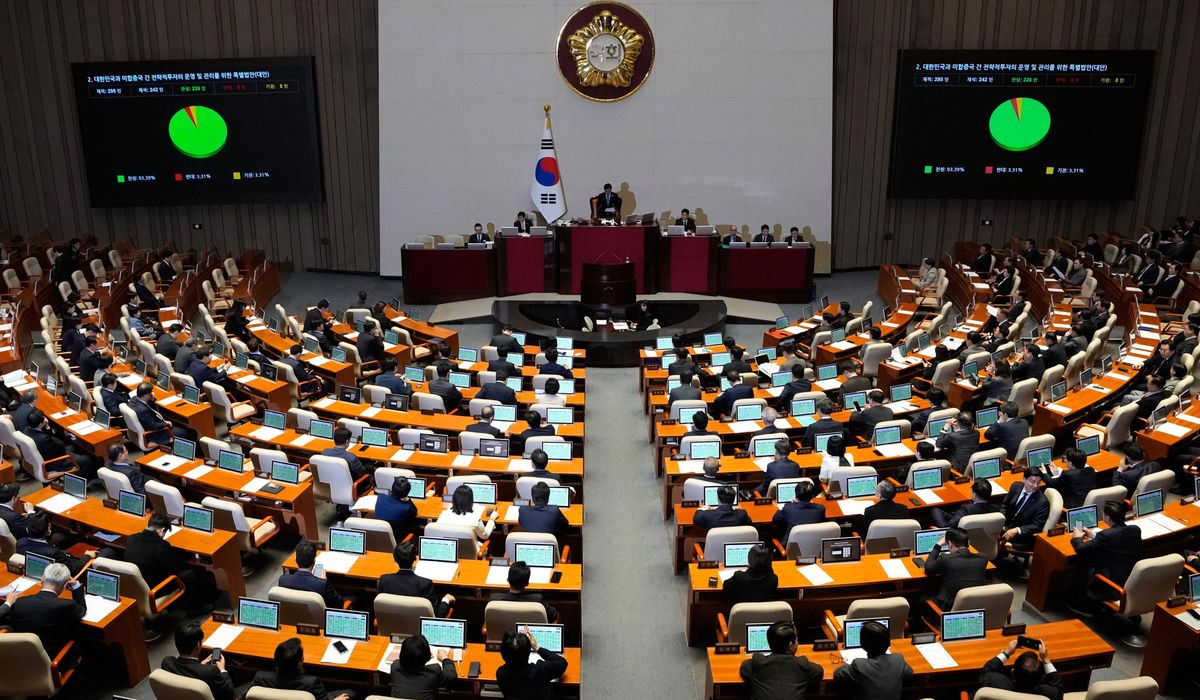
SEOUL, South Korea — South Korea’s National Assembly on Thursday passed a bill to invest hundreds of billions of dollars in the United States — just as Washington announced a probe into alleged unfair trade practices by Seoul.
The double-barreled economic developments came as President Lee Jae-myung admitted he had little input on the decision by the U.S. — under pressure to protect American forces and allies in the Middle East from an ongoing barrage of Iranian attacks — to redeploy air defense systems from South Korea.
The events showcase South Korea’s lack of wriggle room in its lop-sided relations with the U.S., experts said.
In a rare show of unity, Seoul’s ruling and opposition parties joined hands Thursday to pass a bill that will manage a $350 billion investment of Korean money into the United States.
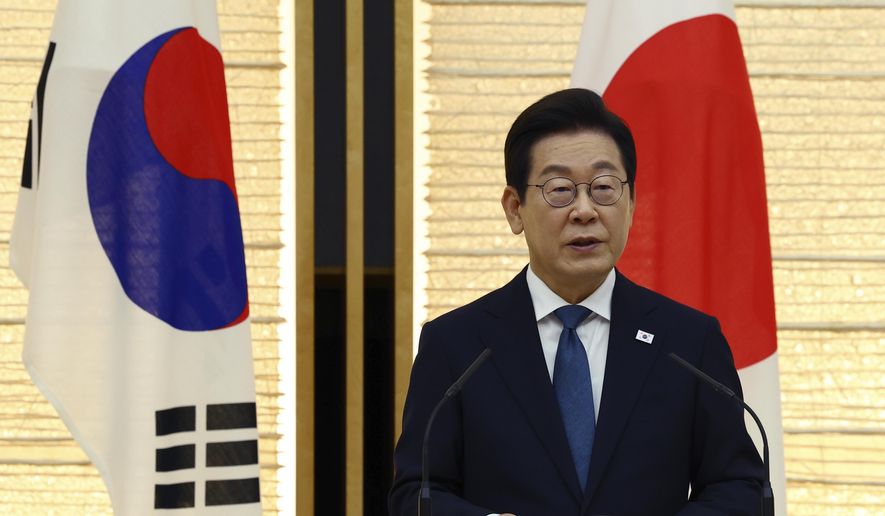
South Korean President Lee Jae-myung speaks …
more >
An estimated $150 billion is expected to go into shipbuilding and $200 billion into other strategic industries.
A special-purpose, state-run corporation with a staff of 50, will be established to manage the investments, Yonhap News Agency reported.
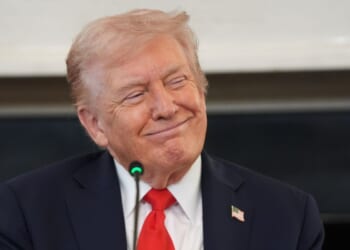
That may mollify U.S. President Trump, who expressed impatience in January with the slow progress Seoul was making on the pledged investment and threatened to raise tariffs on Korean goods.
The pledge was originally made in July 2025 and further codified during an October 2025 summit between the two presidents.
The size of the pledge alarmed some South Koreans, given Seoul’s foreign exchange reserves. In February, per Trading Economics, these reserves totaled $437 billion.
However, Mr. Lee and Mr. Trump agreed during their summit that monies deployed annually would be capped at $20 billion.
Mr. Trump, whose MAGA movement aims to reinvigorate U.S. industry, has taken advantage of America’s market size — the world’s largest — to leverage trade partners. The tool of leverage is tariffs on imports entering America.
Japan has similarly pledged to invest $550 billion in the United States. For decades, the two Asian manufacturing powerhouses have each run trade surpluses with the United States worth tens of billions annually.
Given Seoul’s and Tokyo’s reliance upon the U.S. for defense, neither is positioned to push back.
“South Korea is sort of over a barrel on tariffs,” said Mason Richey, a professor of international relations at Seoul’s Hankuk University of Foreign Studies. “Korea is being squeezed in different ways at the same time.”
Earlier on Thursday, the U.S. Trade Representative announced that it was initiating Section 301 investigations against 16 nations, including South Korea.
The powerful Section 301 of the U.S. Trade Act grants authority to investigate alleged unfair trade practices and apply tariffs to guilty parties.
“The United States will no longer sacrifice its industrial base to other countries that may be exporting their problems with excess capacity and production to us,” said U.S. Trade Representative Jamieson Greer per a USTR release. “Today’s investigations underscore President Trump’s commitment to re-shore critical supply chains and create good-paying jobs for American workers.”
Beyond trade, bilateral defence sinews are being similarly strained.
Reports from Seoul and Washington indicate that the Pentagon is shifting air-defense assets from South Korea to the Middle East, where Iran is proving resilient against the U.S.-Israeli aerial campaign.
Tehran is counter-striking targets regionwide, including air-defense radars, while forcing America’s Gulf allies to burn through air-defense munitions.
The redeployments raise questions over U.S. abilities to fight a two-front war.
Speaking to his Cabinet Tuesday, Mr. Lee frankly admitted his inability to influence Washington.
“U.S. Forces Korea may dispatch some air-defense systems abroad in accordance with its own military needs,’ Mr. Lee said. “While we have expressed opposition, the reality is that we cannot fully push through our position.”
The assets are believed to be Terminal High Altitude Area Defense, or THAAD, interceptors, designed to take down ballistic missiles, and Patriot PAC-3 interceptors, fired against multiple aerial threats.
Neither is crucial to Korean defense.
“I don’t think there is much use of THAAD here, as most North Korean weapons can be shot low, quasi-ballistic, and THAAD is only useful when it shoots at a much, much higher angle,” said Yang Uk, a security expert at Seoul’s Asan Institute.
“The U.S. Patriot missiles are only here to defend their own bases,” he continued. ‘It is not our [Korean-owned] Patriots that are going to another country.”
Still, for South Koreans, the alliance is starting to lose its shine. Mr. Trump’s Pentagon has been pushing South Korea to take on a greater share of defense responsibilities, while the U.S. maintains its “nuclear umbrella” over the peninsula.
“We cannot expect much reinforcement from the U.S. in terms of ground forces: That’s the hard fact,” Mr. Yang said. “If we don’t have nuclear deterrence of our own, and don’t have much help, people will start asking what the point of the alliance is — though that’s not happening yet.”
Seoul, facing an assertive Beijing to its west and nuclear-armed Pyongyang to its north, is in a bind. Doubly so, with the USFK becoming more regionally active.
In February, South Korea-based U.S. F-16s conducted patrols toward China over the Yellow Sea.
According to local media, an agitated Seoul, saying it had not been prewarned of the flights in the sensitive airspace, summoned USFK’s commander for a rebuke.
USFK has not confirmed the reports.
“The U.S. is a less reliable ally than before, but South Korea does not have the strategic autonomy to back away,” Mr. Richey said.
South Korea offers one advantage for America: location.
It is the only terrain on mainland East Asia where U.S. troops have a bootprint. Moreover, key U.S. bases sit on the nation’s China-facing Yellow Sea coast.
“I do think [Secretary of State Marco] Rubio and [Under Secretary of War Elbridge] Colby understand the value of South Korea as an ally due to the geostrategic location it occupies,” Mr. Richey said. “But the U.S. is not in a mood to compensate other countries for the strategic value they provide. … How long can you cease to appreciate your allies before they start to hedge and look around?”