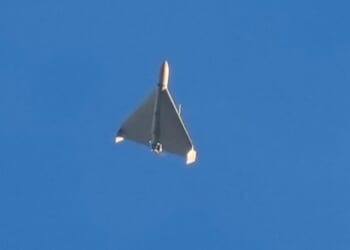
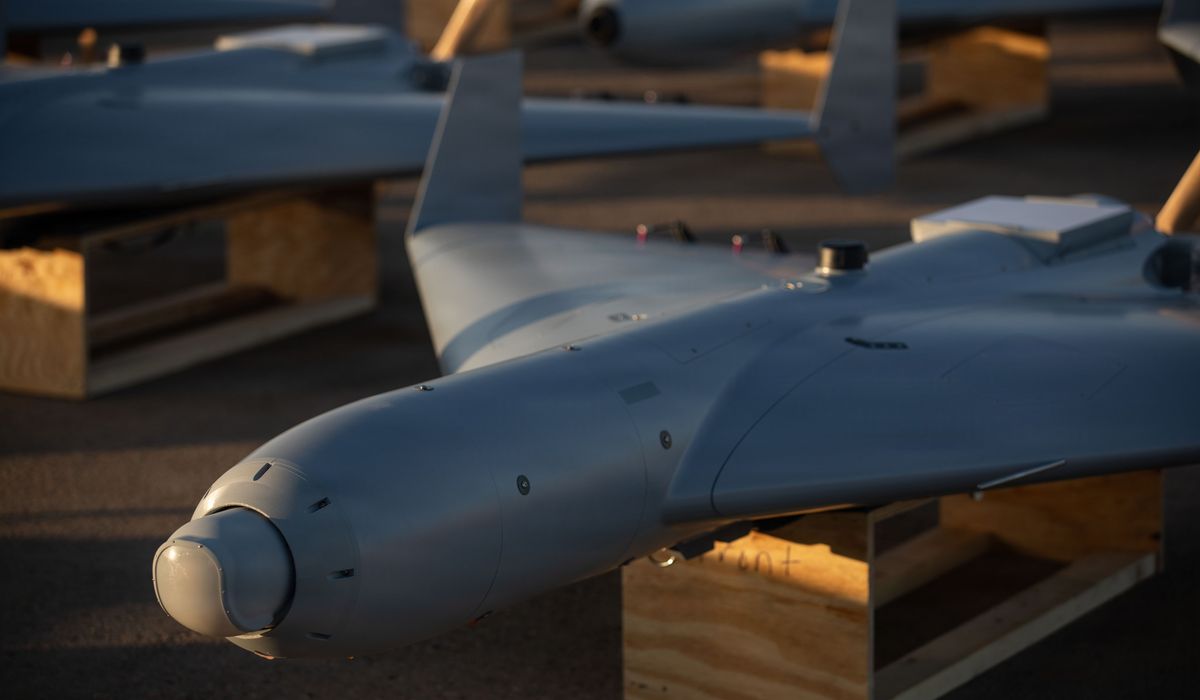
The first combat deployment by the U.S. of a one-way attack drone — a weapon reverse-engineered from an Iranian design and turned back against Iran itself — marks a milestone in Operation Epic Fury. Seven months after unveiling the new American weapon, Adm. Brad Cooper, commander of U.S. Central Command, announced the new drones were being used in the U.S.-Israeli campaign in Iran.
But as the Pentagon touted the debut of the Low-cost Uncrewed Combat Attack System, known as LUCAS, a fundamental question remained: What role is artificial intelligence playing on real battlefields when it comes to the final decision to strike a target?
Adm. Cooper described the LUCAS drones as “indispensable” during a congressional briefing last week.
The economics driving the enthusiasm are obvious. The use of high-cost precision rockets and missiles has steadily depleted U.S. stockpiles as suppliers have struggled to keep pace.

Adm. Brad Cooper, commander of U.S. …
more >
LUCAS, built by Arizona-based SpektreWorks, costs about the same as a small car — roughly $35,000 per drone. That’s a fraction of the $2 million the U.S. pays for one of the Tomahawk cruise missiles that LUCAS now supplements.
“It’s a perfect-use case,” said Lauren Kahn, a senior researcher at Georgetown University’s Center for Security and Emerging Technology. Ms. Kahn previously worked for the Department of Defense on policies meant to push tools such as LUCAS out to warfighters.
Adm. Cooper echoes her assessment, telling lawmakers that relatively cheap drones will push the U.S. to “the other side of this cost curve” in the conflict with Iran.
“This was an original Iranian drone design. We captured it, pulled the guts out, sent it back to America, put a little made in America on it, brought it back here, and we’re shooting it at the Iranians,” Adm. Cooper said during Thursday’s briefing.
Iran’s mass-produced drone, the Shahed, has been used extensively by Tehran in attacks against Israel and battle-tested in Ukraine, where Iranian ally and arms-customer Russia has made drone warfare a key element of its war effort.
Drones have proven so critical in Ukraine that Russia in March 2025 was producing and launching more than 1,000 a week of its own versions of Shahed-style drones, according to a brief by the Center for Strategic and International Studies.
“It has been tested on the battlefield now tens of thousands of times,” Ms. Kahn told The Washington Times.
The U.S. version still needs to cut costs to match its adversaries.
Travis Metz, the Pentagon’s Drone Dominance program manager, told the Senate Armed Services Committee that his program’s goal is to push down costs “to less than $2,000 for a one-way, kamikaze attack drone.”
Ukraine produces comparable systems for less than half that $2,000 threshold, but Kyiv still uses Chinese parts.
America’s drone programs have been fast-tracked, but need to be faster still, some lawmakers said.
“Both the American commercial drone industry and the Pentagon are years behind the curve in producing and employing drones,” Sen. Roger Wicker, Mississippi Republican and chairman of the Senate Armed Services Committee, said in the hearing. “American drone companies were essentially forced out of the global market. Diminished commercial demand made American drones far more expensive than Chinese drones.”
Cheap parts from China and what Mr. Wicker described as “predatory practices” have limited the ability of U.S. manufacturers to compete in the growing global market for inexpensive drones.
But the cheap and dangerous Shahed has forced the Pentagon to pursue a solution to a battlefield problem that is more than just tactical and technological in nature — it’s economics.
Defending against drones with expensive air defense interceptor missiles isn’t sustainable long-term, so new techniques and tools have emerged in the effort to keep pace. Ukraine has continuously improved its technology as it holds the line against the invading Russian forces.
“Ukraine had become a bad word in the Pentagon,” Sen. Jeanne Shaheen, New Hampshire Democrat, said during a hearing with Mr. Metz and his colleagues. Ms. Shaheen recently traveled to Ukraine and saw drone production factories and advanced drone technology that manufacturers there were sending straight to the front line.
“What they were talking about in Ukraine was iterating those drones every two weeks,” Ms. Shaheen said. “I don’t know how we think we’re going to compete if we’re talking about an every six months schedule.”
The LUCAS was in development with the Department of Defense well before it was revealed to the public, according to Ms. Kahn. Now, with its relatively fast procurement and development cycle and continued exposure to the department, there are next-generation questions about how American warfighters will use the deadly weapons.
“You’re talking about a drone that may very well be radio-controlled,” Sen. Mike Rounds, South Dakota Republican, said during last week’s hearing. “It doesn’t take long for an adversary to figure out a way to stop that communication.”
Maj. Gen. Steve Marks, the director of the military’s Defense Autonomous Warfare Group, was pressed at the hearing on how artificial intelligence is used by LUCAS drones.
The general said that he would have to answer in a classified setting.
The response highlighted how LUCAS and other systems that utilize AI have become central elements of a massive and ongoing dispute between the Pentagon and the AI firm Anthropic.
Congress has not passed legislation establishing a legal framework for how AI can be used to kill. No set of rules, other than those the Pentagon has set for itself, governs how an AI weapon can be used in lethal military operations.
The Pentagon’s regulation, Directive 3000.09, was signed by former Deputy Secretary of Defense Kathleen Hicks in January 2023 and remains relatively untested.
With its AI, LUCAS can complete its route to a target even if jammed — and has the capability to carry out a potentially lethal strike without human oversight.
That prospect left some lawmakers uneasy.
“Before we rapidly scale up production and field more of these systems that have AI incorporated into their capability, we need a clear answer on this,” said Sen. Mark Kelly, an Arizona Democrat.
Ms. Kahn, who was part of the team that developed the policy signed by Ms. Hicks, disagrees.
“It is not an autonomous weapon system,” she said. “But it does have autonomous capabilities at certain elements.”
She noted that systems like the Patriot missile battery and the Navy’s Aegis combat system have operated in autonomous modes for decades without generating the same scrutiny.
She argues that simply continuing guidance as anti-jamming — the kind of capability LUCAS is publicly acknowledged to have — is similar. It only has a narrow function, not an entire system making decisions on the battlefield.
“Do we need to broadly think about how we are using AI-enabled capabilities, yes,” she said. “But if we don’t continue to develop our policies and change the testing and evaluation…I think we’ll run into a little bit of a problem there.”
It’s a view that Gen. Marks was comfortable sharing publicly.
“I am not sure that the law of armed conflict has dealt with this issue,” Gen. Marks said. “That’s why I think it’s up to us … that we take this issue of humans in the loop seriously and create the framework that DOD will apply to these systems.”
The gap between producing the drones and fielding them is shrinking, and while LUCAS was in a longer development cycle, it is now being deployed in the field — effectively as an active test.
The Pentagon has signaled a $1 billion multiyear buy, and a second round of competitive testing — the Drone Dominance gauntlet — is scheduled for August, with JIATF-401, the Pentagon’s counter-drone task force, attempting to develop technology to shoot down every drone that vendors put in the air.
“We’re not at totally new and unfounded territory,” Ms. Kahn said. But the technology, she added, is moving faster than the policy designed to govern it.