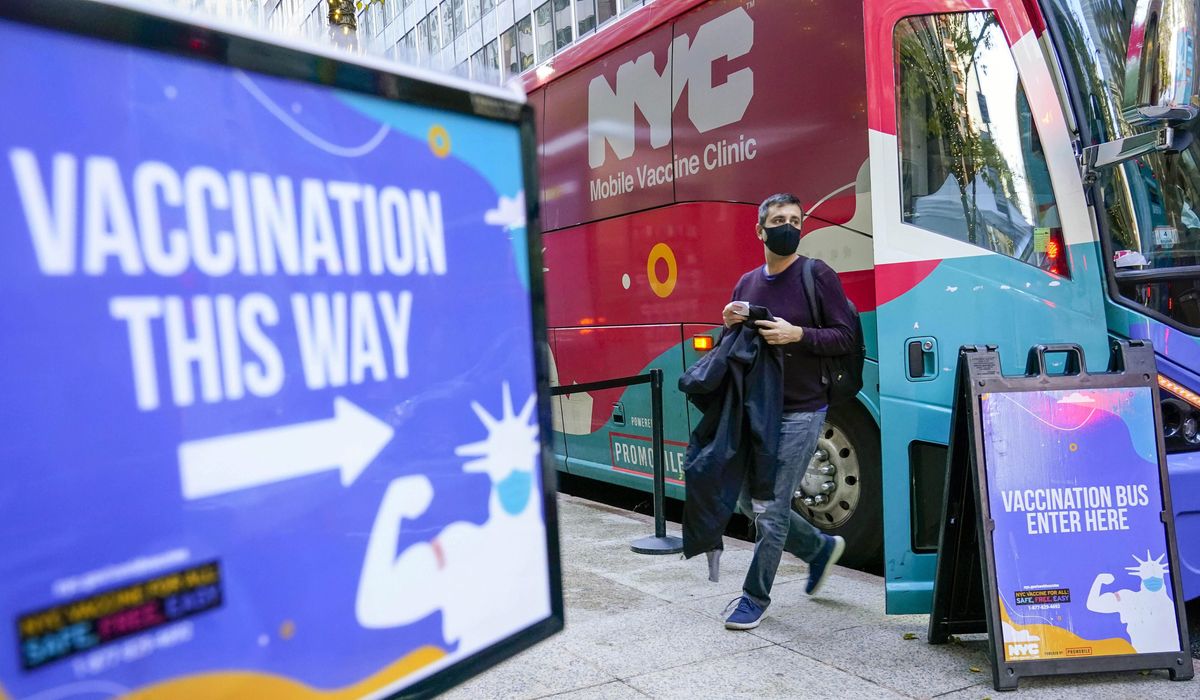
Six years after the coronavirus pandemic began to rip through the U.S., spreading death and sparking draconian shutdowns, the country still has not had a full accounting of the dystopian restrictions the government imposed to try to control the virus — and the public.
A coalition of civil rights groups says it’s time for that reckoning.
They have launched the COVID Justice Resolution, a call for Congress to officially repudiate government “overreach.” They say it’s not an attempt to assign blame — there’s enough to go around — but to reassert constitutional boundaries that slipped during the pandemic.
“There have never been any apologies,” said Jeffrey A. Tucker, a leader of the effort and founder of the Brownstone Institute. “These kinds of wounds are festering, and real, and widespread. I don’t believe there will ever be healing from what happened until we get some culturally significant institution saying very clearly ’This was wrong.’ That has to happen. And, think about it, it has not happened.”
He said he’s looking for the “biggest possible statement in the most painless way.”
The SARS-CoV-2 virus was first spotted in Wuhan, China, went on to slay millions worldwide, and still percolates today.
But six years after it first crested, the world still has no consensus on its origins, nor the actual death toll attributed to the virus.
And while the medical community proclaims a sort of unanimity about treatments, the public — after conflicting advice on masking at the start of the pandemic, and vaccine efficacy during the crisis — is less certain.
The social measures put in place are even more controversial: Police stationed at state borders to block entry; employees divided into essential and non-essential; churches shuttered for months, canceling Easter and Christmas services; school canceled, with students only allowed back after proof of emergency-authorized vaccines.
For all that, Mr. Tucker said, there came a tipping point at which politicians were happy to put the whole thing behind them.
“The whole thing was so insane. It was crazy. it was like a level of clownish evil,” he said. “It’s not clear when it stopped happening. It just sort of slowly faded away. We weren’t even sure when the pandemic ended. We don’t even know that. The channel just changed and we’re left with such pain and suffering.”
The reckoning resolution is backed by his outfit and the Health Freedom Defense Fund, Children’s Health Defense, the Independent Medical Alliance, Stand for Health Freedom and the Autism Action Network.
They call out the stay-at-home orders, school closures, mandatory shuttering of “non-essential” private businesses and houses of worship, masking and vaccine mandates, social media pressure campaigns that trended toward censorship, and the massive amount of taxpayer money pumped into battling the virus and backfilling the economy the government had shut down.
The resolution, which Mr. Tucker said they’re looking for a senator to sponsor, expresses “profound regret” for all of that.
He said President Trump has shied away from a reckoning, perhaps because the first draconian responses came on his watch. “Fifteen days to slow the spread” turned into months and years of lockdowns and restrictions.
Even without a big accounting, there have been small steps.
The Coast Guard announced last week that it was reinstating — with back pay — 56 members who were booted after refusing to get the vaccines.
The Pentagon last December said more than 8,000 troops were fired for refusing the vaccine between Aug. 24, 2021, and Jan. 10, 2023. Defense Secretary Pete Hegseth ordered his department to review some 3,000 cases to see whether people who were given general discharges should be upgraded to honorable discharges.
Jay Bhattacharya, who was a professor at Stanford University and a severe critic of lockdowns and mask mandates, now leads the National Institutes of Health and, as of Feb. 18, also runs the Centers for Disease Control and Prevention.
And a federal judge just ruled in favor of the Central Intelligence Agency, which had fired the former Defense Department doctor who pushed the mandatory vaccines on the Pentagon.
Legally, though, the precedent for the firings remains.
The Supreme Court on Feb. 23 declined to hear two cases from Air Force personnel who were dismissed after refusing the Defense Department’s 2021 vaccine mandate. The airmen had asked for back pay and declarations that their religious rights were violated.
Budget-wise, tens of billions of dollars in COVID cash remain unspent. Sen. Joni Ernst, Iowa Republican, proposed legislation last November to claw back some $65 billion.
And the Labor Department’s inspector general put out an alert several weeks ago warning that more than $700 million in unspent pandemic unemployment benefits are still sitting on government-issued payment cards, and nearly $200 million more have been sent to state unclaimed property offices.
The inspector general said the government needs to take urgent steps to recover the money before it can be grabbed by fraudsters.
“We’ve identified where the money is. There is no excuse for delay, and no acceptable outcome other than returning these dollars to the American people,” said Inspector General Anthony D’Esposito.
He and other inspectors general are still bringing fraud cases and the Justice Department is prosecuting them.
But Congress appears to have moved on.
A bill to double the statute of limitations on prosecutions of pandemic unemployment fraud from 5 to 10 years cleared the House last March with strong bipartisan support. The Senate has taken no action on it.
For more information, visit The Washington Times COVID-19 resource page.