Let me take you back to October 2002.
Two-thirds of Americans were convinced Saddam Hussein was close to having a nuclear weapon. Another 14% thought he already had one. And two-thirds — that’s right, the same supermajority of your fellow citizens — believed Saddam personally helped the terrorists who flew into the World Trade Center.
None of it was true.
Not the nukes. Not the stockpiles. Not the al-Qaeda connection. Post-war investigations didn’t just fail to confirm the WMD case. They dismantled it brick by brick, calling it, in the polite language of government commissions, “a colossal failure.”
Less politely: they told us a story, we believed it, and 4,500 American soldiers and somewhere between 150,000 and 1,000,000 Iraqis died for it.
So you’ll forgive me if I don’t snap to attention when The Swamp starts cycling through its greatest hits again.
Same Script, Different Villain
Here’s what they told you in 2002: Saddam has WMD. He’s close to the bomb. He’s connected to the terrorists who hit us. We can’t wait for the smoking gun to be a mushroom cloud. (That last one was Condoleezza Rice, and you have to admit, it’s a metaphoric masterstroke.)
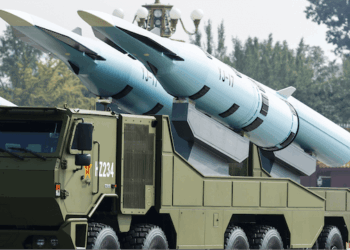
Here’s what they’re telling you now about Iran: The regime is “a week away” from a bomb. They have material for 11 nukes. And they have long-range missiles capable of hitting the U.S. mainland. But — and this part is important — we’ve already “decimated” their facilities.
Wait.
If we decimated the facilities, how are they still a week from the bomb? If we broke their nuclear program, how are they reviving it? And if this is a “limited operation,” why does the target list now include the nuclear program (which shouldn’t exist), the ballistic missile arsenal (which was decimated), the navy (even ships in international waters), the Supreme Leader (a new one every day it seems), and support for regional proxies (Israel has already invaded southern Lebanon)?
When the threat is this serious, the story should get clearer the closer you look. Instead, exactly like Iraq, the closer you look, the fuzzier it gets.
The Art of Weaponized Uncertainty
Here’s a thing politicians discovered a long time ago: you don’t need certainty to sell a war. You just need enoughuncertainty to keep people scared.
In 2002, the intelligence community loaded the National Intelligence Estimate on Iraq with caveats, such as dissents, hedges, and qualifications. State Department analysts thought the aluminum tubes weren’t for centrifuges. Energy Department scientists agreed with them. None of that made it into the speeches. What made it into the speeches was Condi’s Cloud.
Today, Trump’s team is running essentially the same play, just faster and on social media. They announced the attack in a video. Truth Social posts clarified the aims (which now change by the minute). Phone interviews hinted at the expected duration of the war.
Each platform got a slightly different version of the story, which means none of them got the story, because there isn’t just one. There was just enough fog to keep the operation moving forward. At the same time, the adults argue behind closed doors about whether this is a “limited rollback” or the opening act of something considerably less limited.
To its credit, Reuters reported that aides were actively debating “how far to go” and fretting about midterm optics. It’s a remarkable thing to be doing in the middle of a war. But then again, these are remarkable times.
The Incentive Structure, or: Why They Keep Doing This
Here’s the uncomfortable part, and I want you to sit with it for a moment.
Nobody in Washington is twirling a mustache. Nobody woke up and decided to deceive the American public for sport. The problem is structural: the incentives of the political system point relentlessly toward threat inflation, and the public doesn’t punish anyone for overstating danger.
Think about it. If you say, “Iran might be moving toward nuclear capability, and we should monitor it carefully,” you sound positively European. If you say, “Iran is a week from the bomb, and we cannot allow that,” you sound like an American leader. The first statement is more accurate. The second one wins elections.
Bush’s team learned this. They turned uncertainty — genuine, documented uncertainty about what Saddam actually had — into near-certainty in their public messaging, and it worked. Majorities supported the war. Congress voted for it. The press, with some honorable exceptions, played along.
The fact that the war turned out to be a catastrophic misadventure didn’t change the underlying incentive. It just means the next salesman needs a new coat of paint on the same car.
Meanwhile, bureaucracies are constitutionally incapable of saying “we don’t know.” Technical experts on Iran say there are real questions about the range and reliability of Iranian missiles, uncertainties about weaponization timelines, and debates about what “decimating” a nuclear program actually achieves. That nuance doesn’t make it into the briefings. What makes it into the briefings is the “unacceptable threat to the American people.”
And once the bombs start falling? The logic of sunk costs kicks in. Iraq started with “disarmament.” Then it became regime change. And then a counterinsurgency. And finally, unfortunately, Iraq became a decade-long nation-building project.
The Iran operation started as “stop the bomb,” and the shopping list is already four items long. Mission creep isn’t a bug. It’s the feature. As of writing, we’re on “carpetbombing civilian enclaves in Tehran.”
Look, I’m Not Saying Iran Is a Lovely Country
I want to be precise here, because someone always wants to misread this.
I’m not saying the Iranian regime is good. I’m not saying its nuclear ambitions are fictitious or its support for regional militias is benign. Heck, if I were the Ayatollah, I’d be working relentlessly to get a bomb to enjoy the kind of tranquility it affords Kim Jong Un. I’m also not saying military force is never justified or that Iran presents no challenge whatsoever to American interests.
What I am saying is the last time Washington sold us a war against a country larger than Grenada with this particular combination of ingredients — shifting threat assessments, politically convenient intelligence, vague war aims that multiply under scrutiny, and an information environment designed to outrun skepticism — it didn’t go well.
I’m absolutely asserting that “trust us this time” isn’t an argument. It’s an insult.
The minimum rational response from anyone who watched the Iraq debacle unfold — and watched the post-war commissions confirm that the WMD case was fiction built on assumptions built on political pressure — is to demand clarity before committing, not after.
The Fool-Me-Twice Problem
There’s an old saying, famously mangled by the dumbass who was president during the last time we did this: fool me once, shame on you; fool me twice, shame on me.
The script, urgency, and shifting aims are the same. The certainty about things that turn out to be uncertain is the same. The political incentives to overshoot and then rationalize are the same.
The only thing that’s changed is the country on the poster. It’s an even bigger nut to crack than last time.
Wrap Up
My skepticism isn’t pacifism. It’s not naivety about the nature of the Iranian regime or the genuine complications of nuclear proliferation.
It’s a learned response to watching a political system demonstrate, in excruciating detail, how easily it can turn uncertainty into inevitability and doubt into doctrine. The system turns a country that posed no imminent threat (47 years… for crying out loud!) into a justification for a war that costs trillions of dollars and an uncountable number of lives.
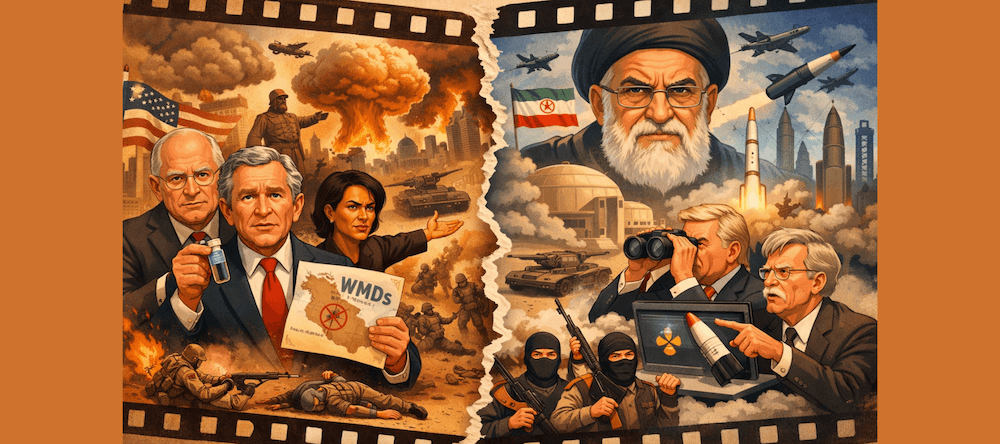
I’ve seen this movie.
The ending sucked.
I won’t buy a ticket to the sequel just because they changed the title.