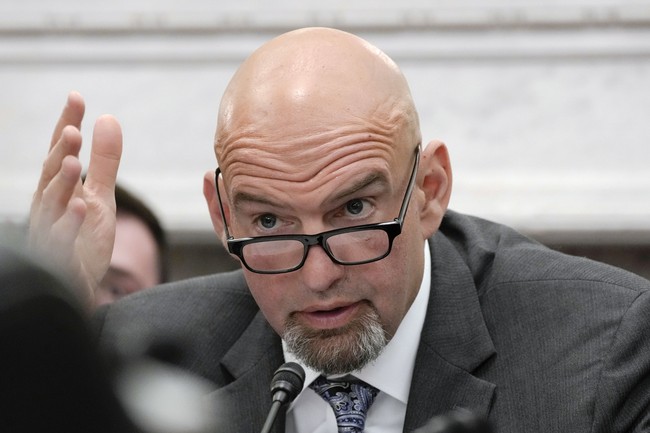
Sen. John Fetterman (D-Pa.) backed the U.S. and Israeli strikes on Iran without hesitation, calling Operation Epic Fury entirely appropriate, and said eliminating Ayatollah Ali Khamenei, the un-alived supreme leader of Iran, removed one of the most dangerous figures in modern history.
President Donald Trump confirmed the mission targeted senior regime leadership gathered in Tehran, with early reports stating roughly 40 to 50 of the top Iranian officials were killed in the attack’s early wave. Fetterman didn’t hedge, asking why anybody would grieve leaders of a regime tied to terror networks and decades of repression. He said that Americans should recognize the strategic impact of removing the head of a government that funds violence across the world.
.@SenFettermanPA on killing of Iranian Supreme Leader Khamenei, after closed-door briefing: “The world is safer, and it’s more just now…Why can’t you just acknowledge that one of the most evil people on the face of the earth was erased? That’s a good thing,” pic.twitter.com/7s0AQx37EY
— CSPAN (@cspan) March 3, 2026
Fetterman’s stance again puts him at odds with several Democratic colleagues who questioned the legality and timing of the strikes. He described their reactions as bizarre. He pointed to the regime’s record, including the 1988 mass executions of political prisoners that killed an estimated 30,000 dissidents under orders tied to regime leadership, making clear the target wasn’t the Iranian people, just the regime.
Vice President JD Vance stated that the administration’s objectives remain preventing Iran from acquiring nuclear weapons. Fetterman said he’d oppose efforts to restrict the president’s authority under the War Powers Resolution.
Because Fetterman’s policy beliefs keep him planted firmly on the left, Fetterman won’t switch parties. But when national security comes into focus, he regularly breaks from progressive orthodoxy and takes a position rooted in deterrence and strength. In a chamber full of Congresscritters using scripted responses, his statements read as uncommon steadiness.
Critics raised legal concerns, questioning whether the threshold for immediate military action had been met, while others argued Congress should’ve been consulted before the strike.
Raise of hands: who envisions Schiff, Jeffries, and Swalwell would keep their pie holes shut?
Fetterman countered that Iran’s nuclear development and missile expansion represent a continuing threat, even if not tied to a single launch window, saying that waiting for perfect conditions invites greater danger.
Israeli Prime Minister Benjamin Netanyahu led his country’s role in the coordinated strike, and Fetterman defended both Netanyahu and Trump against critics who labeled the attack as reckless. Fetterman argued that removing senior regime leadership weakens proxy forces such as Hezbollah. His position exposed a visible split inside his party, particularly among lawmakers who reflexively oppose any military action.
The broader debate now turns on escalation and authority. President Trump said the objective remains stopping Iran’s nuclear ambitions and restoring deterrence in the region. Lawmakers continue to argue over oversight and limits, but Fetterman’s remarks show that support for the strikes crosses party lines, even if only in narrow lanes.
The result of Operation Epic Fury and how it will reshape the relations between the U.S. and Iran remains to be seen. What’s clear is that one Democrat senator chose to defend a strike he believes strengthens American and Israeli security, even when doing so separates him from much of his caucus.
National security debates test whether lawmakers follow party currents or independent judgment.
Fetterman, thankfully, chose judgment.
If you value analysis that cuts through predictable talking points, join PJ Media VIP today and get 60% off with promo code FIGHT.