A major Mexican military operation last weekend ended with Nemesio Rubén Oseguera Cervantes, better known as El Mencho, and one of the world’s most powerful cartel leaders, dead. And the aftermath across Mexico turned violent fast.
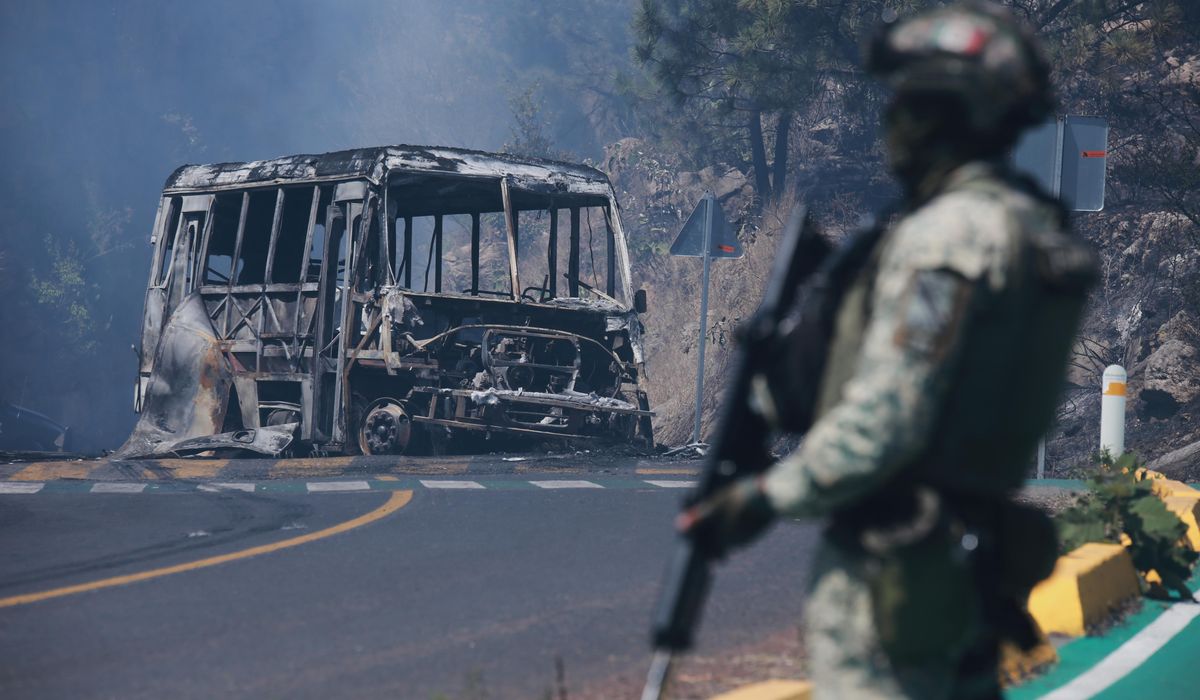
Mexican officials say that during the raid itself and the wave of chaos that followed, more than 70 people were killed, including at least 25 members of Mexico’s National Guard. Now, cartel crews immediately afterwards set up hundreds of roadblocks across Mexico, while several key airports in places like Guadalajara and Puerto Vallarta were briefly shut down, leaving tourists, including some Americans, basically stranded.
The U.S. Embassy in Mexico urged Americans in some parts of the country to shelter in place out of potential fear for their own safety.
Now, the White House says the U.S. did provide some intelligence support for this operation, calling it an example of what’s become really unprecedented, close cooperation between the U.S. and Mexico. The questions now, though, are what exactly that support looked like, what happens to the cartel next, and whether taking out one leader actually reduces violence or triggers the next round of it.
I’m Ben Wolfgang, and this is my question-and-answer segment on the landmark Mexican military operation that led to the death of the cartel leader, what it means for the United States and for Mexico going forward, and whether it’s a political win for President Trump.
Who was El Mecho and why did his death matter so much?
El Mencho was 59 years old and was the head of the Jalisco New Generation Cartel, or CJNG, for about 15 years — more or less since that organization was founded back in the 2009, 2010 time frame. He’s had a $15 million bounty on his head, both from the U.S. and Mexican governments, for years. So that should give some indication on just how pivotal of a figure he was considered to be in the drug trafficking world.
Essentially, he’s been on the run for a long time, but was still able to command one of the world’s most violent and deadly cartels that spread fentanyl and other drugs all across the planet — virtually every continent in the world — and raked in billions of dollars in profits every year.
What happened during the operation?
Well, Mexican authorities said they actually tracked him via one of his romantic partners. So that just could give you some insight on how closely Mexican officials had been trying to find out his whereabouts now for a matter of years. They finally got a lead, intelligence-wise, by tracking one of his romantic partners and eventually made the decision this past Sunday to move in.
Now, as you would expect, El Mencho was traveling with his own heavily armed security detail, and they essentially engaged in a shootout with Mexican military forces. This is where some of the casualties stemmed from. You had this violent shootout in which multiple people on both sides died. El Mencho himself was wounded and then eventually captured by Mexican authorities after trying to hide in the bushes. So he was moved via helicopter and essentially died while being transported by Mexican authorities.
There have been a few conflicting details coming out in terms of exactly what happened during that operation itself. But the broad strokes of it so far is that it was relatively quick and obviously bloody.
What happened in the aftermath of the operation?
This to me is probably one of the most important and potentially impactful aspects of this entire story — that’s how quickly the cartel, CJNG, was able to mobilize its members across various regions of the country to engage in violence and disruption of other sorts. We’re talking about, of course, firefights with Mexican National Guard members — you know, more than two dozen of whom were killed — the setting up of roadblocks that impacted travel, airports, flights, cancellations, and other kinds of violence.
There have been plenty of video footage and photos across social media of burning cars, burning roadblocks, just violence, burned out buildings across various regions of Mexico. So I think if you want to take a step back and think about what this means for the long term, El Mencho’s death didn’t immediately decapitate essentially this cartel. It was able to get messages out to its members.
In fact, it was also able, by some reports, to engage in what seems to be a fairly sophisticated social media campaign to actually amplify the amount of violence that was going on around Mexico. Essentially, they used what some have dubbed fake news to make it look like they were sowing more chaos even than they were. So not only are they able to engage in violence in the immediate aftermath of the death of their leader, they also seemed to have had a plan in place to make it look like they were more powerful and dangerous than they even were.
How did this impact locals and tourists in Mexico?
As you can imagine, this level of violence had a real impact on both local populations and tourists in Mexico, including Americans visiting places like Puerto Vallarta, which is a pretty popular vacation spot and generally considered to be relatively safe — one of the relatively safer areas in Mexico.
Even though a lot of the airports weren’t closed entirely for very long, there were still plenty of flight cancellations simply because people couldn’t get there because of roadblocks, enhanced security, and a number of other factors impacting those airports and those transportation hubs.
I’m not entirely clear at this point — I haven’t seen a whole lot of detail on what preparations were made, what coordination was made, if any, between Mexico and the United States in terms of trying to get some of those folks out. Obviously, you can’t announce an operation like this ahead of time, so your ability to get people to safety is pretty limited. But I would be willing to bet, and I’m pretty confident, that behind the scenes you had the State Department asking the Mexican authorities, are you going to have enough security on the ground to protect resort towns or other areas where you’re going to have a lot of tourists, from the violence that I’m sure both governments expected to erupt after this operation.
What role did the U.S. play and what do we still not know?
Well, there are a lot of questions about this. Now, one thing that we were getting some reporting on now is the new U.S. military-led Joint Interagency Task Force-Counter Cartel, which is essentially a new body stood up by the Pentagon, led by the U.S. military, that’s working with the Mexican military to more or less map networks of cartel members operating on both sides of the border. Because let’s not forget, these cartels, of course, operate all across the United States to one degree or another.
So you have the Pentagon under the Trump administration that has clearly placed a huge priority on disrupting these cartels and stopping the flow of fentanyl and other drugs into the United States. President Trump, of course, designated El Mencho’s cartel and a number of others as a foreign terrorist organization last year, shortly into his term. I think it might have been the first week that he was in office, designated some of those cartels foreign terrorist organizations, which as a technical and legal matter does give the Pentagon, does give the White House, does give the federal government more avenues, essentially, to pursue them.
Watch the video for the full conversation.
Read more:
Click here to receive the daily Threat Status newsletter delivered directly to your inbox.