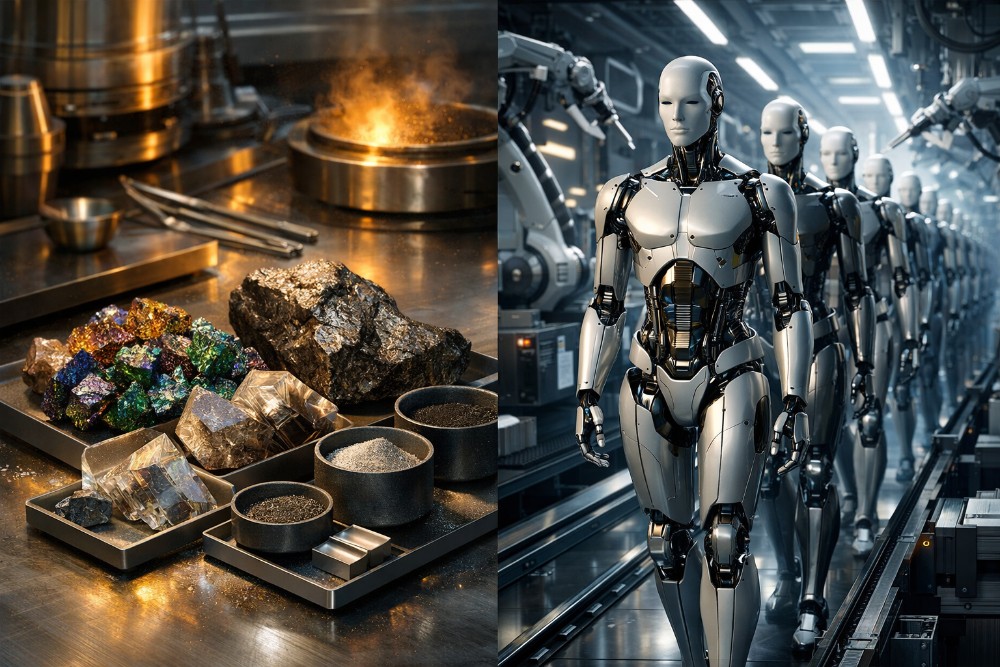
AI.
Robots.
And the rest of Elon’s visions…
These things all have one major “flaw” in common. They require MASSIVE amounts of critical metals that the US doesn’t currently produce.
Take Tesla’s sleek new Optimus robot for example.
Developers claim that the humanoid robot can do all sorts of tasks that are too repetitive or hazardous for people. It has the same AI stack used for Tesla’s self-driving cars.
The rest of the technology is dizzying in its complexity. Engineers made Optimus lightweight using advanced alloys and composites. It has refined sensors for fine manipulation. And it leans on Tesla’s advanced electric motors and batteries.
It’s an incredible feat of engineering and science. That’s why, if you are bullish on Optimus and the future of robotics, you are a mining bull too. You must be, because without these weird metals, none of it can happen.
That’s the disconnect for investors. They all want to own Tesla, but don’t know a thing about the companies that produce the materials needed for the Optimus program.
Here’s the thing…the U.S. produces little to none of that metal. Let’s break down the critical metals needed for Optimus into their metal inputs:
- Structure: aluminum, magnesium, and steel
- Motors and wiring: copper, neodymium, praseodymium, dysprosium, and terbium
- Battery: lithium, nickel, cobalt, manganese, graphite (non‑metal), silicon
- Electronics: silicon, tantalum, tin, silver, gold, and specialty semiconductors.
The bad news is that few of these come from the U.S. Here’s a list of those metals that come from imports:
- Tin – recycled only, no mined supply
- Aluminum – less than 1% of global supply
- Neodymium and praseodymium, – only at the Mountain Pass mine (MP Materials)
- Dysprosium and terbium – No mined supply currently. Energy Fuels and USA Rare Earth are developing production.
- Nickel – only from the Eagle mine in Michigan
- Cobalt – only as a byproduct of nickel and copper mining
- Manganese, graphite, tantalum – none
Without these metals, the Optimus robot doesn’t exist. Hell, the future of computing and technology doesn’t exist.
That’s the situation facing all the developed nations today. China mines or refines the bulk of these metals. China built that industry out over a decade or more. And so it holds the keys to those metals today.
In contrast, the U.S. began phasing out mining in the 1950’s and 1960’s. take tantalum for example. The last domestic mine closed in 1959. Since then, the metal’s utility soared.
Here’s how the U.S. Geological Survey describes tantalum:
Tantalum (Ta) is ductile, easily fabricated, highly resistant to corrosion by acids, and a good conductor of heat and electricity and has a high melting point. The major use for tantalum, as tantalum metal powder, is in the production of electronic components, mainly tantalum capacitors. Major end uses for tantalum capacitors include portable telephones, pagers, personal computers, and automotive electronics. Alloyed with other metals, tantalum is also used in making carbide tools for metalworking equipment and in the production of superalloys for jet engine components.
The U.S. is 100% reliant on imports for one of the most important metals in advanced jet engines and electronics. And we need more of it every year…
From 2023 to 2024 (the latest data available), tantalum demand in the U.S. grew 75%. And all of that relied on imports. In 2023, the U.S. imported half of all the tantalum produced globally. And it went up from there.
Now the west must react quickly…and nothing in mining happens quickly.
When demand soars and supply does not, the price must go up. The price of tantalum hit multi-year highs in 2025. Tantalite (the unrefined ore) sold for $100 per pound in May 2025. The import price of tantalum hit $836,000 per ton.
The bulk of the raw material (tantalite) comes from the Democratic Republic of Congo and Rwanda. Like oil in the 1900’s, much of the current U.S. diplomatic focus is on securing supplies of these metals.
When the U.S. invaded Venezuela, the oil story was a distraction. At least one factor was the presence of coltan, an ore of niobium and tantalum. Venezuela has a large amount of critical metals resources.
The “big thinkers” focus on these metals because they are the root of projected power. If you want to win the global AI war, you need all these materials. China boxed out the world, so everyone else is spending whatever it takes to catch up.
As investors, we need to jump on that train. It’s a great way to make money. And if you are a tech bull anyway, it makes sense to invest in the metals that drive the development and production of technology.