Panama’s Supreme Court just gave China a big blow… and Donald Trump’s national security plan for the Western Hemisphere a big win.
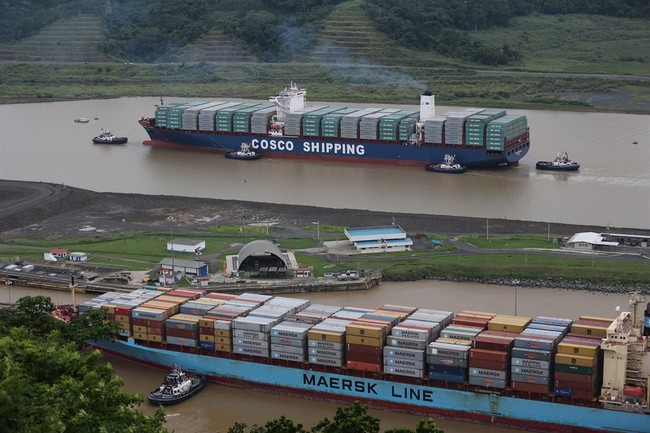
On Thursday, it declared that two 25-year concessions that Panama Ports Company (PPC), a subsidiary of Hong Kong-based CK Hutchison Holdings, holds are unconstitutional. The concessions allowed the company to operate ports at either end of the Panama Canal. The contracts originated in 1997 and were renewed in 2021.
Naturally, PPC wasn’t happy, and issued a statement that said in part:
The new ruling, based on available information, lacks legal foundation and jeopardizes not only PPC and its contract, but also the well-being and stability of thousands of Panamanian families who depend directly and indirectly on port activity, as well as the rule of law and legal security of the country. The ruling is diametrically opposed to previous Supreme Court rulings regarding contracts similar to PPC’s.
When asked about it on Friday, China’s Foreign Ministry Spokesperson Guo Jiakun made it clear that the country wasn’t happy with the court ruling, either, and isn’t going down without a fight.
“I believe you have noticed that relevant company has immediately issued a statement, saying that the decision is inconsistent with the law of Panama that approved the concession, and the company will reserve all rights including to proceed legally,” he said to a Bloomberg reporter. “China will take all measures necessary to firmly protect the legitimate and lawful rights and interests of Chinese companies.”
Panamanian President José Raúl Mulino issued a statement on the ruling, reassuring his constituents that it would not disrupt activity, cost jobs, or impact the economy, and that there will be a transition period that will end with a “new concession under terms and conditions favorable to our country.”
“I have also instructed the Panama Maritime Authority to meet immediately with Panama Ports to coordinate the necessary actions,” he said. “We hope that the company, a member of Hutchinson Port and a subsidiary of the multinational conglomerate CK Hutchinson Holdings, with a global presence and protective of its corporate reputation, will cooperate openly at this stage.”
He concluded that “the Panamanian State is the guarantor of the defense of the rights that the company is entitled to by the Constitution and the law, and will also be the supervisor of the contractual obligations that correspond to it until the end of the transition period to which I have referred.”
In the meantime, as part of that transition, APM Terminals Panama, a subsidiary of Danish shipping giant A.P. Moller-Maersk, will serve as the temporary operator of the ports. Ultimately, this could open the door for United States companies to bid on the new, restructured concessions.
Removing China’s presence from the Panama Canal has been an important focal point of Trump’s foreign policy from day one. In his inaugural address to the nation, he declared, “China is operating the Panama Canal, and we didn’t give it to China.”
He added, “We’re taking it back.”
Shortly after, Secretary of State Marco Rubio took his first overseas trip to Latin America, where he stopped in Panama and met with Mulino and Foreign Minister Javier Martínez-Acha. According to the State Department:
Secretary Rubio informed President Mulino and Minister Martínez-Acha that President Trump has made a preliminary determination that the current position of influence and control of the Chinese Communist Party over the Panama Canal area is a threat to the canal and represents a violation of the Treaty Concerning the Permanent Neutrality and Operation of the Panama Canal. Secretary Rubio made clear that this status quo is unacceptable and that absent immediate changes, it would require the United States to take measures necessary to protect its rights under the Treaty.
Around the same time, Panama made the decision to discontinue its membership in China’s Belt and Road Initiative (BRI), which it joined in 2017. In December of last year, members of Panama’s Parliament met with high-level officials in Taiwan.
Trump becoming president, Rubio becoming his right-hand man, and the numerous Latin American nations that are swinging away from socialism — and cutting ties with China in favor of the United States — made 2025 a bad year for Beijing. China saw steady unraveling with its relationships with Peru, Argentina, Chile, Bolivia, Costa Rica, Honduras, Guatemala, Paraguay, and even Mexico.
“Just a few days ago, Beijing abruptly announced a new policy paper for Latin America which speaks of respect and equality, but in practice, it maintains an aggressive policy of interference, pressure and imperialistic commercial opportunism,” wrote one of my favorite journalists, Arturo McFields, in December. “In this geopolitical game of thrones presented by China, the U.S. seems to be one step ahead. The new U.S. National Security Strategy has made clear that Latin America is a priority.”
And if January is any indication, 2026 isn’t going to be a great year for China, either. The capture and arrest of Nicolás Maduro and, more importantly, the U.S. taking over what’s happening in Venezuela, including its oil industry, was, perhaps, the biggest blow. It severed the dragon’s access to billions in oil-backed loans and preferential resource deals; also, it lost a major point of access into the Western Hemisphere.
This ruling about the Panama Canal is just the icing on that cake. Let’s see what February brings.
Want to support conservative media? You can do so by becoming a PJ Media VIP member. It’s less than $20 for the entire year, and you get some cool perks too. We’ll see you in the comments section!