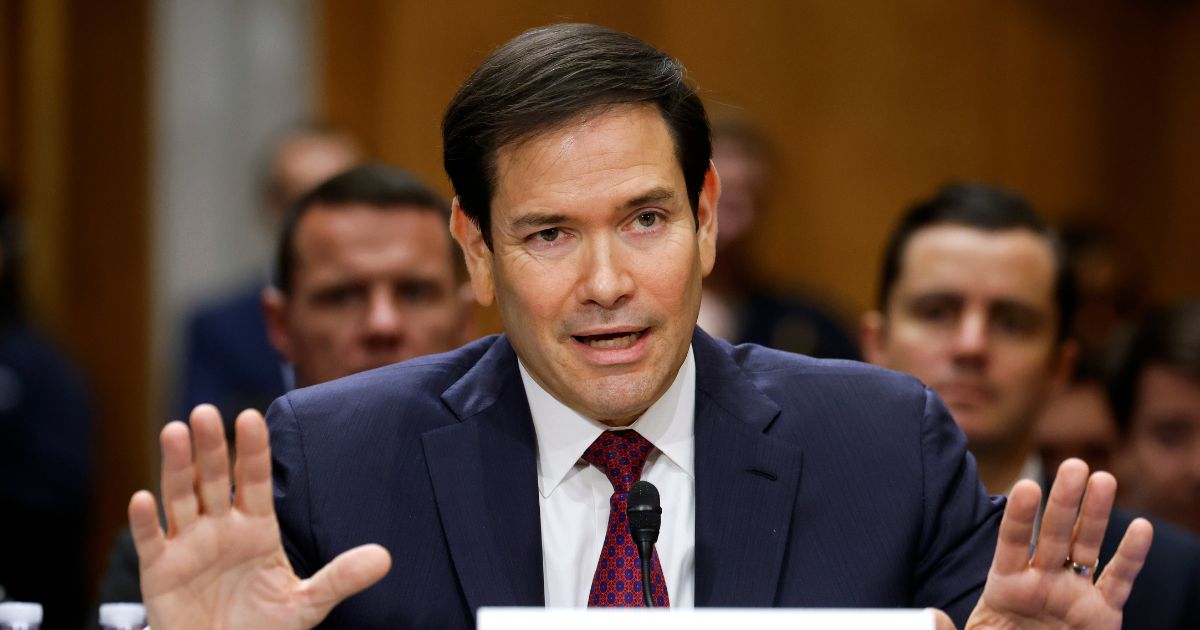
Secretary of State Marco Rubio was not having it when Democratic Sen. Jacky Rosen of Nevada tried to get him to answer with “yes” or “no” to her questions.
During a Wednesday hearing of the Senate Foreign Relations Committee, Rosen wanted Rubio to concede that President Donald Trump’s decision to apprehend Venezuelan President Nicolás Maduro earlier this month to stand trial for drug trafficking charges was undermined by his recent pardon of former Honduran President Juan Orlando Hernández.
Hernández was convicted in 2024 of aiding in the trafficking of over 400 tons of cocaine into the United States during his time in office. He was sentenced to 45 years in jail.
Trump pardoned him in November, saying on social media that Hernández had been “treated harshly and unfairly.” Trump connected the pardon to his desire to see Tito Ashfura become the next president of Honduras. Ashfura, in fact, won the election last month.
First stating that she wanted a “yes” or “no” response to a series of questions, Rosen asked Rubio, “Was Hernández convicted of trafficking approximately 400 tons of cocaine into the United States?”
“I’m not involved in the pardon process. I can tell you…” Rubio began to answer before Rosen cut him off.
“No, but I’m just asking…,” the lawmaker said.
Rubio then shot back, “Yeah, but I don’t do yes or no. I don’t play games. This is not a game show.”
“The president felt he was unfairly treated,” Rubio added.
“It undermines the United States’ credibility on the world stage,” Rosen argued.
Rubio pointed out that Hernández was not the president of Honduras when Trump pardoned him.
“The difference between him and Nicolas Maduro is that he was actively engaged in narco-trafficking. It was an ongoing endeavor,” Rubio noted.
However, Rosen reasserted, “I think it does undermine our credibility.”
In his opening remarks to the committee, Rubio defended the administration’s decision to remove Maduro.
“And let me just say this: What is our goal going in? We had, in our hemisphere, a regime operated by an indicted narcotrafficker that became a base of operation for virtually every competitor, adversary, and enemy in the world,” he said.
“It was — for Iran, their primary spot of operation in the Western Hemisphere was Venezuela. For Russia their primary base of operation in the Western Hemisphere, along Cuba and Nicaragua, was Venezuela. In the case of China, China was receiving oil at a huge – about $20 a barrel – discount, and they weren’t even paying money for it. It was being used to pay down debt that they were owed,” Rubio added.
“And so you had basically three of our primary opponents in the world operating from our hemisphere from that spot,” he said.
He concluded by saying that transitioning the Venezuelan government to a stable democracy “won’t be easy.”
“I mean, look, at the end of the day we are dealing with people over there that have spent most of their lives living in a gangster paradise, so it’s not going to be like from one day to the next we’re going to have this thing turn around overnight. But I think we’re making good and decent progress.”

Advertise with The Western Journal and reach millions of highly engaged readers, while supporting our work. Advertise Today.