
“Never open your article by talking about the weather.”
That’ advice comes from one of the high priests of editorial writing, Mark Ford, who ran a bootcamp for writers which I attended long ago. I’ve not forgotten what he said, so I try to stick to my wheelhouse which is economic issues, energy, metals, geology and military stuff, and various related subjects.
But today? Well… Today the weather IS the economy. And don’t just take my word for it; here’s the temperature map for the Lower 48 states this past Sunday:
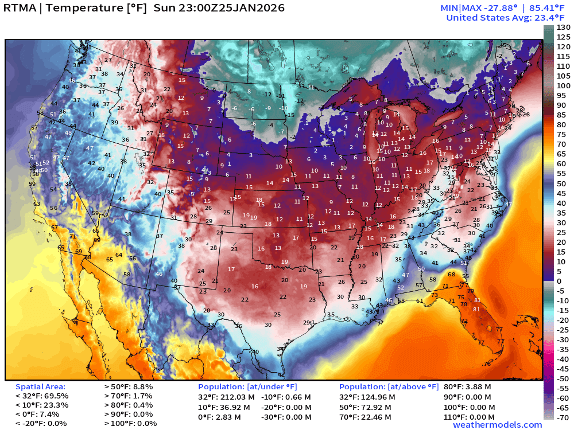
“Baby, It’s Cold Outside.” Courtesy WeatherModels.com.
More than half of the country is snowed in. Planes, trains and automobiles are stuck all over the place. Commerce is frozen and yes, I intended the pun. Sea-to-sea, the U.S. is as cold as it’s been since the 1880s according to a weather historian who I follow.
Meanwhile, weather also drives energy output, which powers the economy. So… Let’s not talk about the weather. Instead, let’s discuss energy. And let’s dig in…
Where Do You Get Your Power?
Unless you live in SoCal or southwest Arizona, or you’re down in Florida (see that map above), it’s cold out there, cold enough to freeze your house, burst your pipes, and kill you if you’re not prepared.
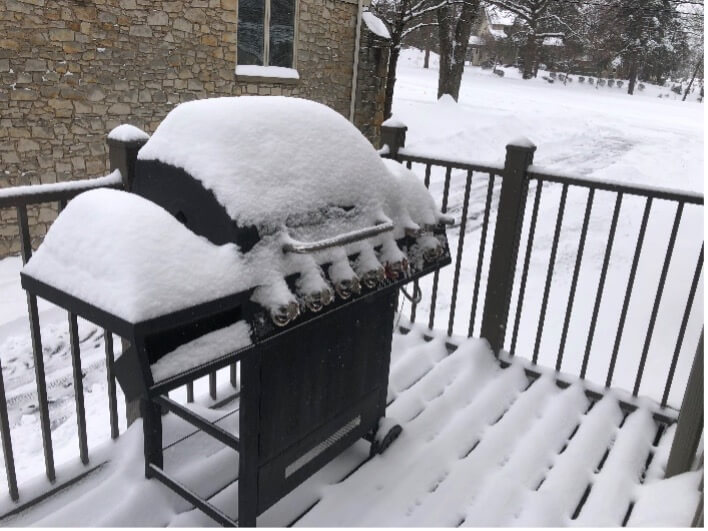
Cold and snowy: your editor’s barbecue grill, yesterday afternoon. BWK photo.
The reason you’re not freezing to death in the dark is gas wells, coal mines, nuclear materials and power plants that connect to a super-complex, expensive, 100-year legacy assemblage of pipes and wires, aka “the grid.”
Oh, and did I say “expensive”? Yes, just wait until you see next month’s electric or gas bill. I hope you own some gold or silver or have investments in mining shares. (Just kidding; hang onto the metal and don’t sell your shares early in a long rally.)
The short version of a long story is that North America – U.S. and Canada – is divided into what are called “Regional Transmission Organizations” (RTOs), each of which monitors and controls the electric power grid in its jurisdiction. Here’s a map, courtesy of the PJM Interconnection System, LLC:
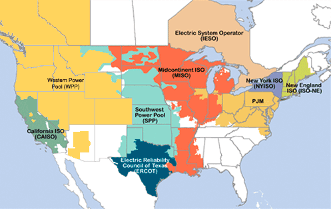
North American RTOs. Courtesy PJM.
As you can see, not all states or regions are part of an RTO, and this particular map doesn’t detail the very important Canadian interconnections. But that’s okay; we just need the big picture.
The point is that if you live in an RTO, your electric power likely comes from within that mix of power sources, although there’s provision to do what’s called “wheel” power across RTO lines, from one region to another.
If you live in the Mid-Atlantic PJM zone (Ohio and Kentucky east to New Jersey, Delaware, Virginia and a few other areas), here’s where – actually, “from what” – your electric power comes:
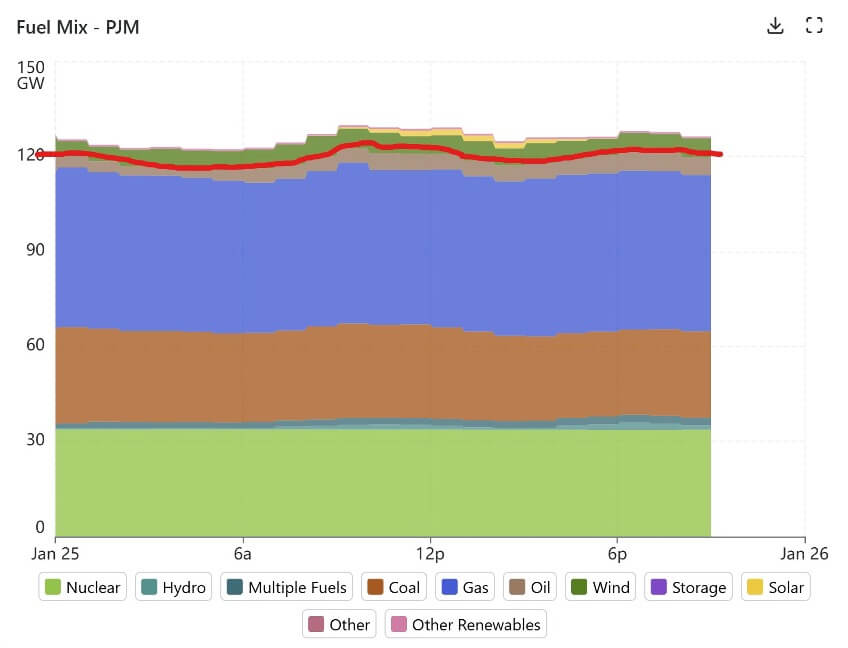
Power fuel mix. Courtesy PJM.
That is, over the past few days, Jan. 25 – 26, most of your electric power was generated by a supply stack of nuclear (light green), coal (brown), natural gas (light blue), and relatively small amounts of oil and hydro; that is, everything below the red line on the image.
And what’s above the red line is wind and solar power, essentially negligible within PJM.
To be fair, other regions produce more renewable power. For example, here’s this past Sunday in terms of electric power in the Great State of Texas and its self-contained ERCOT system:
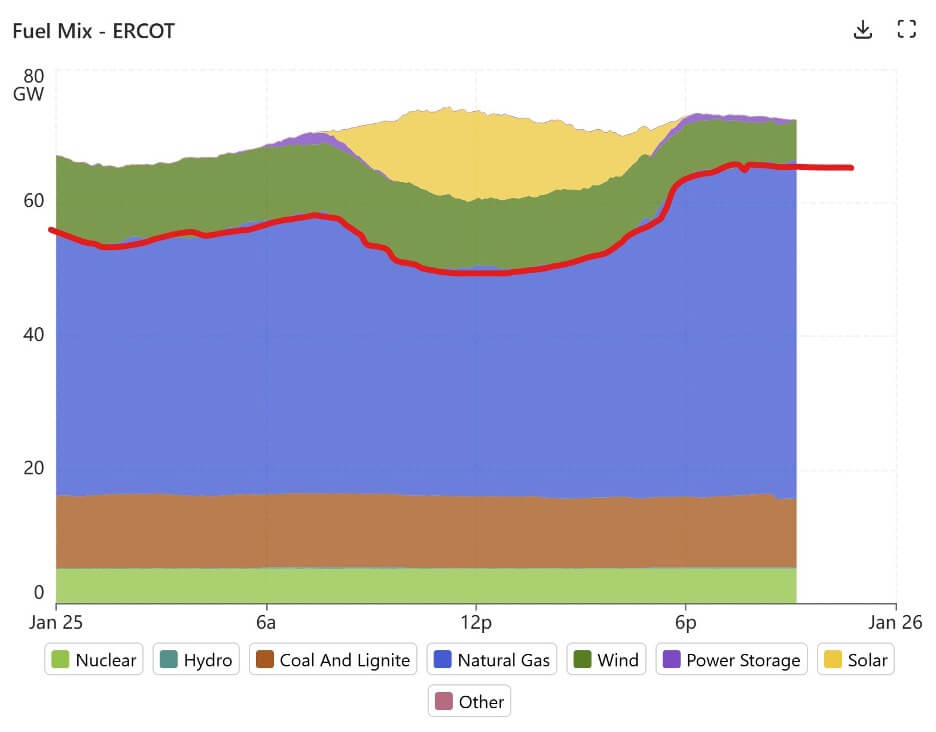
Power fuel mix. Courtesy ERCOT.
Notice that red line again. Everything below it is traditional sources, namely nuclear, coal and gas. But Texas has wind when it blows, and solar by day, although both of these sources dropped offline hard during the early phases of the recent winter storm. The makeup energy form was natural gas, which came online within moments of flipping the switches.
And just to blow your mind, here’s the California power mix, truly an assemblage of a bunch of everything:
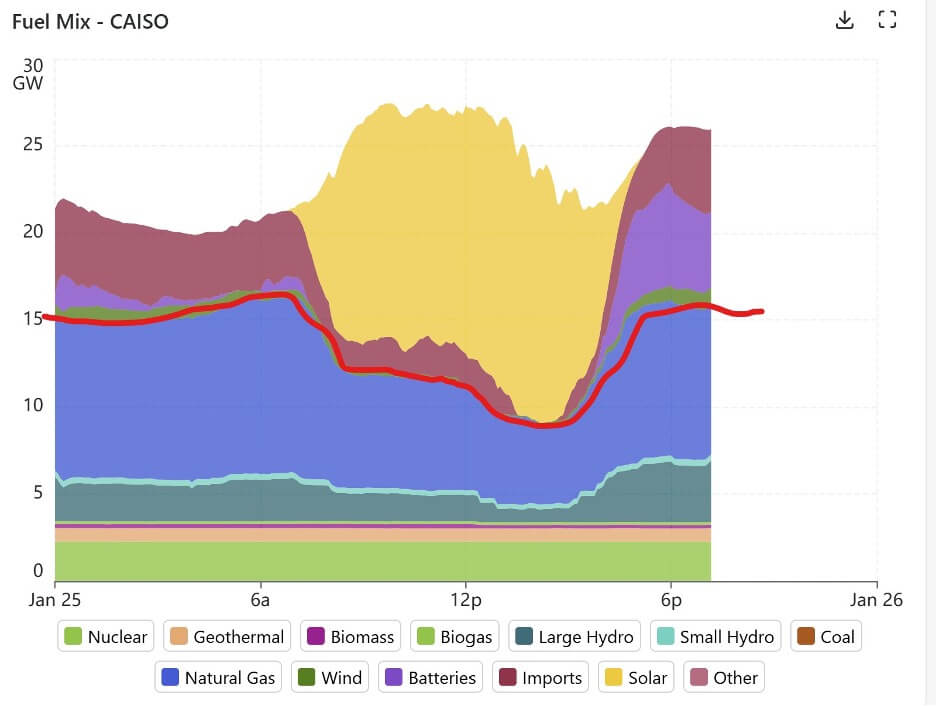
California fuel mix. Courtesy CAISO.
Over the past two days, California’s daily power baseline was a stack of nuclear, natural gas, and some geothermal and large-scale hydro, all shown below the red line. Plus, there’s a large whack of solar by day, and even some batteries by early evening, until they discharge; oh, and they’re not made in the U.S. if you care about things like that.
Then there’s a big slug of power at the top of the stack; it’s what CAISO calls “imports,” namely, electricity wheeled down from elsewhere. It might be hydro from Oregon, Washington or British Columbia. Or it could be coal or gas-fired power wheeled from, say Utah or Wyoming. The point is that California is net-deficient in its homegrown, RTO-specific energy output, and constantly relies on out-of-state sources to keep the lights on.
On this last point, I can’t help but note what happens to the California grid on days when there’s a storm and the sun don’t shine, like this past December (Christmas Day, in fact):
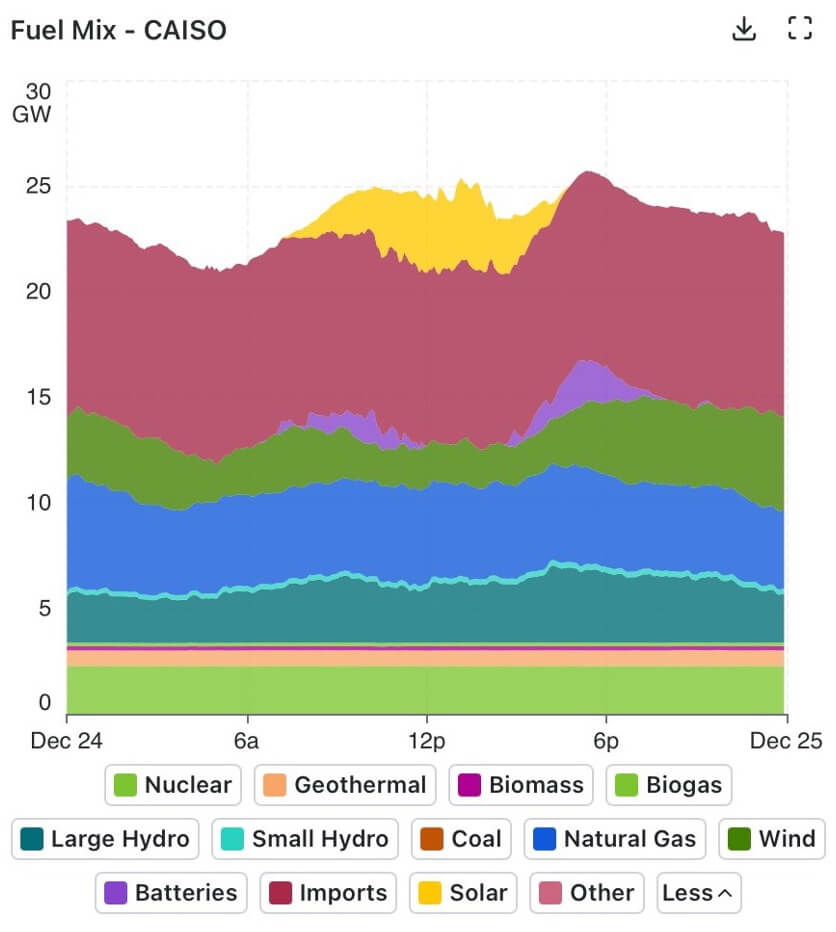
Clouds on Christmas meant way less solar power. Courtesy CAISO.
Look at that drop-off in solar due to a large storm system that impacted the state. And look at that related, humongous slug of “imported” power to make up the difference. Those interstate transmission wires were humming, that’s for sure, to supply about one-third of California’s power demand.
Crazy New England
California is its own thing, “fer sure,” as they say out there. But look also at New England, whose power sources are truly out of whack. Here’s a breakdown of fuel mixes for ISO-NE:
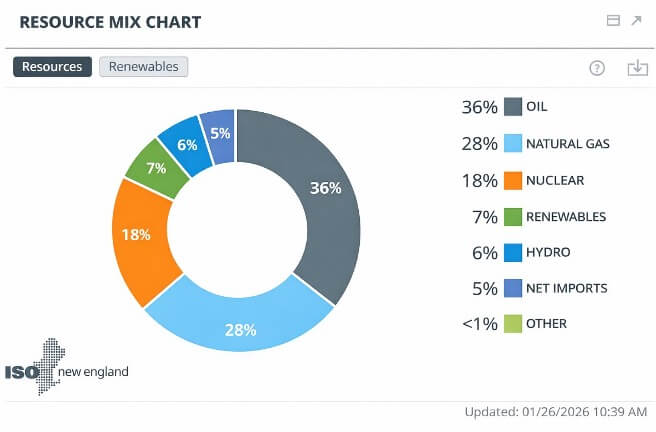
New England fuel mix. Courtesy ISO-NE.
And just for the heck of it, let’s break down the “renewables” part too, with this chart:
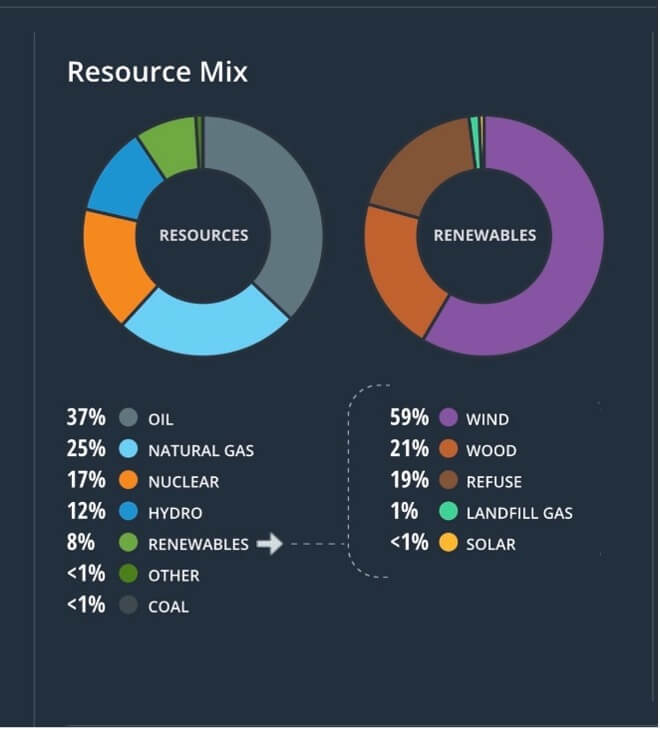
New England fuel mix. Courtesy NextWave.
In the renewable department, New England harnesses some wind, when it blows; about 5% of total electric power overall. Plus, the region burns wood and “refuse,” a polite way of saying that they burn trash. Solar is negligible, even amongst the renewable mix.
New England uses hydro, too. But the little secret on that point is that most of the hydro power comes from Quebec, namely from Hydro Quebec, a Canadian Crown Corporation.
Also from the charts, you can see something quite strange; and you’re reading it correctly. That is, about one-third of New England’s power is derived from “oil,” and no, not whales. In fact, New England burns significant diesel fuel or other heavy petroleum fractions for power and heat, 36% per the latest numbers!
As you may know, there are no oil wells in New England or its Atlantic offshore, so all of the oil that they use is imported, every barrel. In years past, one important source of New England’s imported oil was Venezuela (Joe Kennedy, Jr. used to run that racket), but not lately due to U.S.-Venezuela politics; although hey, after the last couple of weeks, perhaps Venezuela will make a comeback.
Plus, New England gets electric juice from two nuclear plants, built in the 1960s and 70s, and which have encountered political opposition since the first concrete was poured. Over the past 20 years or so, New England closed down four other nuke plants, and there are no plans to replace them., while even upgrades and permit extensions to the survivors are problematic.
Then there’s natural gas for power in New England, most of which is imported as LNG, mostly from Trinidad & Tobago although pre-2022 some gas came from the far north, Arctic region of Russia. Yes, seriously. Here’s a photo:
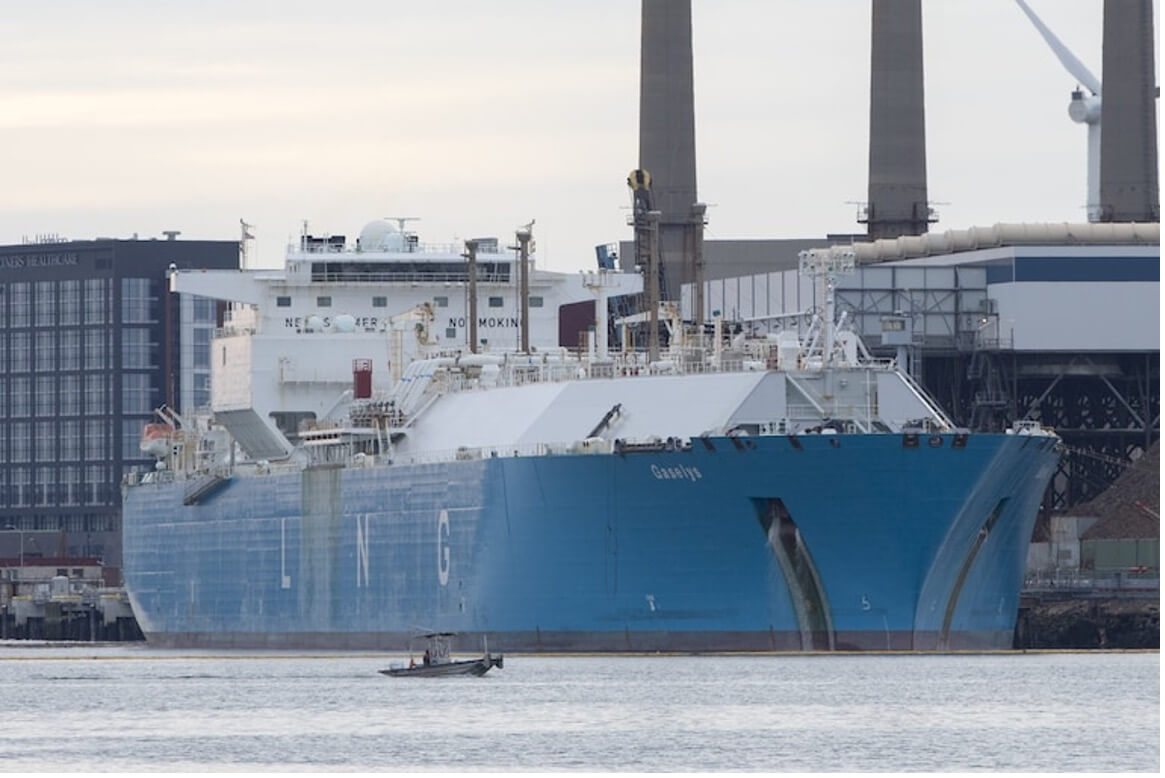
Tanker with Russian LNG at Mystic River Terminal, near Boston (2018). Courtesy Washington Post.
Okay, so why does New England not bring in LNG from, say, Louisiana? Because a federal law from 1920, called the Merchant Marine Act (aka “Jones Act”), makes it nearly impossible to transport LNG from one U.S. port to another. Among other things, Jones requires that cargoes be hauled in U.S. built ships, and the U.S. doesn’t build LNG carriers. That, and more; a long story and appalling when you understand it.
Meanwhile, why not just run a natural gas pipeline from, say, central Pennsylvania about 200 miles into New England to transport Marcellus gas? Ha… People have thought about this, but hardline, left-wing New York and New England politics killed a series of project ideas deader than doornails:
- The Constitution Pipeline (PA to NY): Approved by FERC 2014, killed by NY water permit denial in 2016.
- Northeast Energy Direct (PA to MA): Blocked by Massachusetts in 2016.
- Access Northeast: Killed by MA/CT/RI opposition in 2017.
- Northeast Supply Enhancement: Rejected by New York, but Williams Companies (WMB) is still trying.
The stated political reasons not to run new pipelines to New England are the usual variations on the scourge of “climate change” from burning methane. That, and/or other scary environmental issues that come from running steel pipe along or underneath mostly pre-existing rights of way like other pipelines, or roadways and rail lines.
When it comes to energy (and much else), and for some odd and easily disprovable reason, New England politicians tend to think they’re smarter than everybody else. The word “sanctimonious” doesn’t begin to do them justice, and trust me, I’ve met more than a few.
As things now stand, energy policy in New England represents a throwback form of political and economic culture. It seems to have been fashioned after bumper stickers and informed by facile slogans. Indeed, some might say that New England’s approach to energy is astonishingly ignorant, considering how many sturdy old prep schools and ivy-adorned colleges are up there.
Burning oil? C’mon, man… that’s primitive. No pipeline gas? You gotta be kidding. Can’t even do LNG right? Gimme a break.
Sometimes I wonder if New England’s bizarre energy policy – and high-cost energy poverty – harkens back to its Colonial-era, roots. Embedded within New England’s social and political culture is the archaic, yet persistent Puritan idea that life on earth was meant to be painful; that people were born to suffer their way into the Kingdom of Heaven.
As an outsider looking in, New England energy policy reflects the intellectual bankruptcy of government up there; namely, that the people in charge are not happy until everybody else is not happy. And still, the huddled masses put up with it, with high prices, an unstable grid, and energy insecurity when it gets cold every now and then.
Energy Investment Ideas
Let’s wrap up… and I hope that I’ve helped you understand a few things about what makes your lights come on and your computer run, if not charge your EV.
If you’re interested in natural gas companies, I’ve long admired EQT Corp. (EQT), a key player in the Marcellus Shale of Pennsylvania, Ohio and West Virginia. Shares have traded in a range in the past year but are generally up over the past three years.
Another solid name from the gas patch is Range Resources Corp. (RRC), again a key operator in the Marcellus region. Like EQT, shares in Range have traded relatively flat (ie, “in a range”) over the past year, but moved generally up over a longer time.
For oilfield services, there’s the globally powerful Schlumberger Co, aka SLB (SLB), a titan of the services industry which has a great chart in the past couple of months, and more upside ahead.
Please note that none of the companies I mentioned here are “official” recommendations for the Morning Reckoning; we don’t track a portfolio. But I watch the energy space and keep an eye on developments. If you buy shares, watch the charts, always use limit orders, look for down days in the market, and never chase momentum.
And finally, the next time you encounter an oilfield roughneck, roustabout, miner, power plant operator, lineman, or any other worker from the true, down-to-earth, boots-in-mud energy space, give them a thumbs up and thank them for keeping you and your family energized during this major winter weather event.
That’s all for now. Stay warm, and thank you for subscribing and reading.